SOLE CARTEL
How to read a sneaker design patent
A practical guide to the lines, claims and dates behind footwear design
A sneaker patent drawing can look like an early product sketch. Read it that way and you can miss the point: the document may claim only a small part of the shoe, while everything around it merely shows where that design belongs.
Start with the claim and the description, then return to the picture. This guide uses actual U.S. grants from Nike and adidas to show how that works. Nike’s upper demonstrates why an interrupted line can still be claimed. adidas’s midsole shows why a field of dots can describe a three-dimensional surface rather than a printed pattern.
Know which right you are reading
Design patent: Protects an ornamental design embodied in or applied to an article, including its shape or surface ornamentation. The claim and drawings define the design. [1, 2]
Utility patent: Concerns how an invention works or is used. A shoe can have utility and design patents covering different aspects. A design drawing alone does not establish a cushioning mechanism or manufacturing method. [1]
Trademark and trade dress: Concern signs or appearances that identify commercial source. Trade dress can include product appearance, but product-design trade dress must be nonfunctional and have acquired distinctiveness. Its legal inquiry differs from a design-patent comparison. [8]
The reading order
Identify the document → read its single claim → decode the line description → compare the figures → separate what the record says from what you infer.
The examples are reading exercises, not infringement opinions or product-release predictions. This guide concerns U.S. law and is general information, not legal advice. For a clearance or enforcement decision, consult a qualified IP lawyer. Sources checked November 9, 2026.
Start with the first page
Identify the grant before naming the shoe
Record the country, granted patent number, title, inventors, applicant or assignee as printed, application number, filing date and grant date. U.S. design-grant numbers use a D prefix. Keep the application number separate: Nike’s 29/465,825 is the application; D696,853 is the granted patent. [4]
The title identifies the article. It may be as general as “Shoe” or “Shoe upper.” Do not turn that into a retail model name without a reliable link from another source. The assignee printed at grant is also a historical fact, not an ownership search performed today.
Read the claim and the description together
A U.S. design application has one claim. It commonly identifies the ornamental design for an article “as shown and described.” Those few words send you back to the drawings and their explanation. [2]
Look for the paragraph that explains broken lines, boundaries and shading. It is the key to the picture, not boilerplate to skip. A partial design can be shown within a much larger unclaimed object. A broken-line boundary may define a claimed region without representing a physical seam. [2, 3]
Use the line explanation as your legend
- Full lines normally show claimed design features. Read the stated exceptions and the complete drawing set.
- Broken lines commonly show unclaimed surroundings or claim boundaries. Some interrupted lines can nevertheless depict claimed features, including stitching or folds. Nike provides a concrete example on the next pages. [2, 4]
- Shading can communicate contour, surface character or contrast. Do not automatically turn black-and-white linework into a specific color, material or printed graphic. [6]
Follow the figure descriptions
A lateral view shows the outside of the shoe; a medial view shows the inside. Front, rear and perspective views reveal relationships a side view can conceal. An enlarged detail is especially useful when the full-shoe drawing is hard to read. Use the figure list rather than assuming every patent has the same set of views. [2]
Keep notes in two columns: “The document states” and “My interpretation.” That small separation prevents a plausible-looking product guess from becoming a reported fact.
Nike shows why the legend matters
U.S. D696,853 S • Shoe upper
Inventor: Angela N. Martin. Applicant and assignee at grant: NIKE, Inc. Filed August 30, 2013; granted January 7, 2014. One claim and four drawing sheets. [4]
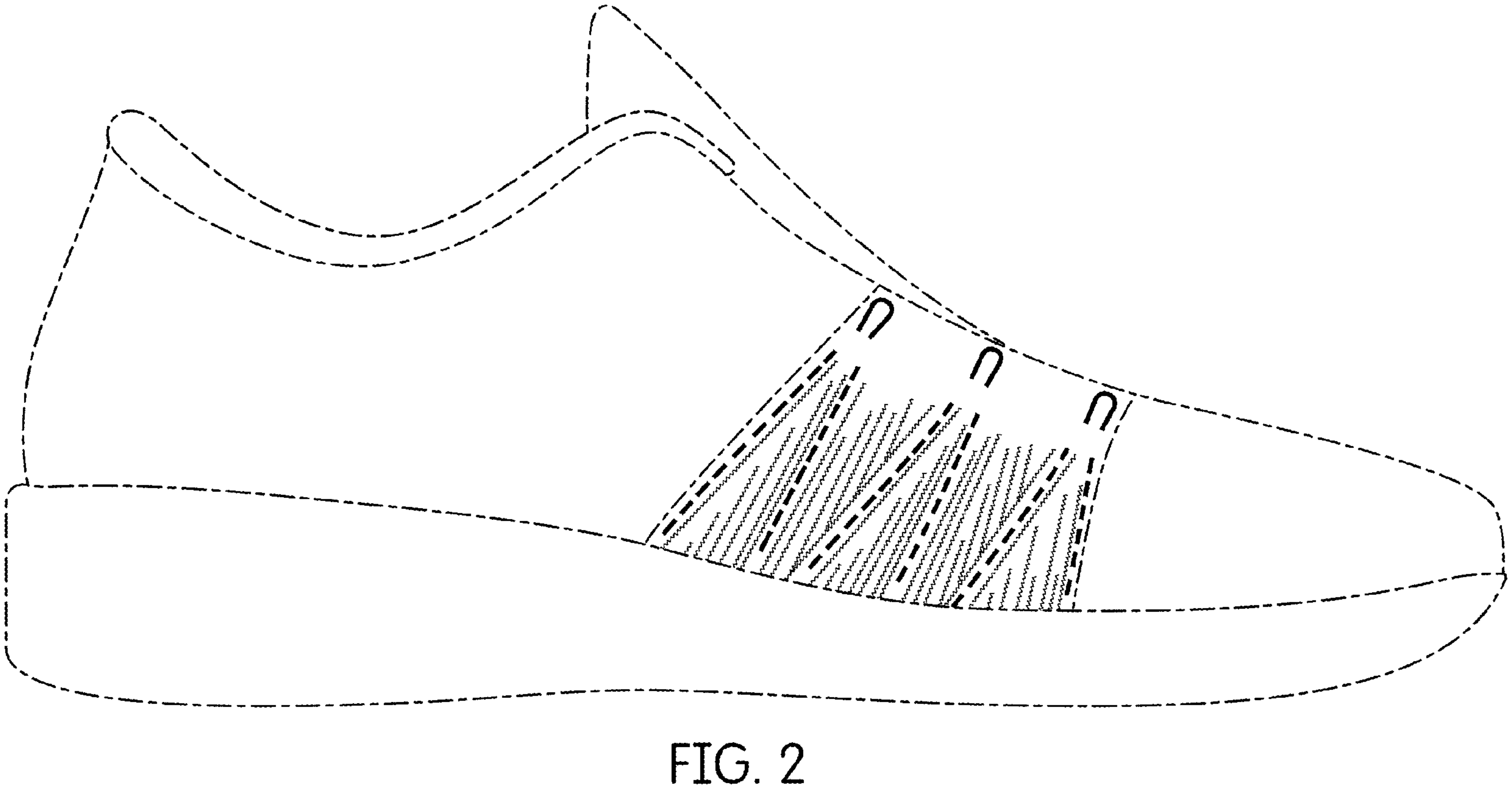
The claim identifies an ornamental design for a shoe upper. Figure 2 shows the whole shoe in profile, but the full silhouette is not what this grant claims. The description distinguishes the patterned region from the surrounding shoe and its boundaries.
Read the surrounding shoe as context
The uneven-length broken lines depicting the rest of the shoe are expressly excluded from the claimed design. The similar broken lines immediately around the shaded region mark unclaimed boundaries. They locate the design without claiming those boundary lines. [4]
Keep the claim tied to the article
The protected subject matter is a design for an upper, not an abstract collection of lines detached from a shoe. Nor does the drawing alone establish a fabric composition, performance benefit, launch date or retail name. The useful first question is narrower: which visual features are actually included?
Interrupted does not always mean unclaimed
Nike D696,853 • Read Figure 4 beside the description
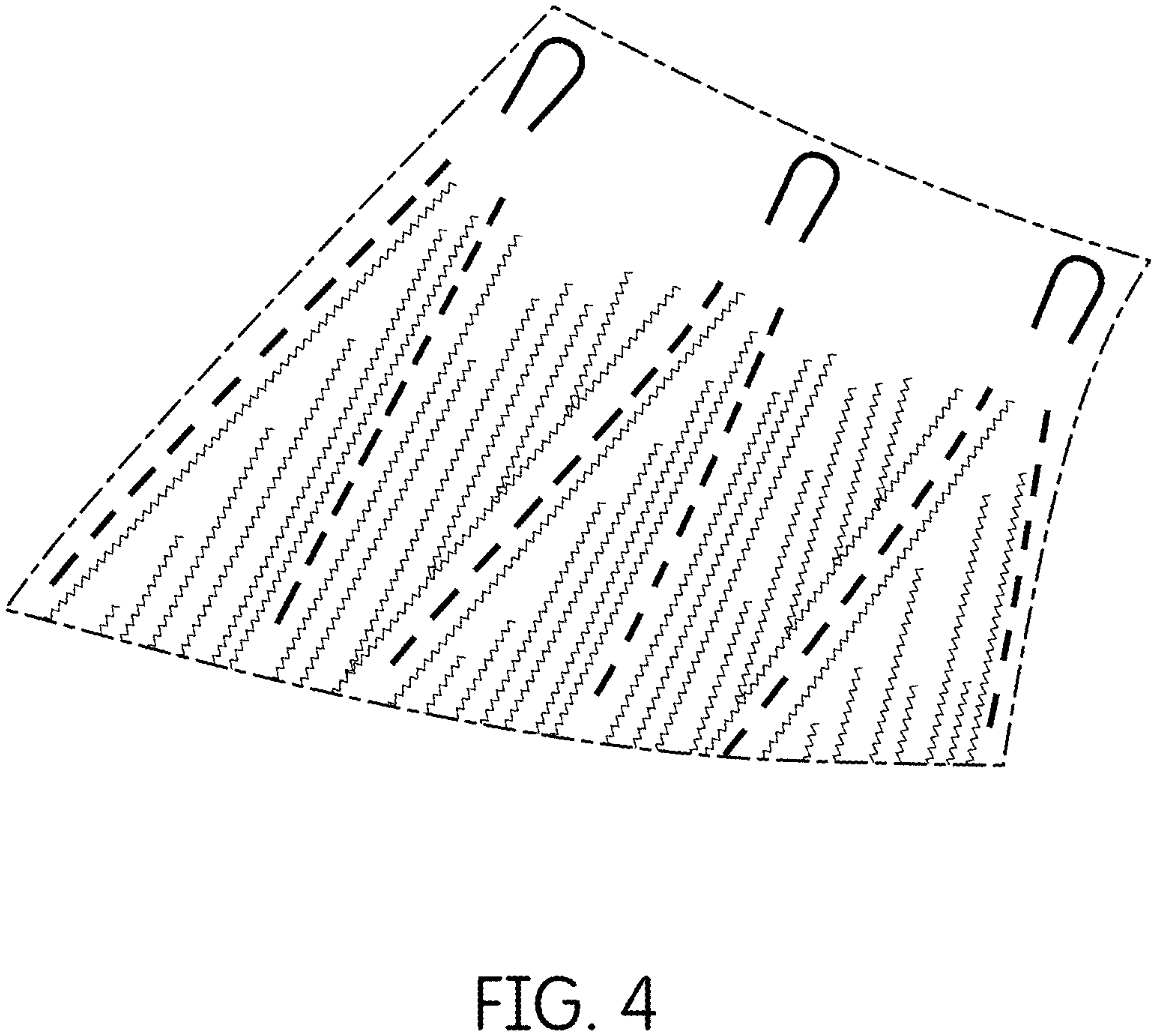
The patent expressly includes the three bold lines, their curved upper loops and their interrupted lower segments in the claimed design. That last detail defeats a common shortcut: treating every gap in a line as a disclaimer. [4]
Try it: Find one curved loop and follow its bold line downward. Then compare that line with the uneven-length broken perimeter. Both contain interruptions, but the description assigns them different roles.
What to conclude: The bold interrupted segments remain part of the claimed visual design. The surrounding boundary lines do not. Read the region as a whole rather than treating the three bold features as the entire claim.
What to avoid: “Nike patented three stripes.” That description discards the particular drawing, the surrounding patterned region and the article named in the claim. The lesson here is how to read the patent, not how to generalize it into ownership of a visual idea.
adidas shows a shoe but focuses the claim
U.S. D776,410 S • Shoe
Inventors: Nic Galway and Ben Herath. Applicant and assignee at grant: adidas AG. Filed January 4, 2016; granted January 17, 2017. One claim and seven drawing sheets. [5]
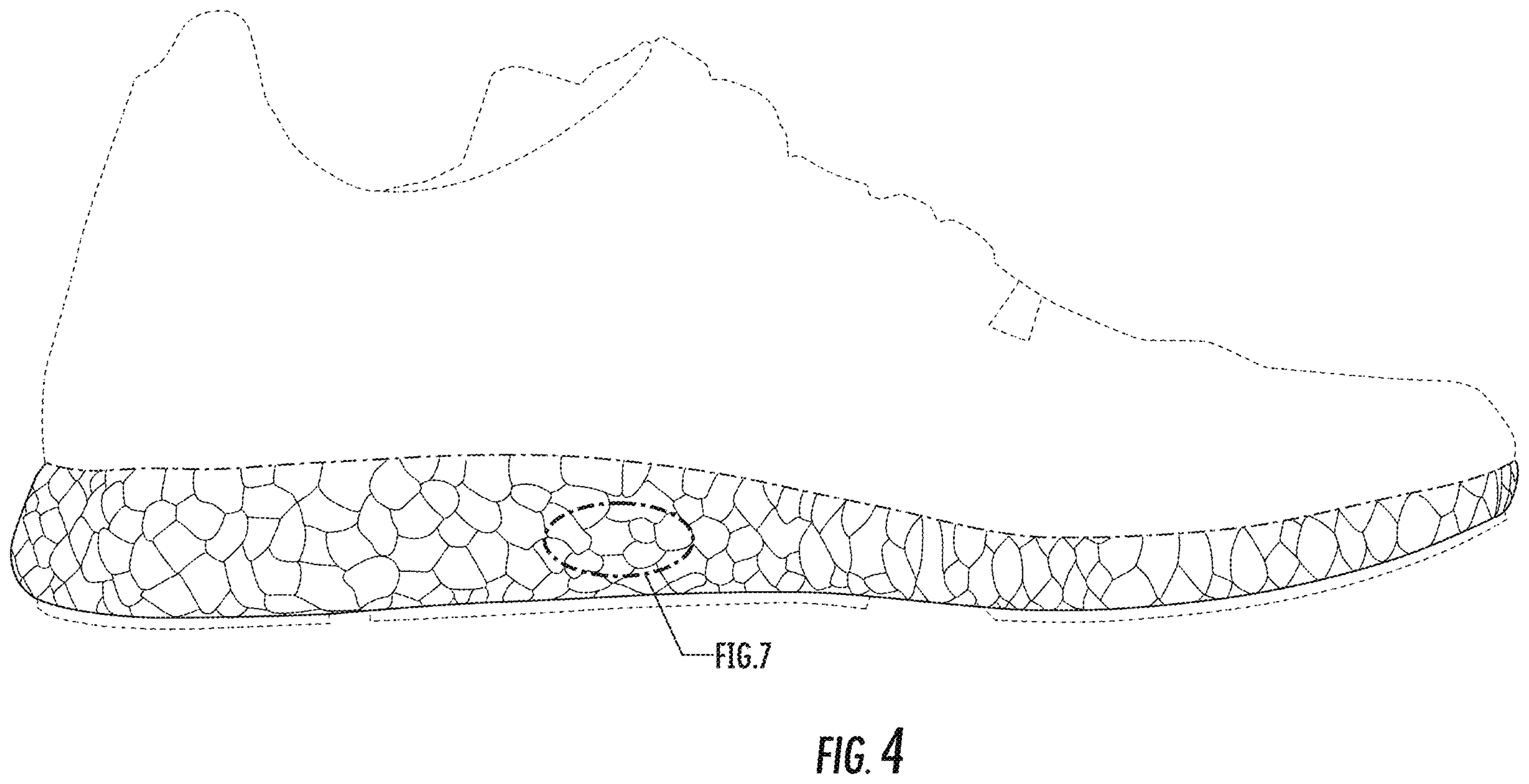
The title is simply “Shoe.” Figure 4, however, directs attention to the visible midsole design while depicting much of the surrounding shoe in broken lines. The title alone cannot tell you how much of the shoe is claimed.
Separate the two broken line functions
The description assigns dash-dot lines in Figures 1–6 to the boundaries between claimed and unclaimed portions; those boundary lines form no part of the claimed design. Other broken lines in those figures show unclaimed portions of the shoe. [5]
Read the patterned surface in relation to those boundaries. Do not promote the unclaimed upper into the claim simply because the patent title says “Shoe.” Equally, do not assume the patent is a claim to a chemical formula or cushioning technology because the design sits on a midsole.
Follow the enlargement callout
The oval callout in Figure 4 leads to Figure 7. It lets you connect the enlarged surface back to its location on the shoe. Keep that connection: an isolated close-up can otherwise look like an unrelated decorative pattern.
Dots can explain three dimensional form
adidas D776,410 • Read the detail as part of the drawing set
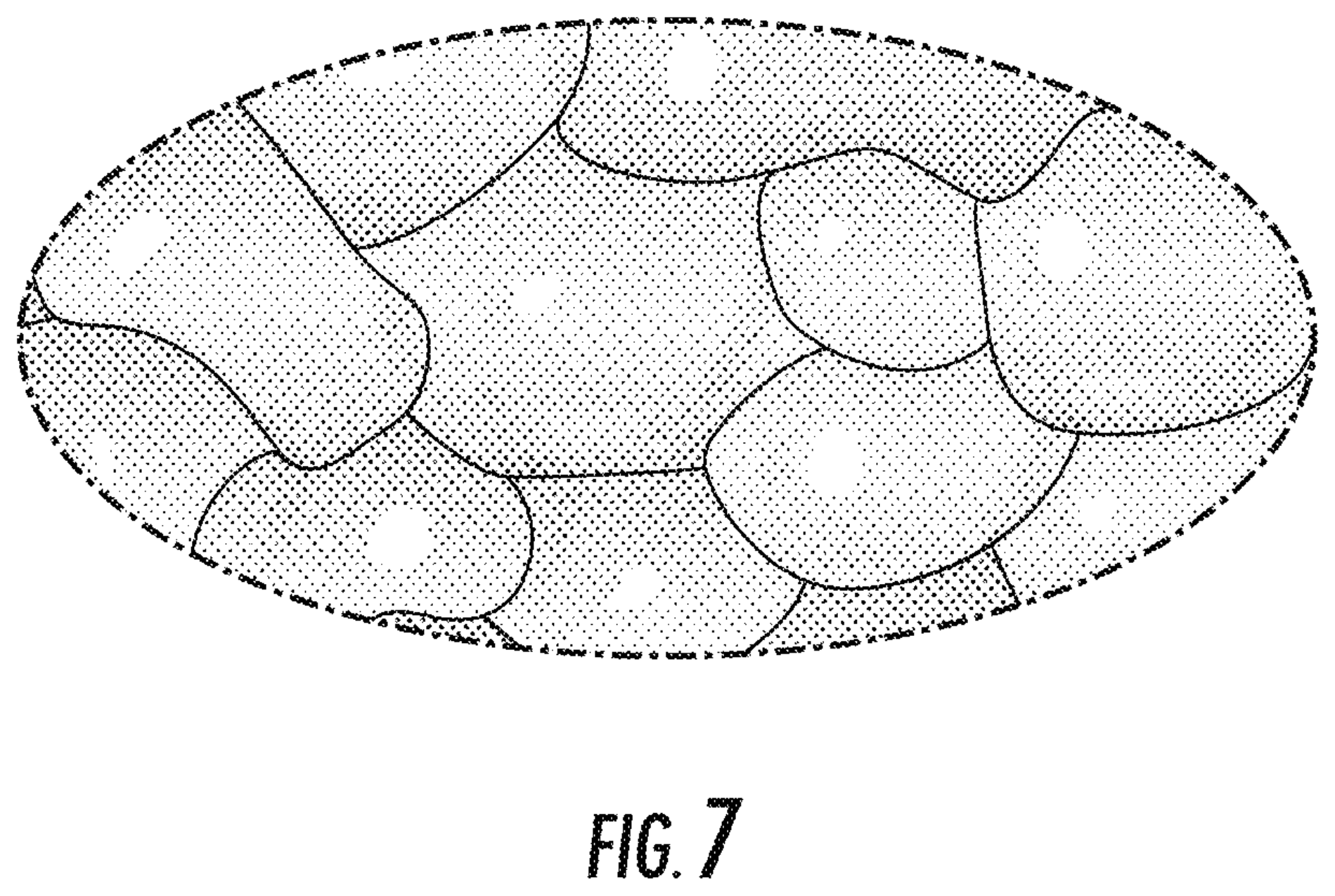
The description says the stippled shading in Figure 7 shows three-dimensional contours only. It also says that shading was omitted from Figures 1–6 for ease of illustration. The dots are therefore not a promise of a polka-dot colorway. [5]
Try it: Compare the enclosed irregular forms in Figures 4 and 7. Use the close-up to understand their surface character, then return to the full side view to understand their placement.
The dates tell a separate story
The same grant lists a January 2016 filing, an August 2013 parent application and April 2013 foreign priority. These entries record different parts of its application history. None is automatically the sneaker’s release date. The grant itself prints a 15-year term. [5]
For U.S. design applications filed on or after May 13, 2015, the standard term is 15 years from grant; earlier applications generally receive 14 years. Design patents have no maintenance fees. Do not use an early priority date alone, or a search site’s “active” label, as a current enforceability opinion. [1]
Nike’s example prints 14 years; adidas’s prints 15. Compare the actual filing and grant fields before doing date arithmetic, and check official records if rights today matter. [4, 5]
A familiar detail can involve another right
Prada and the red heel stripe
A red stripe on footwear can raise a trademark question. Prada’s historical U.S. trademark registration No. 2,851,315 describes a red stripe running along the middle of the heel, partly over the back of the sole and partly over the back of the shoe. Its registration date is June 8, 2004. [9]
The International Trademark Association cited that registration in its 2011 amicus brief in Christian Louboutin v. Yves Saint Laurent. That brief advocates a position in the Louboutin case; it is not a court ruling deciding Prada’s rights. The example illustrates a category distinction: a trademark record identifies a claimed source indicator; a design patent claims an ornamental design. [10]
For product-design trade dress, distinctiveness and nonfunctionality matter. A claim of confusing commercial source is not interchangeable with a claim that an accused product embodies a patented design. A similar-looking stripe does not, by itself, settle either issue. [8]
Resemblance is a starting point
Design-patent infringement is assessed through the ordinary-observer framework, considering overall visual appearance in light of relevant prior art. A checklist of matching details is not the legal test. The Federal Circuit’s en banc Egyptian Goddess decision explains that framework. [7]
For a real dispute, identify the asserted patent and claim, the accused product, relevant prior art and the procedural record. A complaint states allegations. A brief advocates a position. A preliminary order is not necessarily a final result. Attribute each statement to the right source.
Your five minute reading check
- Can I identify the exact grant, named article and assignee as of grant?
- Have I read the claim and every line-style explanation?
- Can I point to what is claimed, what is context and what is only a boundary?
- Have I checked the other views and any enlarged detail?
- Am I keeping patent dates, product names and legal conclusions separate?
The best reading is often more precise than the first impression: this particular appearance, in this part of this article, shown this way.
Sources for the reading guide
Numbered references correspond to the text. Source titles below are clickable. Patent facts are taken from the grants themselves; the examples do not state a present ownership, validity or enforceability conclusion.
1. USPTO Manual of Patent Examining Procedure 1502
Definition of a design; distinction from utility patents; terms and maintenance fees.
2. USPTO Manual of Patent Examining Procedure 1503
Single claim; identified article; drawings, views, broken lines, boundaries and shading.
3. USPTO Protection for partial designs
Design protection for a portion of an article and visual disclaimers.
4. U.S. Design Patent D696,853 S
Official Nike grant, January 7, 2014. Claim, description and bibliographic data on PDF page 1. Figure 2 on sheet 2, PDF page 4; Figure 4 on sheet 4, PDF page 6.
5. U.S. Design Patent D776,410 S
Official adidas grant, January 17, 2017. Claim, description and bibliographic data on PDF page 1. Figure 4 on sheet 4, PDF page 7; Figure 7 on sheet 7, PDF page 10.
6. USPTO Design patent application guide
Drawing practice, surface shading and disclosure of appearance.
7. Egyptian Goddess Inc. v. Swisa Inc.
543 F.3d 665 (Federal Circuit, en banc, 2008). Court opinion hosted by WIPO Lex; ordinary-observer framework and prior art.
8. USPTO Trademark Manual of Examining Procedure 1202.02
Registration of trade dress, including product design, functionality and acquired distinctiveness.
Image credits and further sources
9. Prada trademark registration 2,851,315
Serial 76309415. Historical register reproduction via Justia: description, original registrant and registration date. Used for historical identification, not present legal status.
10. INTA amicus brief in Louboutin v. YSL
Second Circuit No. 11-3303-CV, 2011, printed page 15 (PDF page 24). Cites Prada’s red heel-stripe registration. An advocacy filing, not a ruling deciding Prada’s rights.
11. USPTO Terms of Use and Editorial Guidance
Patent-information section explains typical copyright treatment and cautions about embedded trademarks and copyrighted material.
12. 37 CFR 1.71 paragraphs d and e
Copyright notices in patent disclosures and required authorization for facsimile reproduction as it appears in USPTO records.
About the reproduced drawings
All four illustrations are actual drawings from the two published U.S. patent grants, not product photography or AI reconstructions. The figures were cropped from their sheets; Nike Figures 2 and 4 and adidas Figure 4 were rotated for reading. Original labels, line styles and proportions were preserved. Captions identify the patent, figure and sheet. The linked grants retain the complete original pages.
USPTO guidance says patent text and drawings are typically not subject to copyright restrictions, with limited exceptions. Published U.S. patent drawings are therefore generally reproducible without separate permission, but that is not a blanket worldwide license for every patent-related image. Embedded marks and other protected content require attention. Reproducing a drawing does not grant permission to make or sell the design. [11]
A copyright notice, where present, requires separate reading: the U.S. rule provides for authorization of facsimile patent-document or disclosure reproduction while other rights remain reserved. No copyright notice was observed in these two grant PDFs, and no brand logo appears in the selected figures. [12]
Sole Cartel is not affiliated with or endorsed by Nike, adidas, Prada or the USPTO. Brand names identify the examples. This guide supplies no license to manufacture footwear and no opinion on a particular product’s legal clearance.