Design reading / Air Max 90
Air Max 90 “Puffy”: The Familiar Shape, Drawn in Stitches
By Sole Cartel editorial desk · Sources and official product photographs checked November 6, 2026.
An Air Max 90 can announce itself before you read the tongue. The sweep around the toe, the angled side panel and the window in the heel give the eye a route across the shoe. The Black and Medium Olive/Sequoia versions now being called “Puffy” make that route unusually visible: familiar boundaries appear as stitched paths across broad, tonal surfaces.
The result is worth looking at beyond its release date. This is a design reading of Nike’s official photographs and published descriptions, not a review of a pair in hand. The pictures show a rounded, softly contoured exterior. They cannot tell us how much padding is inside it, what that padding is made from, or how the shoe feels on foot.
A familiar outline becomes the subject
Start with the official Black gallery. In the side view, a line of stitching carries the long curve above the sole and around the front of the upper. Above it, the side panel and Swoosh are traced in the same dark register. You can still follow the Air Max 90’s familiar arrangement, but the eye has fewer contrasting interruptions to use as landmarks.
That changes the reading of the shoe. A boundary can be made conspicuous by a difference in color, by an exposed edge, or by a change in surface relief. Here, light falling across the black upper does much of the work. The outline appears and disappears with the highlights. The design asks you to look at the shape of the boundary rather than simply register a block of color.
This is our interpretation of the photographed form. It is not evidence that Nike removed every separate layer, reduced the number of parts, or changed the underlying assembly method. Visible stitching does not reveal the complete construction behind it.
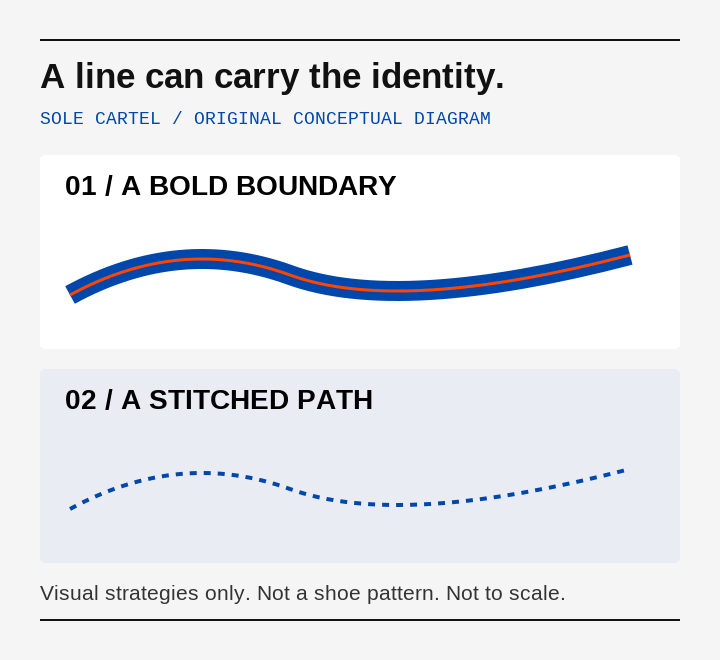
What “Puffy” does—and does not—name
END calls the exact Black style IV4504-001 “Puffy”. Its description connects the rounded appearance to the stitched treatment of familiar lines. It also describes a leather upper and a perforated leather heel panel in place of the usual moulded badge.
The nickname is useful shorthand for the appearance. It is not a technical specification. Nike’s two U.S. pages use the titles Air Max 90 SP — Black and Air Max 90 — Medium Olive and Sequoia; neither titles the shoe “Puffy.” We are using the retailer/editorial nickname to discuss these two identified variants, not presenting it as an official pack name.
Nor should the name do the work of a wear test. A rounded photograph cannot establish insulation, extra cushioning, a wider fit or better comfort. Those would be separate questions requiring better evidence than an evocative nickname.
The heel quiets the branding without erasing it
The Black rear photograph is especially useful. An oval area of perforations occupies the upper heel, with a stitched perimeter and a broad tonal surface below. There is no contrasting raised heel badge visible in that view. The heel becomes a study in shape, holes and reflected light rather than a high-contrast logo panel.
That is a change in emphasis, not a claim that the shoe is unbranded. The side Swoosh remains legible in the official side views. The Olive overhead photograph also shows Nike marks on the tongue and insoles. “Restrained branding” describes where attention goes in these particular images; “no branding” would misdescribe them.
The distinction matters to the design. A recognizable sneaker does not need every familiar cue to speak at the same volume. Quieting one cue can make another—the sweep of a seam, the heel silhouette, the Air window—more noticeable.
Black and Olive make different things visible
The Medium Olive and Sequoia gallery makes the surface treatment easier to separate from the nickname. In the side photograph, light catches the rounded areas between stitched borders; the edges around the eyestay and the long lower curve remain readable without a strong color break. In the overhead view, rows of perforations sit beside the laces.
Black compresses these relationships into highlight and shadow. Olive gives the eye more tonal separation. That is a visual comparison of the supplied photographs, not a controlled color or material test: lighting and image processing also affect what we see.
Nike describes the Olive upper as leather, with Sequoia accents. For Black, Dover Street Market lists a leather upper and rubber outsole, consistent with END’s broad material description. None of those statements is a complete bill of materials. They do not establish the composition of every panel, lining, backing or internal layer, and we have not measured any of them.
The Air window keeps a familiar anchor
Nike’s listings retain the vocabulary of the Air Max 90: stitched overlays, a Waffle sole and visible Max Air. The visible heel window gives this quieter upper a familiar anchor. Against the broad surfaces above it, the window remains an interruption you can identify immediately.
Our Tinker Hatfield essay on the Air Max 90 and Air 180 considers how form directs attention toward visible cushioning. This pair invites a related question: how much of a familiar design can be expressed through contour and stitching before color and badges need to explain it?
The photographs suggest a persuasive answer. Much of the recognition survives. That is the interest of these versions: the shoe’s visual structure is still there to be read, even when its surface becomes more continuous. It does not prove new tooling, different Air pressure, a particular foam, or improved performance. Nike’s public descriptions reviewed here do not settle those questions.
The dated release record
As checked November 6, 2026, Nike’s United States SNKRS pages list both variants at $170, scheduled for November 13:
We omit the displayed clock time because the retrieved pages do not state an explicit time zone. A scheduled listing is not proof that a release has completed or that a particular size will be available. November 13 is the current U.S. listing, not a claim about the first worldwide release.
Our earlier Black regional release record preserves the October source checks; it includes a November 6 U.S. source update. That record and this design essay serve different purposes. One documents changing regional information. The other asks what the shoe’s visible form is doing.
What to record when a pair is in front of you
A useful next step would be a consistent photographic record: side profile, rear heel, eyestay and tongue, then close views of the stitched boundaries. Our condition record guide explains the value of separating what you can document from what remains unknown. For this pair, keep the style code with those images so similar tonal Air Max 90s are not mistaken for one another.
The most interesting thing about “Puffy” is already visible. Stitching makes familiar lines feel newly deliberate. Whether that appearance translates into a different wearing experience remains an open question, and the design does not need an invented answer to be worth examining.
Research note: Official product images were inspected as reference, but are linked rather than reproduced here because no specific reproduction grant was verified. The diagram is original and conceptual. Sole Cartel has not inspected or tested either pair. Source checks are dated November 6, 2026; release information can change. No affiliate links appear in this article.