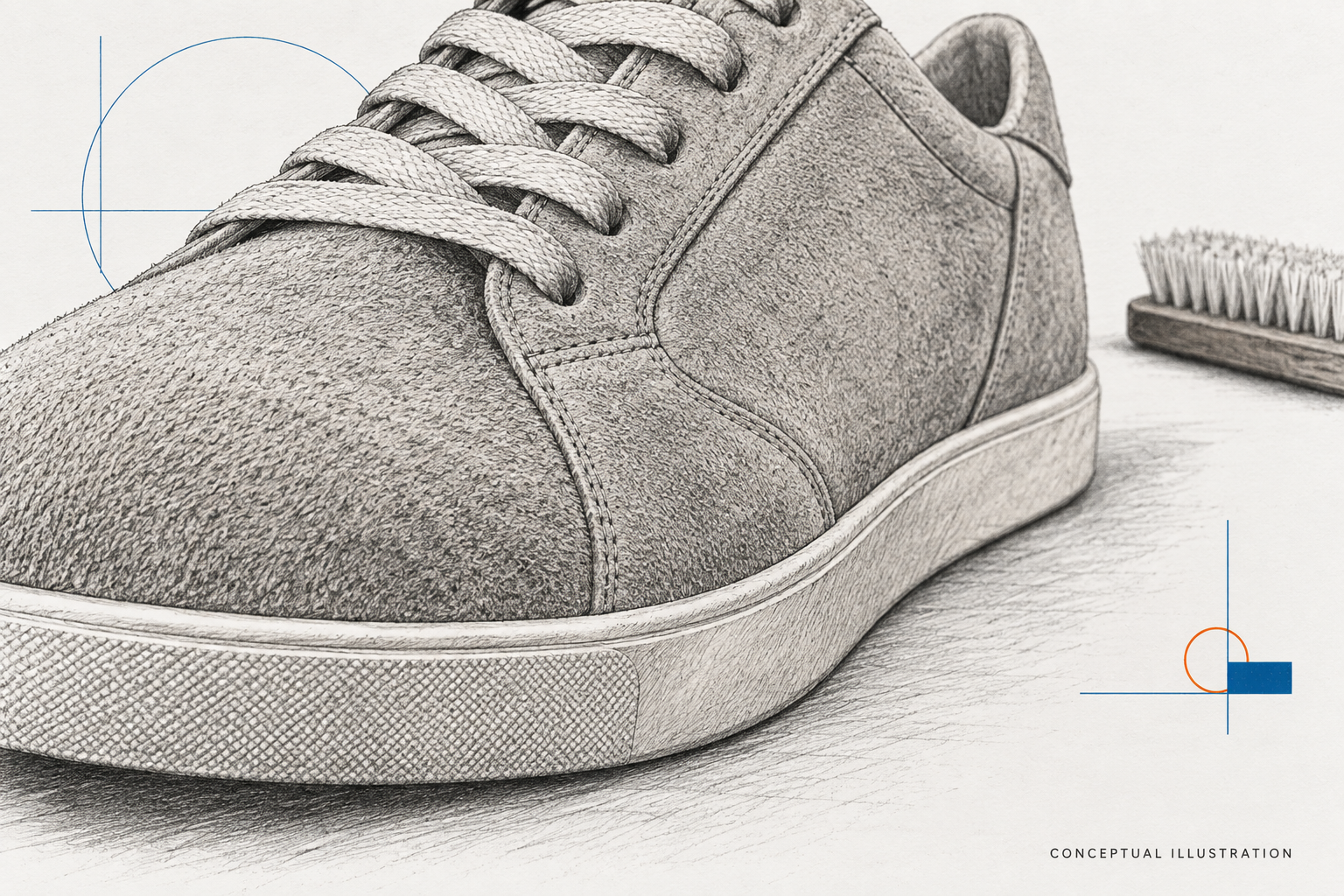
For suede or nubuck sneakers, confirm the material and finish before choosing a brush or cleaner. If the surface is dry and intact, and the maker's instructions allow it, begin with gentle removal of loose dirt. Keep stain treatment separate: a mark that remains is a reason to reassess, not automatically to scrub harder.
This third Care Bench lesson gives you a way to choose the next action without guessing from texture alone. Start with the panel notes from Read Your Pair Before You Clean It. Smooth leather and confirmed rubber have their own lesson; keep those methods on their intended surfaces.
This is a dry, loose-dirt lesson for documented, intact materials. It does not cover stain removal, wet cleaning, protective treatments or vintage restoration. Pause for an unknown finish, flaking, stickiness, shedding or visible separation. These are editorial stopping rules, not a diagnosis. A cleaner-looking shoe has not passed a wearability assessment.
Similar appearance, different information
Timberland's suede and nubuck explainer describes nubuck as leather made by buffing the outer hide surface and suede as using the inner side. That distinction is useful vocabulary. It cannot establish what a particular panel is made from by looking at a photograph.
Treat an unlabelled velvety panel as unresolved. Look for the exact model's material description and care instructions, noting which panel they describe. Keep the source with your notes. If the available record says only “leather,” do not silently turn that into “suede” or “nubuck.” Ask the maker about the finish before treating it.

Our illustration shows the decision branches, not a texture-identification test. The same applies to the macro artwork: it is a conceptual drawing, not a photographed material sample.
Start with a dry surface and loose dirt
Nike's suede-care guide advises letting wet suede or mud dry before brushing. Its initial debris-removal step uses gentle dry brushing; it keeps soap and water out of that step. Nike also cautions against tumble drying.
Clarks' separate suede and nubuck instructions both describe a suede-and-nubuck brush for gently removing loose, dry dirt. This supplies a named nubuck reference, but it does not establish that a Clarks product or method suits every Nike finish.
For this exercise, have the applicable instructions and an appropriate clean brush in reach. Keep any brush used on an outsole away from the upper. Work only within the documented panel, staying clear of loose edges, decoration and neighbouring materials. Our editorial precaution is to begin on a small, discreet area and pause to observe it before covering more of the panel.
If you cannot match the method to that surface, stop at the record. Do not test your way through an unidentified or fragile finish.
Read the full video transcript
Duration: 50 seconds. Silent original illustrations; no actual specimen, cleaning demonstration, test or observed result. All principal captions are also baked into the video.
This guide concerns dry loose-debris decisions for documented, intact surfaces. It does not identify suede or nubuck from appearance. Unknown, wet or fragile panels pause this exercise. Suede and nubuck need applicable material-specific instructions; no universal brushing direction, brush hardness, stroke count or drying time is supplied.
00–10 seconds · Record
Visual: An original care record sits beside an outlined panel of fixed schematic texture. Moving marks indicate reviewing the record, not identifying the material from the drawing.
00–05: Start with the material record. Check the exact panel and its finish. Texture alone cannot identify the material.
05–10: Find the applicable care guidance. A model code alone is not proof. Pause if the finish is unknown.
10–20 seconds · Separate
Visual: Three distinct text cards read Suede, Nubuck and Unknown. The unknown card carries a pause symbol. No paired texture samples or visual identification comparison is shown.
10–15: Suede and nubuck need separate care. Use guidance that names the material. Do not identify either from this drawing.
15–20: Pause if wet, fragile or unknown. Resolve the material and care first. No fixed timer makes a surface ready.
20–30 seconds · Dry first
Visual: A clean brush approaches a fixed schematic panel. It does not scrub repeatedly; no dirt disappears and no texture changes. This illustrates a bounded first-pass decision, not a performed treatment.
20–25: Confirmed suede: begin dry. Let moisture or mud dry before brushing. Nike suede guidance · do not tumble dry.
25–30: A gentle, dry loose-debris pass. Use a clean, appropriate brush. Follow the applicable maker instructions.
30–40 seconds · Motion
Visual: A single direction arrow appears over unchanged schematic texture. The panel is labeled Clarks nubuck: stain-brushing example, with natural-nap direction identified in the main caption. A directional marker advances once across the arrow; no treatment result or restored fibers appear.
30–35: Nubuck needs its own instructions. Clarks stain example: follow the nap. Context example; no stain treatment shown.
35–40: Follow the specified motion. Do not borrow a suede scuff step. This guide does not include stain treatment.
40–50 seconds · Stop + note
Visual: First, a brush rests apart from a pause icon. Then an observation card appears with two blank photo-frame icons. These are recording placeholders, not before-and-after photographs.
40–45: Stop at unexpected change. Do not escalate to stain treatment. Seek guidance for unstable surfaces.
45–50: Record the observation and source. Keep the same view and lighting. A texture change does not prove repair.
Persistent disclosure: “Illustrated guide · no cleaning test or result.”
Sources and limits: Nike suede care supports the suede dry-debris starting point; Clarks UK care guidance separately addresses nubuck. The Clarks natural-nap direction instruction occurs in its stain-brushing context. It appears here only as an attributed example of why direction is guidance-specific; this video neither demonstrates nor recommends a stain treatment. Nike’s optional suede scuff motion is not transferred to nubuck. Source checks completed October 6, 2026 (America/New_York).
Stopping and recording are Sole Cartel editorial precautions, not a diagnosis or validated repair protocol. No physical pair was available or tested. The fixed vector texture marks are schematic artwork, not a magnified material sample.
Why the arrows need context
Brush direction is not one rule for every problem. Nike describes a side-to-side motion for an optional suede scuff step. Clarks describes following the nap—the direction the surface fibres lie—and avoiding back-and-forth movement for stains in its suede and nubuck sections. Those instructions address particular steps; they are not evidence from a head-to-head test.
Keep this first pass limited to loose dirt and follow the instructions applicable to the pair. Do not combine snippets from different guides into a new stain-removal routine. The video labels its direction example to the source and context; it does not prescribe a universal brushing motion.
Stop, dry if needed, and compare
After the gentle pass, set the brush aside and look again. Record a remaining mark without relabelling it as dirt that must come off. If you observe an unexpected change in colour, texture or surface stability, stop. Save the observation and the care source; ask the maker or a suitable footwear-care specialist what to do next.
If the panel is wet, defer this dry-brush exercise. For suede, Nike's drying-before-brushing advice applies within its guide. For nubuck, obtain the drying directions for that material and finish. This lesson sets no number of hours, heat setting or moisture threshold.
Repeat relevant photographs with similar lighting, camera position and viewing angle. Describe what you can see: loose debris removed, a mark remaining, a patch looking different, or no visible change. Keep these observations with your condition record. They document an event; they do not prove repair or hidden structural health.
Keep the decision with the pair
Open the printable material-and-method reference card →
Use the blank card to retain the panel identification, exact care source, brush or product, decision to proceed or pause, and the observation afterward. “Unknown—no treatment” is a useful entry. For the environment around the pair between care sessions, see the storage observation guide.
The Care Bench · Part 3. Prepared by the Sole Cartel editorial desk with AI-assisted research, writing and illustration. Manufacturer sources checked October 6, 2026. The decision framework, small-area precaution, recording and stopping rules are editorial recommendations. No physical cleaning trial, photographed treatment or restoration result is claimed.