The useful question is not how full you can make an old sneaker look. It is whether you can support its accessible shape without putting the pair under new strain.
Treat this as a storage decision for the particular shoe in front of you. A nominal shoe-tree size, a familiar packing material or a cleaner-looking silhouette does not establish that the setup suits an aged upper, lining or sole.
Preserve the Pair · Part 3 of 3
The series separates three questions: environment, light and support. Revisit Part 1: measure the storage environment for enclosure and moisture decisions, and Part 2: UV filters and visible light for the display environment. This final chapter focuses on fit, access and handling.
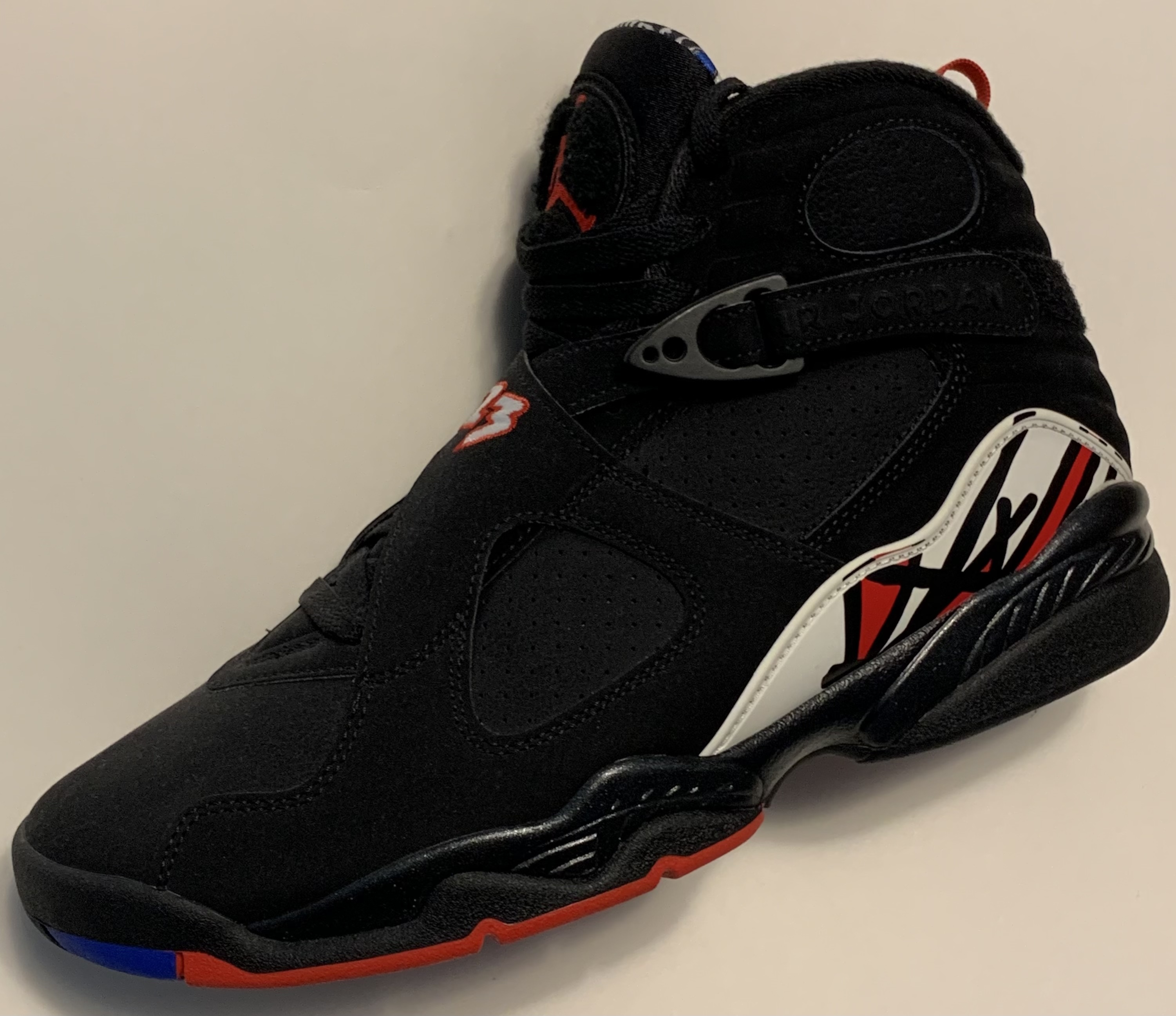
Photo: Osyffar. Nike Air Jordan VIII.jpg. CC0 1.0 Universal. Photograph reproduced without edits.
Begin with what you can access
Before changing the packing, photograph the current setup and note the pair’s identity, date and visible concerns. Record only the areas you can reach without pulling apart or forcing the shoe. “Interior not accessed” is a useful entry when that is what happened.
If material appears stuck to the lining, the opening resists access, or surfaces appear brittle, sticky or unstable, pause. Do not turn inserting or removing support into an improvised treatment. For a fragile or valuable pair, seek an object conservator’s assessment before changing the setup.
This is a conservative handling approach, not a test that certifies the shoe as stable. The condition-record guide gives you a place to preserve the observations and photographs.
Support is different from stretching

CCI’s leather guidance warns that overstuffing can create tension and damage. That is the important boundary here: adding more material to chase a fuller shape can defeat the purpose of support. CCI: Caring for leather, skin and fur
Do not push against a resistant toe or collar, straighten a crease by force, or flex the sole to make room. If placing it requires forcing the shoe open or pushing it into a different shape, stop and reconsider the arrangement. A shoe that looked different when new is not a template you need to reproduce today.
The diagram is a concept, not a packing recipe. Its small insert is deliberately unmeasured. It does not show the correct quantity, material or fit for your pair, and internal support may be inappropriate where access or condition is uncertain.
Read the full transcript
24 seconds, silent. Original conceptual animation, not footage, a fitting demonstration or a physical test. All principal captions are built into the video. There is no measured force, prescribed filling volume, insertion procedure, reshaping or simulated restoration.
00–08 seconds · Observe before changing
Visual: An unchanged generic shoe rests on a simple tray beside a blank CURRENT PACKING card. An orange observation outline moves between the opening, upper and sole edge. Nothing is pulled out, bent or cleaned.
00–04: Start with the current condition. Look only where you have access. Keep the existing packing in the record.
04–08: Name the areas you can inspect. Leave hidden areas marked unknown. This outline is not your actual pair.
08–16 seconds · Decide before adding
Visual: The same unchanged shoe sits beside a blank SUPPORT PLAN card and an animated pause ring. No support is inserted. There is no measured force, filling volume, prescribed shoe tree or visible restoration.
08–12: Avoid overstuffing. Keep the current shape as the reference. The drawing demonstrates no fitting method.
12–16: Decide before adding material. Uncertain fit or access? Pause. No force or reshaping is illustrated.
16–24 seconds · Keep a support record
Visual: A blank record contains MATERIAL, CONTACT and UNKNOWN fields. A marker moves between these unfilled fields. A separate SETUP VIEW frame remains empty. No observation, photo, compatibility result or certification is invented.
16–20: Record material and placement. Keep the supplier description. Note what remains uncertain.
20–24: Review the actual setup. Keep comparable views of the pair. Blank fields are not proof of success.
Persistent disclosure: “Conceptual animation · not footage or a test.”
The first caption of the second scene is the single source-derived factual proposition. The remaining text and record prompts are original editorial instructions for documenting the actual setup, not a material recommendation or fitting protocol. Source links and checked date are in the accompanying article and graphics provenance.
Be specific about the material
CCI’s historic-accessory guidance describes unbuffered, acid-free tissue with a neutral pH and gives examples of covered polyethylene-foam supports. Those are specified museum materials and methods, not an endorsement of any white tissue or packaging foam. CCI: Storage for Costume Accessories
For a proposed support, retain the supplier’s material description and the exact product reference. Write down what would touch the lining or upper. If the specification is missing, leave compatibility unresolved rather than replacing it with an “archival” label in your notes.
Original box tissue, an unknown foam insert and a retail shoe tree each need their own evaluation. The sources here do not test a particular cedar, plastic or spring-loaded tree against your sneaker’s construction. We therefore recommend neither a universal tree nor a blanket ban on a material category.
The decision may be to leave the current setup alone while you get advice. Record that decision as clearly as you would record an added support.
Give each shoe its own place
CCI’s footwear examples include individual supports, side-by-side storage and separation; the accessory note warns against stacking. Its textiles guidance also describes light internal support and mounting that reduces direct handling. CCI accessory note · CCI: Caring for textiles and costumes
Apply that as a planning principle: allow room for the two shoes and consider an appropriate base or tray for moving the arrangement. Avoid making a weak upper, loose trim or fragile sole edge the part you repeatedly grab. A base also needs suitable materials and a fit that supports the shoe; this is not a universal tray recommendation.
Do not add adhesive, ties, heat, water or a reshaping treatment as an extra step in this guide. Those introduce different decisions from simply planning support.

Leave a record of the setup
Before you put the pair away, complete these fields in your notes:
Before: Pair ID, date, existing packing and photo references.
Access: Areas observed and areas left untouched.
Decision: Support added, existing support retained, or change deferred—and why.
Material and placement: Product/specification source, contact areas and base arrangement. Keep unknowns explicit.
After: A setup photograph and a description of what actually changed.
Use the email-unlocked condition forms if you want a consistent record. Append later observations instead of replacing the earlier entry.
The outcome is a documented arrangement you can revisit. It is not proof that creasing has stopped, aging has been prevented or the pair is fit to wear. Keep the support decision beside the environment record so the next person can understand both the setup and its limits.
Source scope. Sources rechecked October 18, 2026. The CCI sources describe care of heritage collections, including historic footwear. They do not validate a particular modern sneaker composite or retail support product. This article includes original conceptual illustrations and an illustrated video; no restoration, packing trial or wearability test was performed.