Part 5 of Tinker Hatfield: The Shoes, the Ideas, the Legacy
The night the label became history
On June 12, 1991, Chicago beat Los Angeles 108–101 to win its first NBA championship. United Press International’s report found its decisive late figure in John Paxson, who scored ten points in the final four minutes. Scottie Pippen finished with 32; Michael Jordan had 30 and ten assists. The Bulls won the series four games to one. This was a victory made by several players, against a Lakers team missing injured starters James Worthy and Byron Scott. The contemporary UPI report supplies the result and the team context.
For a history of shoes, that is a useful place to begin. A signature product concentrates attention on one person. A championship requires an organization. Put the shoe at the center of the picture and the temptation is to treat everything around it as evidence of the designer’s genius. Start with the basketball and a more interesting question appears: how did an object become capable of holding the memory of something much larger than itself?
Nike’s archive identifies the Air Jordan VI as Jordan’s first championship shoe; its entry gives the original release as 1991 and credits Tinker Hatfield. The preceding Air Jordan V is dated 1990 and carries the same designer credit. Both entries list an original price of $125. Those are product dates, rather than a complete schedule of every sample, player appearance or regional delivery. Nike’s VI archive and V archive establish the sequence.
The two shoes belong together because they make a small drama out of design’s competing jobs. A basketball shoe must be put on, adjusted and played in. A signature shoe must also be recognized. The V and VI bring those demands into contact at the tongue, the bottom of the foot and the back of the ankle. Their most memorable features invite us to look, but several also invite a hand to act. That double address is the subject of this chapter.
A person, rather than a numbered brief
In a 2011 interview, Hatfield described beginning Jordan projects by calling and visiting Michael, discussing his life, including the cars he drove, and finding ways to bring those interests into a product. He also described collaboration as blending his own ideas with another person’s. This is retrospective testimony about his working relationship, not a transcript of a particular V or VI design meeting. Eric Plummer’s direct interview makes that distinction possible.
It suggests why an aircraft or automobile could matter without becoming a technical specification. Such references offer a designer a vocabulary: an attitude, a profile, a way of making one area appear to surge forward. They can make an athlete feel represented by an object. None of that requires a shoe to behave like a machine from another field. A metaphor succeeds when it makes a useful connection, and becomes misleading when its resemblance is presented as a measured performance benefit.
Hatfield later called his Cooper Hewitt recognition a collective award for his collaborators. In the museum’s 2019 interview, his advice also put writing, speaking, drawing and thinking alongside fearlessness. These are accounts of a practice that includes explaining and negotiating ideas, rather than drawing alone. Cooper Hewitt’s interview is the source for that account.
A Cooper Hewitt essay reproduces Hatfield’s explanation from a July 1989 newspaper profile: a basketball shoe’s added forms should have value in the activity, rather than being arbitrary lumps. The museum quotes him connecting close fit around the ankle with the player’s experience. This is period testimony accessed through the museum’s later essay; the original newspaper page has not been inspected here. Cooper Hewitt’s source-linked discussion preserves that earlier statement of intent.
That statement gives the next two models a useful standard to argue with. A conspicuous feature could be justified through use, but its appearance could still carry another message. The question is how the designer joins those responsibilities. The V and VI reward examination at precisely that point, where an expressive form meets a hand, a foot or a changing view of the wearer.
The V: aggression drawn at ground level
Nike’s V history connects Jordan’s competitive style to an American Second World War fighter aircraft and connects that reference to the pointed shapes on the midsole. Its account also places Spike Lee’s Mars Blackmon in the shoe’s introduction. These are Nike’s retrospective explanations of design and promotion. The aircraft comparison is an attributed inspiration story; it establishes no aerodynamic advantage. Nike’s V history is the account being examined.
The competitive personality was already news in the V’s release year. UPI’s March 29, 1990 report describes Jordan’s 69-point, 18-rebound performance in Chicago’s overtime win over Cleveland. It records Phil Jackson’s concern that going to one player so often could take his teammates out of the game, alongside his praise for the individual performance. The report gives the athletic context without identifying Jordan’s footwear. UPI’s period account is evidence for that tension, rather than for which pair he wore.
That tension matters to a signature line. Its organizing figure must appear exceptional enough to deserve a separate product, yet the sport asks him to operate within a team. The designer’s task of representing one athlete sits beside the coach’s task of coordinating several. Aggressive visual language can condense the first problem into a recognizable attitude; it cannot settle the second. The aircraft story becomes more interesting when placed alongside that live uncertainty. It was a way of giving individual brilliance a form while the larger basketball story was still being worked out.
Read the pointed motif as graphic design and its force becomes easier to understand. Teeth suggest a mouth; a mouth suggests an animal capable of attack. Placing that suggestion near the ground gives the shoe an expressive lower edge. The wearer does not need to know a particular aircraft designation to understand the threat. That is an efficient signature device: it can work as an immediate shape before it becomes a story someone learns and repeats.
The metaphor also changes the scale at which the product can be read. A shoelace is a small object seen close up. An angular patch of contrasting color can organize a much larger view. In editorial terms, the motif gives the shoe a verb. It appears to bite. That reading is an interpretation of the design, rather than a claim about what every spectator saw or how a player’s movements changed. Its value lies in describing the visual argument clearly enough to test against the object.
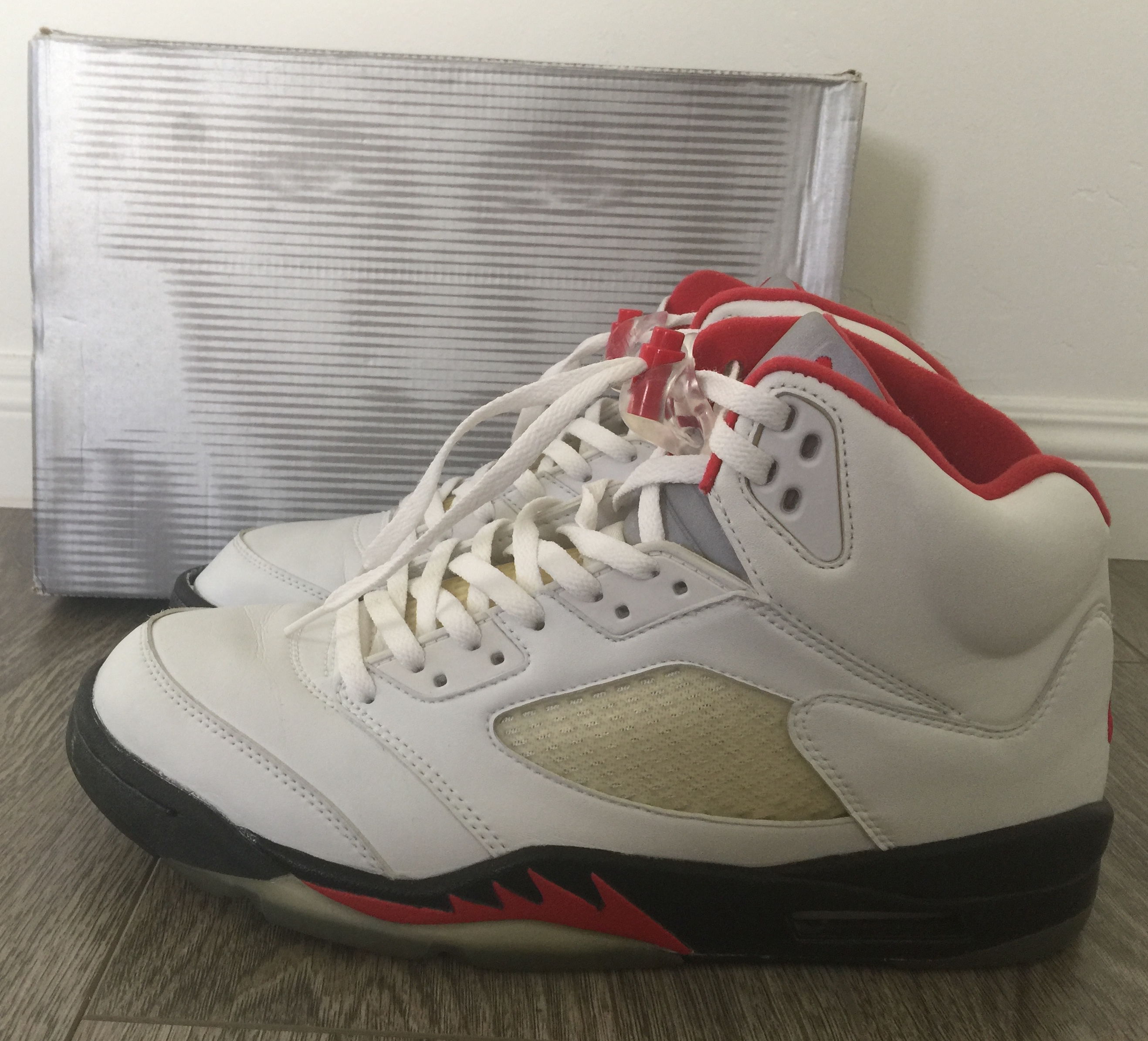
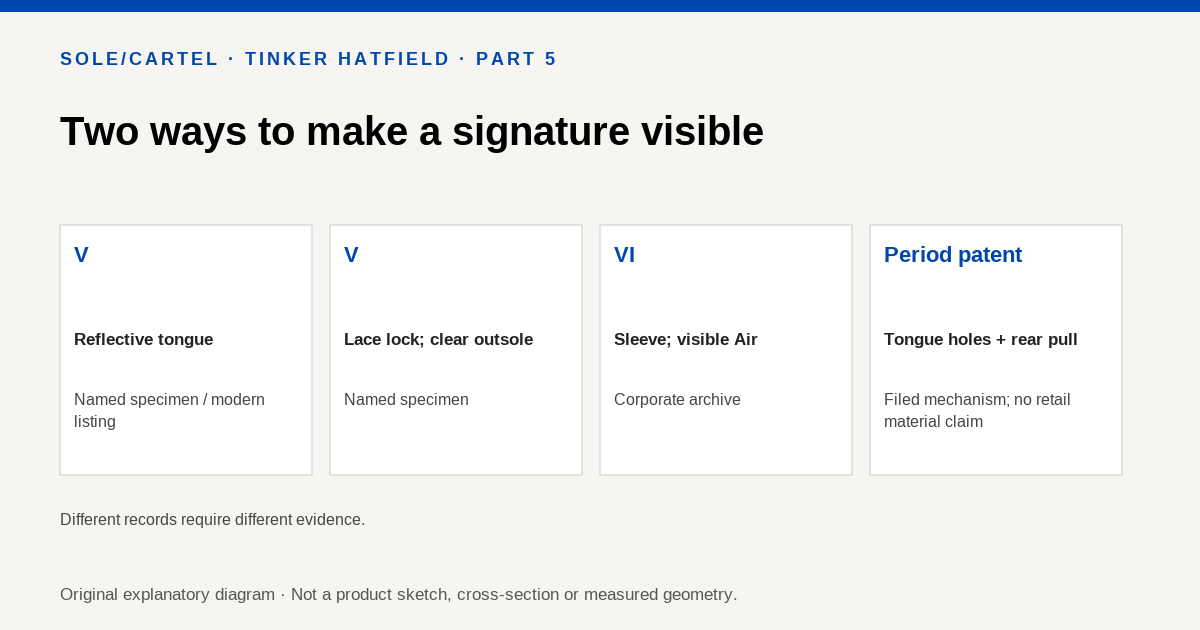
A Christie’s catalog describes a specific 1990 Fire Red player-exclusive V, size 13, with an asymmetrical collar, lace lock, clear rubber outsole and reflective tongues; it also records a customized embroidered 23. That is evidence about a named surviving specimen as cataloged by an auction house. It should not be silently converted into a specification for every 1990 retail V. Christie’s specimen catalog provides the component description.
The lace lock offers a different kind of invitation from the teeth. It asks to be handled. A viewer can infer an action from its position among the laces, even without knowing the exact force it can withstand. That matters to the overall composition: the shoe contains a small mechanical focal point within a larger theatrical one. To describe that relationship is more revealing than calling every protruding part either decoration or technology. The object allows those roles to overlap, while the evidence still has to establish each claimed function separately.
The tongue and the camera
The distinction between reflection and illumination matters here. In its explanation of retroreflective materials, 3M describes light returning toward the direction of its source, appearing brightest to an observer close to that source. This is a general optical explanation. It is not an identification of the exact reflective construction used in a particular Jordan V, nor a certification of the shoe’s visibility. 3M’s explanation supplies the mechanism, with those limits.
As a design reading, this makes a reflective tongue unusually well suited to the relationship between wearer and image maker. The detail can change its apparent brightness when the conditions of illumination change. It need not present one constant appearance. A shoe can therefore acquire a second face in a photograph: the photograph is showing a real response to light, but it is still a response produced under particular conditions. That is a richer idea than the loose claim that the tongue simply glows.
Nike’s listing for the 2025 AJ5 Reimagined, SKU HF3975-001, explicitly describes a reflective tongue. It identifies reflective heel branding as a replacement for the original stitched Nike Air branding and describes lightened panel edges. The listing is evidence for that named modern edition and Nike’s stated comparison, not a laboratory analysis of the 1990 materials. The edition-specific SNKRS listing documents those choices. The edition’s contemporary 2025 report identifies its year.
The later relocation of a reflective effect to the heel is revealing. Reinterpretation can keep a familiar idea while moving it to another part of the object. That gives collectors something more exact to discuss than whether a retro possesses the original’s spirit. The relevant questions become where the effect occurs, how the logo is constructed and what happens when the viewing conditions change. These questions are visual and historical before they are judgments of quality. They do not require pretending to have measured the materials.
The bottom becomes a second face
The clear outsole recorded on Christie’s Fire Red specimen makes a normally downward-facing surface part of the shoe’s presentation. Nike’s current listing for the White Metallic retro, HQ7978-103, separately identifies a lace toggle, translucent outsole and rubber outsole. It describes its upper as a combination of real and synthetic leather with textiles. That specification belongs to the listed White Metallic edition; it cannot establish the composition of a different original colorway. Nike’s White Metallic product record identifies that modern product.
A translucent bottom asks for a different kind of looking from a colored sidewall. It invites the shoe to be turned over. That change of viewpoint is important in a collector’s object, where examination often means seeing surfaces that ordinary use hides. In motion, an underside can also become briefly visible. A designer who treats it as an image surface gives the object more than one public face. This is an interpretation of presentation, not an assertion that clear rubber grips better than opaque rubber.
Clarity can be seductive because it seems to promise complete access. Yet seeing through a surface does not explain its chemistry or predict how it will behave on a dusty court. The visual experience and the technical question are different. The V’s importance in this chapter is that it makes a utilitarian surface available for expressive work. Its outsole can belong to the physical task of playing and to the graphic task of representing the shoe at the same time, without either role proving the other.
The VI: a shoe with handles
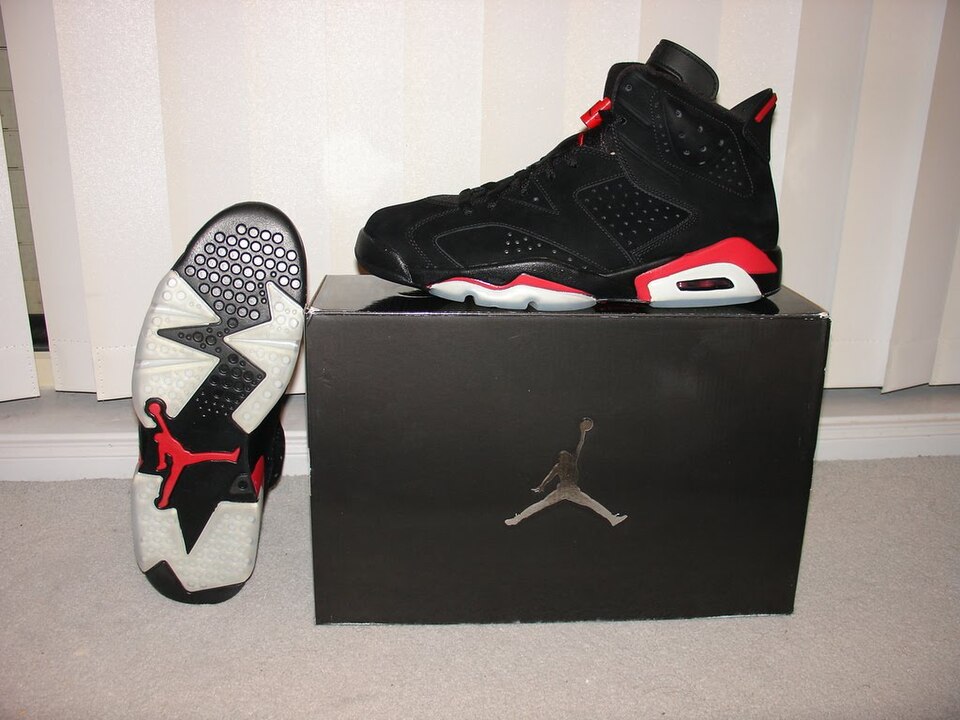

Nike’s VI archive attributes its inspiration to Jordan’s German sports car and identifies a neoprene sleeve, translucent rubber sole and visible Air. It dates the design’s original release to 1991. The broad automotive reference is the supported account here; assigning it a precise car model would require a more specific record. Nike’s VI entry supplies that account.
The useful question is what the machine reference does once translated into footwear. A projecting rear element can evoke a car’s bodywork while giving the hand a place to go. The resemblance may attract attention; the grip makes that attention actionable. The shoe’s personality does not have to be suspended while someone puts it on. It can be expressed through the very component used for that task. This is where the VI offers a particularly strong answer to the supposed division between appearance and function.
A period technical record makes the entry problem unusually tangible. Hatfield’s US5276983A application was filed June 12, 1991, and published as a granted patent January 11, 1994. It describes finger holes in an extended tongue paired with a transverse rear pull, allowing force to be applied at the front and heel when putting on a snug shoe. It also describes reinforcement around the holes. The document’s generic footwear description and inspected figures are period design evidence, not an exact retail VI material schedule. The patent and its drawings preserve the intended operation.
This is an unusually modest design problem for such a dramatic object: before the foot can perform, it has to get inside. A tight opening and an easy entry can pull design in different directions. Handles make that conflict legible. They turn an area usually grasped wherever the fingers happen to land into a more deliberate interface. The interesting achievement is the clarity of the proposed interaction. The person holding the shoe is given a front and a back, and an intelligible action between them.
There is also a lesson in the empty space. A hole removes material, but it can add an instruction. A projecting loop creates a gap that tells the hand where to reach. These are forms organized around an absent finger. They show how an architect’s attention to access can become useful at the scale of an everyday object, without requiring a claim that architectural training uniquely explains the solution. The design invites us to understand the body as something that touches the shoe before it wears it.
In a 2020 direct interview with Sports Illustrated, Jordan Brand executive Gentry Humphrey emphasized athlete insights, the blend of art and science and the practical entry role of the VI’s prominent tongue. He also offered a Batman-related aesthetic account. That retrospective account adds another voice to the shoe’s explanation; it does not resolve the sequence of every influence or establish measured performance. Humphrey’s interview should be read as attributed testimony.
Multiple references need not cancel one another. A designer can think about a car’s silhouette, an exaggerated costume and the mechanics of a hand grip while working on one component. The danger comes when a later explanation becomes a tidy origin myth with only one cause. Here, the filed entry mechanism gives us something firmer to examine than a contest between colorful anecdotes. Whatever else the tongue resembled, its description contains a proposed action that a reader can understand independently of those associations.
Winning, and the stories that follow
The championship changed the interpretive setting. Before a decisive result, a signature shoe can express ambition. Afterward, a familiar object can stand for an accomplished event. That shift happens in the historical relationship between object and wearer; it does not establish that the product caused the outcome. A first title gives a brand a powerful narrative ending. The historian’s job is to notice how easily that ending can be projected backward onto decisions made while the result was still unknown.
UPI’s account also recorded Jordan’s Finals MVP and the Bulls’ four consecutive wins after losing the opener. Its emphasis on Pippen and Paxson makes an instructive companion to a signature-shoe history. That same contemporary report concerns basketball achievement, rather than a comparative footwear test.
The VI can hold the memory of a title precisely because a material object is easier to isolate than a season’s worth of work. It gives a complex achievement edges, a silhouette and a color arrangement. Someone can recognize the reference without reciting a complete game log. That compression helps explain the cultural power of a championship shoe. It also explains why the team context belongs in the story: compression is useful, but it is still a selective account of what happened.
From promotion to preservation
The Smithsonian’s Nike Advertising Oral History and Documentation Collection inventories print advertising from 1985–1993. One basketball entry describes reproduced photographs of Jordan and Spike Lee, each with a basketball, under an Earth-and-Mars comparison. The finding aid supplies an archival location and a broad approximate date range, not a verified V-specific advertising date or a measurement of public response. The institutional inventory, page 20 of the finding aid, documents the material’s existence.
That distinction helps keep promotion from swallowing reception. An advertisement records what a company wanted to say. A purchase, a review and a photograph of someone wearing a pair would answer different questions. This chapter can establish that the shoe was promoted within a developed athlete-and-character framework. It cannot turn that framework into evidence that every audience understood the shoe alike. The commercial personality remains part of the history, with the audience’s variety left intact rather than filled by an invented consensus.
A later collecting framework makes the narrowing of attention explicit. Sotheby’s presented its Dynasty Collection as six individual shoes attributed to Jordan’s championship-clinching games, beginning with a 1991 VI. CGC’s separate account identifies a VI connected to June 12, 1991, and discusses its authentication and provenance. These are interested institutional accounts of particular objects, not independent performance studies. Sotheby’s collection description and CGC’s specimen account identify their claims.
The selection is culturally revealing even without accepting an auction house’s language of ultimate importance. A set organized by clinching games makes sporting chronology the collecting principle. It values the object’s connection to an event, rather than merely its resemblance to the retail design. A modern pair may reproduce much of the appearance and remain a different kind of historical thing. Neither category makes the other meaningless. They preserve different relationships: one to a particular player’s use, the other to a design available for repeated interpretation.
What survives in the shoe
The collector comparison here is documentary, with no claim of physical handling or testing. Its reference points are the cataloged 1990 Fire Red player-exclusive V, Nike’s archived 1990 Black/Metallic Silver V, the 2025 Reimagined HF3975-001, Nike’s archived 1991 Black/Infrared VI and the 2026 Infrared Salesman CT8529-001. These are deliberately identified editions and specimens. A player exclusive is not an all-purpose proxy for original retail construction; an archive photograph is not a chemical analysis.
For the V, Nike’s Reimagined description makes the heel change explicit: reflective branding replaces stitching. It also retains the tongue effect and names a translucent outsole and mesh-like side panels. HF3975-001’s listing gives the comparison an inspectable basis. The useful collector question is how a returning device has been redistributed, rather than whether every component can be called original.
For the VI, Nike’s January 16, 2026 announcement describes the Salesman edition as drawing on an unreleased 1999 sample, with the accent color spread farther across the midsole. Its product listing identifies CT8529-001 as Black/Light Crimson. This is a sample-derived reinterpretation, distinct from a straightforward return of the 1991 Black/Infrared arrangement. Nike’s announcement and the SKU-specific listing identify that distinction.
A collection record can therefore preserve more than a colorway nickname. It can identify the particular year and product code, the construction of a logo, the placement of an accent, and the source used for each comparison. Photographs made under stated lighting conditions can be especially useful when reflectivity is part of the discussion. Such a record does not need a verdict on which version is best. It needs enough specificity to keep one release from quietly substituting for another.
What survives most persuasively across these two designs is a way of joining expression to an action. The V makes the shoe’s lower edge an image and its tongue a changing visual surface. The VI makes entry itself conspicuous. Championship history later gives those choices a new emotional charge. The enduring design lesson lies in the meeting of those scales: a finger finds a place to pull, a spectator recognizes an attitude, and a collector turns a remembered event into an object that can be studied again.
Compact chronology
| Date | Event type | Record |
|---|---|---|
| 1990 | Original release year | Air Jordan V; Hatfield credit. |
| 1991 | Original release year | Air Jordan VI; Hatfield credit. |
| June 12, 1991 | Game / championship | Chicago’s first title. |
| June 12, 1991 | Patent filing | US5276983A application. |
| January 11, 1994 | Patent publication | US5276983A grant publication. |
| 2025 | Modern edition | AJ5 Reimagined HF3975-001. |
| January 16, 2026 | Announcement | Nike introduces AJ6 Salesman. |
Source notes
Nike’s archive and retail descriptions express the manufacturer’s perspective. Direct interviews are retrospective testimony. The patent documents a proposed mechanism and its dates; it does not certify every retail material or prove an outcome. Auction and authentication records concern named objects and carry commercial interests. The added shoe photographs are individually licensed and credited; no other archival-image reproduction rights are claimed.