Nike retrospectively dates McEnroe's unexpected Trainer prototype adoption to 1986 and retail introduction to 1987. Nike Japan
The story has an unusually useful complication. The athlete was not simply performing the role the product team had written for him. His choice helped change the interpretation of the object. A proposed solution to a training problem acquired another possible life through use.
That is the Air Trainer 1's most interesting contribution to the Tinker Hatfield story. Its argument was less spectacular than a window into a running shoe's cushioning. It asked whether the product category itself had been defined too narrowly. Perhaps the relevant unit of design was a session containing several activities, rather than a single sport.
The answer was a compromise, and that word deserves rehabilitation. Compromise can describe an unwilling surrender of standards. It can also describe the central work of design: deciding which competing demands matter, which can coexist, and where the solution must stop. A versatile shoe has to make those choices visibly enough that a customer understands the proposition, yet honestly enough that versatility does not become a promise of universal superiority.
Start with the session
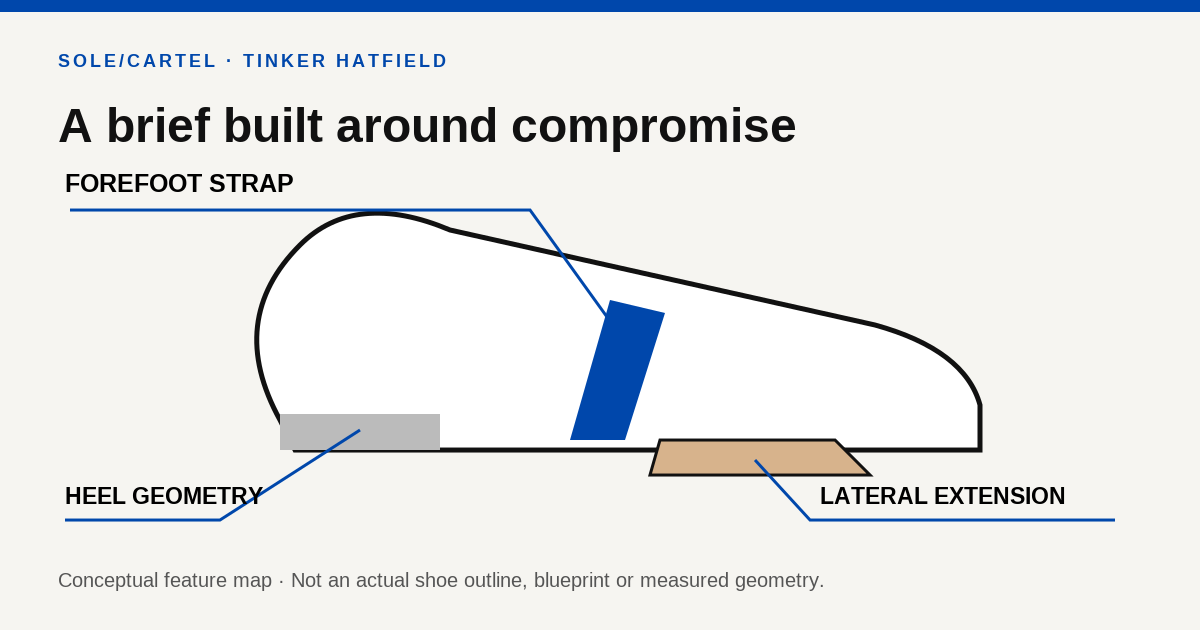
Nike describes a mixed gym brief, with a strap, raised collar and sole extension intended for containment and support. These are intentions rather than independent performance findings. Nike Japan
Hatfield remembered court heels around 8 mm and running heels at 12–15 mm; he sought an intermediate solution. These are recalled reference points, not a measured Trainer specification. Nike Japan
The significant word is intermediate. The brief did not ask for the most emphatic version of either endpoint. It asked the designer to decide how much of each proposition a single shoe could retain. This gives the design a more demanding identity than a shoe that happens to be worn for different activities: the conflict belongs inside the development problem.
Our interpretation is that the tradeoff gives the Trainer a productive tension. A specialist can concentrate the brief around a narrower use. A generalist has to account for disagreement among uses. The resulting decision is not automatically better or worse; its merit depends on whether the chosen balance suits the intended session. That makes the practical limits part of the idea, rather than an embarrassment to be hidden by the word versatility.
A workout is a sequence. Thinking about its transitions produces a different brief from thinking about one isolated movement. The person changes direction, pace, equipment and intention. Their shoe remains the interface between the body and whichever surface comes next. The design question becomes how much variation that interface should accommodate before a different tool is preferable.
There is an everyday intelligence in that question. The inconvenience of changing equipment can sound minor beside the language of elite performance. Yet convenience belongs inside the brief. Carrying, storing and selecting tools are parts of using them. An improvement can be important because it removes a decision or interruption, even when it does not set a new technical record in any individual task.
This is our reading of the Trainer's proposition, rather than a claim that every gym user experienced an identical problem. A complete history of consumer adoption would require evidence from purchasers, retailers and training environments that is not present in the design recollections alone. The distinction leaves room for an ordinary customer whose reasons differed from the designer's.
It also prevents a common historical shortcut: imagining that an activity did not exist until a company named a category after it. People can combine exercises without buying a product described as a cross-trainer. A commercial category makes that combination visible in a catalog. It gives the retailer a shelf, the company a development brief and the customer a name. That process can be consequential without being the literal invention of mixed exercise.
The Air Trainer is best examined at that junction between an existing behavior and a newly legible product proposition. Calling it a category-making design is an argument about organization and communication. Calling it the first shoe ever used for multiple activities would require a much broader historical demonstration.
The architect's practical education
In his 2019 Cooper Hewitt interview, Hatfield described studying architecture and testing shoes for Bill Bowerman at the University of Oregon. He also characterized his design recognition as shared with collaborators. These are the designer's own retrospective accounts, useful for understanding how he explains his working formation. Cooper Hewitt's Q&A
A named colleague belongs in this account. A caption accompanying designboom's 2014 interview with Mark Parker credits the 1987 Air Trainer One as designed with Hatfield. The caption supplies shared credit without allocating individual components. Parker interview and product caption
At WIRED25 in 2018, Hatfield identified Parker as developer on the original Trainer. This participant's recollection supplies a role, not a complete production-team record. WIRED25
The distinction improves the shoe's history. A proposal needs more than a recognizable sketch to become an object that can be made. The credited developer belongs between the idea and the manufactured result. We should not invent who selected a particular material or solved a particular tooling problem, but neither should the absence of that detail erase the person whose contribution is named.
Parker describes exchanges with Hatfield, Eric Avar and athletes about needs and motivations. These concern broader practice; they do not establish which conversation produced a particular Trainer component. Parker on design conversations
Parker traces his design interest to distance running, modifying shoes and keeping a sketchbook. His account places him within making and discussing products before the later executive role. Parker's account of his formation
This gives the chapter two routes into footwear. Hatfield's architectural education and athlete experience meet Parker's account of running, modification and drawing. We need not treat those routes as identical to recognize the conversation they make possible. A development partnership can bring different habits to the same proposal. In the Trainer's case, that is a more useful picture than imagining a fully resolved object passing from a lone designer's desk directly into a player's equipment bag.
The collaborators also change how the architectural inheritance should be read. It provided Hatfield with a way to organize a proposal; it did not supply every answer needed to construct one. In this case, the author of the organizing idea and the developer can remain visible together. The result is a more credible account of how a new category acquired a physical form.
Reading the visible hardware
For a specific modern reference, Nike's Chlorophyll listing identifies the Air Trainer 1 as Hatfield's 1987 design and connects its palette to his gym. The page names the forefoot strap, leather and Air cushioning for SKU DM0521-100. It presents a modern release, so its materials description should not be transferred automatically to an original pair. Nike SNKRS, DM0521-100
A closure can perform two jobs in the viewer's understanding. It fastens the product, and it tells a story about fastening. The strap makes an action apparent: this is something the wearer can tighten across the front of the shoe. That visible action is easier to grasp than an invisible claim about performance. It supplies a readable symbol of preparedness.
The symbol must still be separated from the result. Seeing a strap does not reveal its tension, its interaction with the underlying upper or how it behaves on a particular foot. A photograph cannot settle whether the closure creates an improvement under a specified load. An explanatory diagram should therefore label the part and the intended role, rather than drawing arrows that pretend to represent measured forces.
The same discipline applies to the collar and sole. Silhouette can establish where an element is placed and how it relates visually to neighboring elements. It cannot, by itself, disclose stiffness, chemical composition or resistance to movement. Those require physical examination, specifications or testing appropriate to the question.
This distinction makes the Trainer more interesting to look at. Instead of assigning each visible feature a guaranteed benefit, the viewer can ask what problems it appears to address and what evidence would establish success. The object becomes a proposal that can be investigated, rather than a list of features that must be accepted.
The palette offers a different type of reading. A color relationship can make separate components feel like a coherent system. Small accents can direct attention without covering the whole upper. Such observations describe visual organization; they do not prove why every purchaser liked the shoe. Design history needs room for a product's formal qualities without converting aesthetic judgment into a sales statistic.
The tennis detour, with the date left open
There is a date conflict worth retaining. Complex says 1985. Complex Nike also describes grass- and clay-specific versions. Exact first appearance remains unresolved. Nike Japan
A release year and an athlete's first appearance answer different questions. Retail introduction concerns availability to purchasers. Prototype use concerns development and exposure before or around that introduction. An event photograph adds a third question: what precise version was being worn? Combining all three into one date produces a cleaner caption and a weaker history.
That weakness matters because the pre-release episode changes the interpretation of the design. An athlete's adoption can be evidence that a proposal traveled beyond its original brief. It can also show how much further adaptation was needed. The version in the athlete's hands may be related to the retail shoe without being an interchangeable specimen of it.
Surface-specific variants are particularly instructive. They suggest that the promise of a versatile platform can coexist with specialized interfaces. The upper-level concept and the details of contact with a surface need not have the same degree of generality. A family resemblance does not erase meaningful differences underneath.
That boundary blocks another seductive inference. A champion wins while wearing a shoe; the shoe becomes associated with winning; the story then quietly treats the shoe as the explanation. The result is an endorsement narrative disguised as causation. An athlete's skill, preparation, opponent and circumstances remain part of the outcome, whether or not the footwear was helpful.
McEnroe's adoption is historically important without that exaggeration. It gives the product a visible human interpreter. The wearer can make an unexpected choice and thereby enlarge the audience's understanding of what the object might be. The design has entered culture when its meaning can no longer be supplied entirely by its maker.
Bo Jackson and the scale of the idea
Jackson's sporting credentials need no invented superlatives. The Baseball Hall of Fame records his major-league debut in September 1986 and his July 1987 agreement with the Raiders to play football after baseball season. His professional movement between sports gave versatility a concrete human reference. Baseball Hall of Fame's career history
The career record also places his Raiders seasons in 1987–90 and his Pro Bowl selection in 1990. The two professional schedules were not an advertising invention. His sporting life made the movement between disciplines a publicly documented fact before it became an easily repeated campaign premise. Baseball Hall of Fame's career history
This does not mean a training shoe replaced the equipment required for either professional sport. The useful connection is preparation across activities. A football player can be depicted outside a football game, just as a baseball player can train away from the diamond. Treating the person as evidence of an athletic identity is different from treating every object associated with him as competition equipment for both sports.
The Hall separately preserves his 1989 All-Star Game cap and records his MVP performance on July 11. That is an identifiable artifact tied to an identifiable event, independent of a footwear campaign's account of itself. Baseball Hall of Fame's artifact history
The museum's account gives the event its own sequence: Jackson led off the American League's first inning with a home run and added a single and an RBI groundout in the 5–3 win. Its recorded home-run distance is 448 feet. The sporting performance and the surviving cap give this moment a history apart from the commercial broadcast. Baseball Hall of Fame's All-Star account
The athlete's action and the advertiser's timing met in the same public occasion. Neither should be mistaken for the other. A campaign can benefit from an outstanding performance without having caused it; a performance can enlarge the reach of a campaign without identifying which shoe a viewer later remembers. That separation is essential when reconstructing why a footwear category acquired a famous face.
The advertisement debuted during that broadcast. Washington Post
These records do not make the Air Trainer 1 Jackson's personal signature model. Athlete association, an advertising platform and a specific model's identity should remain distinct. For this chapter, Jackson's role is the later enlargement of the cross-training idea. A full model-by-model history of the footwear associated with him would need its own documented chronology.
Our interpretation is that a versatile athlete offers advertising something a product diagram cannot: a way to make the premise memorable before a customer has studied its construction. The person's public identity becomes a shorthand for the category. That can be powerful because it makes the abstract proposition feel concrete. It can also obscure the object, leaving a strong recollection of the athlete and a vague recollection of which shoe appeared where.
Collectors confront that problem whenever a familiar nickname is applied loosely across related products. A name may preserve a real association while failing to identify a particular model. It is useful cultural evidence and incomplete catalog information. Both statements can be true at once.
The distinction is especially important in a historical series centered on a designer. The designer develops an object within a company. The athlete supplies experience and public visibility. Advertising turns the relationship into a comprehensible story. Customers then remember, reinterpret and circulate it. Credit should follow those different kinds of work rather than collapsing them into one heroic author.
A category can outlive its first solution
Nike's May 2009 announcement for a new Trainer 1 invokes McEnroe and Jackson, describes DiamondFLX, an inner sleeve, lacing-connected overlays and heel Max Air, and plans U.S. availability for July 1. These specifications belong to 2009, not 1987. Nike's launch announcement
The launch event's athletes were Adrian Peterson, Larry Fitzgerald, Troy Polamalu, Brandon Roy, Amar’e Stoudemire and Bryan Clay. They helped lead more than 50 local young people through a workout. Nike's launch event
This was a different way to make the category visible. The original history contains an unexpected adopter; the later event deliberately assembled a multisport group. The contrast does not prove that development itself became more controlled. It shows two documented ways an audience could encounter the same broad proposition: one athlete discovering an unplanned use, and a company staging a shared activity around a new product.
The change in product vocabulary matters alongside the change in cast. A closure has to be explained through the action it allows and the relationship it creates between wearer and upper. A company can preserve the idea of preparing an athlete while choosing a different way to communicate readiness. Naming a new component does not, by itself, establish that the training problem has disappeared.
Our reading is that a category can persist through such changes because its brief is more durable than any individual implementation. The name connects the products, but the name does not make their specifications interchangeable. Air Trainer 1 and Trainer 1 need separate entries in a collection record. That distinction allows the lineage to remain visible while preserving what changed.
A retro poses a third relationship to the idea. It can return to an earlier composition rather than offer a wholly new answer to the training brief. Its historical value may reside in that return. This is why the collector's comparison should start with the exact edition and the qualities actually documented, instead of assuming that every object in the lineage makes the same practical promise.
What the archive can and cannot supply
Vitra Design Museum's Nike exhibition drew heavily on the company's archive, presenting design studies, prototypes and other development material while emphasizing athletes' contributions. Its institutional account describes a collaborative design culture rather than a collection of finished silhouettes alone. Vitra Design Museum
Within that archive-led approach, the Trainer presents several distinct objects of interest: the mixed-workout proposal, the unexpected tennis adoption, surface adaptations, later advertising and modern editions. They belong to one lineage without answering the same question. The proposal concerns intention; the athlete's choice concerns use; a retro concerns the later life of a recognizable design.
The unresolved first-appearance date therefore does not erase the history that can be told. It limits one caption. We can still distinguish the gym brief from the tennis detour, and the retail introduction from the later enlargement of the category. A chronology that admits an open question can remain useful if its other entries identify exactly what happened and what kind of event they record.
For this series, the Air Trainer is a particularly important bridge. It places the athlete inside the process as more than the recipient of a finished answer, and it gives development a named collaborator. The shoe's cultural identity emerges through those relationships. The same object can be understood as a practical proposal, a player's choice, an advertising reference and a collected design, with no single perspective sufficient to explain the others.
Compact chronology
| Date or period | What the date identifies | Evidence boundary |
|---|---|---|
| Before retail introduction | McEnroe prototype adoption | Exact first appearance unresolved; retrospective accounts conflict. |
| 1987 | Retail introduction | Nike retrospective; not prototype date. |
| July 1987 | Jackson signs with the Raiders | Agreement provides for football after baseball season; not a shoe launch. |
| July 1989 | Jackson's All-Star MVP | Sporting context, separate from footwear identification. |
| 2009 | New Trainer 1 announced | Later product; separate specifications. |
| Modern retro editions | Historical form reinterpreted | Identify exact SKU before comparing construction. |
What survives in the shoe
Nike's Limestone and Valerian Blue release, DM0522-200, explicitly describes suede, a forefoot strap, heel Air cushioning and a mid-cut collar. Beside the leather description for DM0521-100, it provides a concrete example of why a model name alone does not identify an edition's upper material. Nike SNKRS, DM0522-200
The useful comparison begins with an inventory. Identify the pair, its labels and its provenance. Record the closure, panel relationships, collar profile, outsole pattern and visible condition. Establish which historical reference is being used. Then say exactly which similarities are observable and which differences remain unmeasured.
No original specimen was handled for this article, and no retro was tested. The named modern editions are documentary references, not a claimed physical comparison with a verified 1987 pair. That limitation prevents photographs from becoming a stand-in for examination. It also leaves a clear next step for a specimen-led sequel: obtain documented examples and compare them under an explicit method.
What can already be collected is the logic of the design. A visible fastening system turns preparation into an action. A multisport brief makes transitions part of the problem. An unexpected wearer complicates the maker's intentions. Later editions keep the recognizable proposition in circulation while inviting different uses and interpretations.
The best historical reading of the Air Trainer 1 holds those threads together without demanding that it defeat every specialist shoe. It matters because it made a useful compromise intelligible. It gave a varied session a coherent product idea, and gave athletes and audiences enough room to make that idea larger than its initial brief.
Source notes
Sources were checked on October 10, 2026. Nike's origin narrative and athlete recollections are retrospective corporate testimony; they are attributed accordingly. The institutional sporting records establish career and event context, not footwear identification. Parker’s shared credit and developer role are attributed to separate caption and participant records. Modern SNKRS pages establish their named editions, with no current availability or price claim. The prototype-date discrepancy remains unresolved. Formal and cultural interpretations are the editorial desk's analysis, not measured performance findings.
For documentation practice, see Sole Cartel’s condition-record guide.