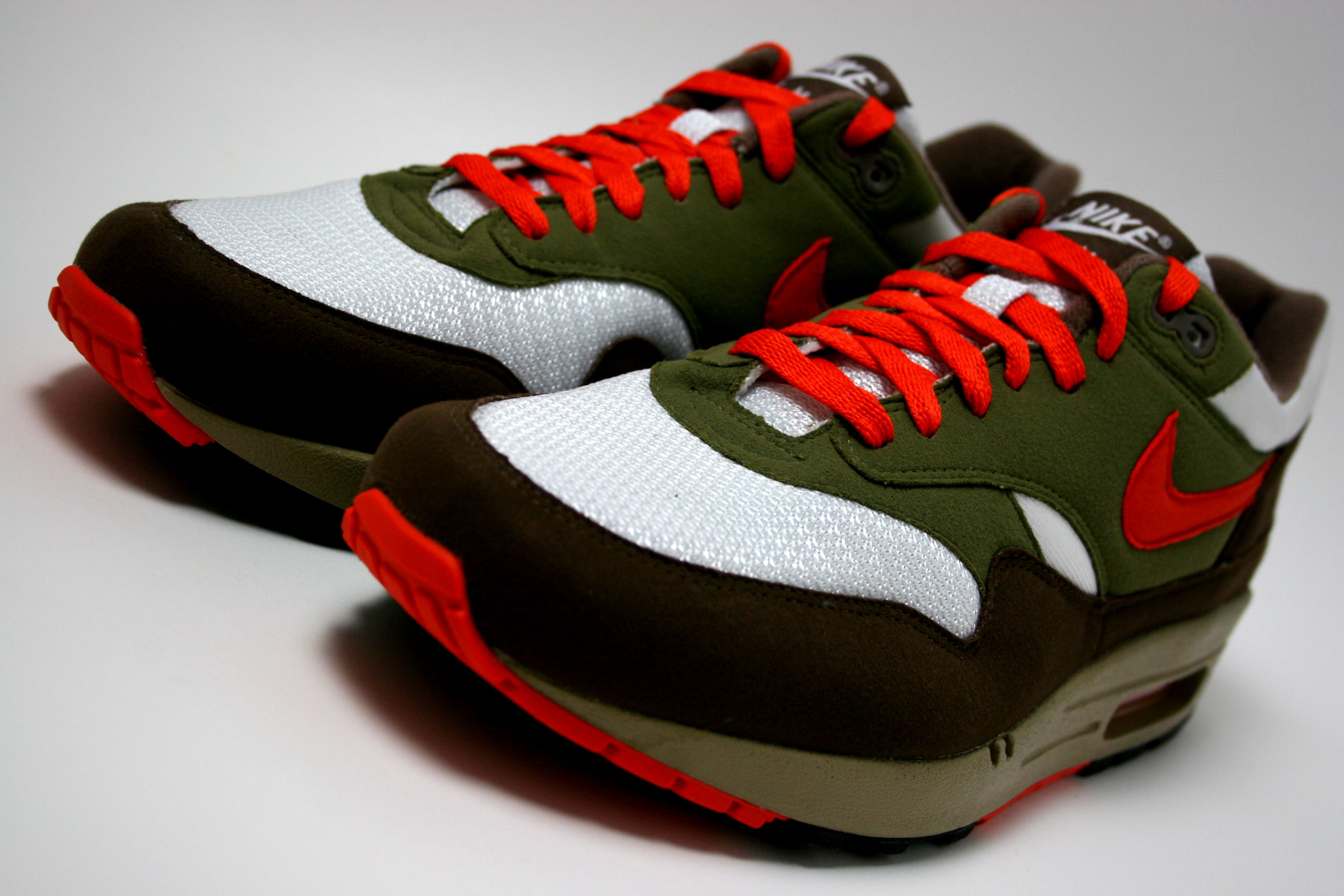
A drawing can keep two different times inside it: the moment someone proposed an object and the later moment when the object became available to other people. Vitra Design Museum’s exhibition page identifies a Tinker Hatfield Air Max sketch as 1986. The shoe that made visible Air a public proposition belongs to 1987. The distinction is small enough to disappear in a caption and important enough to shape how a collector understands an entire release. Vitra Design Museum, Nike: Form Follows Motion
Start there, with a documented drawing rather than an imagined flash of genius. A sketch can record an intention. A production shoe records a series of decisions about how much of that intention could be manufactured, sold and worn. The window in an Air Max heel is an unusually effective place to observe the distance between those two things.
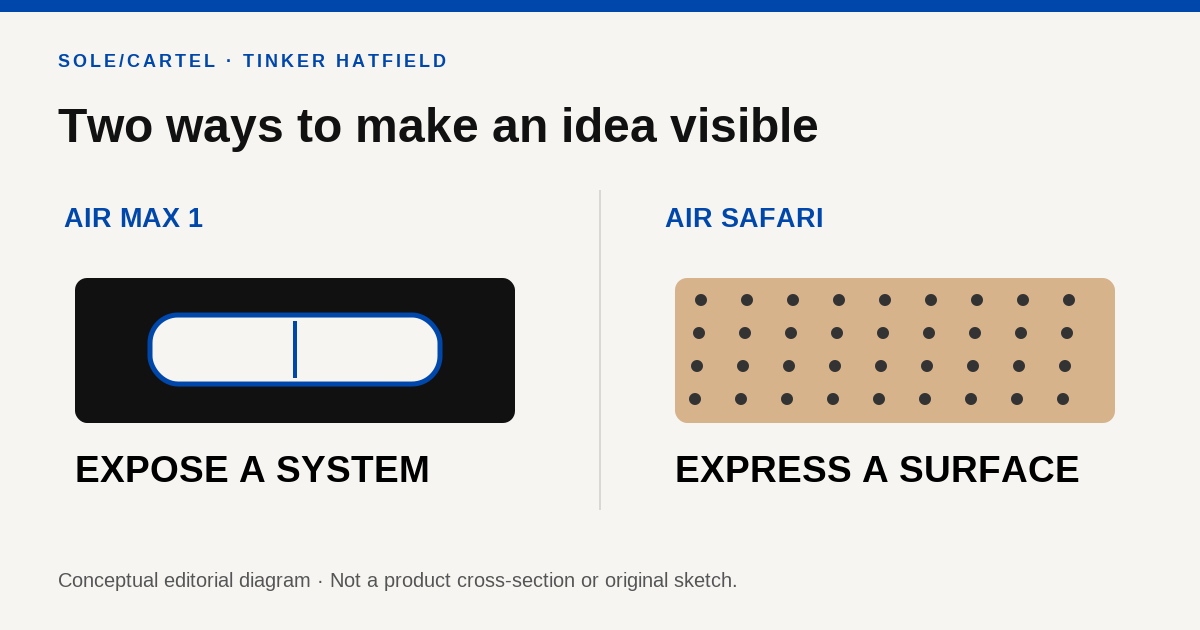
Beside it sits the Air Safari, another Hatfield design with a conspicuous spotted surface. The two shoes offer an unusually useful comparison. One makes a technical component available to the eye; the other makes a surface carry associations beyond sport. Their shared year does not make their arguments interchangeable.
Read together, they suggest a broader change in the designer’s task. A shoe could have a functional reason to exist and a visual argument about why anyone should care. That argument did not have to wait for an advertisement. It could be built into the object.
Air existed before the window
Hatfield did not invent Nike Air. The antecedent belongs to engineer Frank Rudy and a development effort that preceded the Air Max 1. Vitra’s published catalogue excerpt describes Rudy bringing his concept to Nike in 1977 and working with in-house engineer Joe Skaja on manufacturing pressurized bags and enclosing them in foam. It identifies the Tailwind’s debut at the 1978 Honolulu Marathon. That is a history of technical development before it is a history of exposed technology. Vitra Design Museum, Designing with Air, catalogue excerpt
This sequence changes the question. The Air Max problem was not simply how to put air in a shoe. It was how to give an existing cushioning idea a visible form that people could recognize and understand. Nike’s Department of Archives describes the challenge explicitly: the company had Air technology but needed a way to expose the bag from outside the footwear. Its account also places Hatfield’s earlier work in offices, showrooms and stores after he joined Nike in 1981. Nike, The History of the Air Max 1
An opaque sole requires an explanation: there is something inside this shoe that is worth paying attention to. A window supplies a visible referent for that explanation. The reader of the shoe can point to it. Even someone unfamiliar with cushioning terminology can distinguish a transparent opening from the material surrounding it.
That is a communication advantage, not an independent measurement of performance. The window makes a component legible while its behavior remains dependent on engineering that is largely hidden. This is part of the design's interest: a carefully selected view can make a complicated object understandable without showing everything inside it.
On the drawing board
Look closely at the original drawing reproduced by Vitra. It places a lateral profile beside a heel view, with red areas and handwritten instructions around both. One annotation asks for a sleeker mudguard because the submitted samples were too thick. Another rejects sample lacelocks as too square, with holes too large. These are observable marks on a development artifact the museum dates to 1986; they are not reconstructed dialogue. Vitra, press-image record, item 19
The notes show criticism of something already translated into samples. Our interpretation is that the Air Max's visual identity was being negotiated at several scales: the broad outline mattered, but so did a small piece of hardware and the thickness of an edge. A conspicuous innovation did not eliminate ordinary refinement.
There is a useful friction between the image and the famous origin story. An architectural encounter explains a possibility; annotations explain what had to be reconsidered after a possibility became a developing product. Both belong in the history. The latter gives the finished shoe its specificity. A window alone would not settle the proportions of everything surrounding it.
The building was already making an argument
Hatfield has repeatedly attributed the visible-Air idea to the Centre Pompidou in Paris. In a 2013 interview, he connected the building’s exposed systems with his desire to help people understand the Air technology in a running shoe. In that telling, the building was a prompt for storytelling through design. It remains a retrospective account by the designer, rather than a contemporaneous diary of the visit. Designboom, interview with Tinker Hatfield, August 7, 2013
The architectural reference has substance independent of Nike’s version. The Centre Pompidou describes the building by Renzo Piano and Richard Rogers as an exposed arrangement of systems, with blue for air-conditioning, yellow for electricity, green for water and red for the movement of people. The exterior escalator is part of the building’s public identity. These visible components help organize how a visitor reads the structure. Centre Pompidou, An iconic architecture
The useful comparison is one of selection. A building cannot display every operation with equal clarity; neither can a shoe. Each must decide which parts deserve attention and how the surrounding form will direct that attention. Transparency by itself is not an explanation. A transparent panel placed arbitrarily could disclose a jumble. A deliberately framed panel can turn one component into the thing a viewer remembers.
This is Sole Cartel’s interpretation of the relationship: the Air Max window operates as a small exhibition inside a wearable object. It gives the cushioning unit a location, an edge and a contrast with the solid body around it. The viewer is invited to look through the sole rather than treat it as an undifferentiated block. That reading describes the design’s visual effect; it does not claim Hatfield used those words or that every wearer experienced it that way.
There is also a limit to the architectural analogy. The shoe is not a miniature Pompidou, and mapping every colored panel to a Parisian service pipe would turn a useful connection into an unsupported code. The documented relationship concerns the decision to reveal a system. Beyond that, formal comparisons are critical readings, not recovered design instructions.
Nike returned to the association in July 2024 when it announced its Art of Victory exhibition at the Pompidou. Hatfield again credited the architecture, emphasizing the willingness to make a conspicuous, disruptive design. The partnership is evidence that Nike continued to cultivate this origin story decades later. It does not independently verify every detail of the original visit. Nike, Pompidou partnership announcement, July 13, 2024
The opening needed a team
The celebrated designer is easier to remember than the development chain. Yet the window is precisely where a lone-author account becomes inadequate. A drawing can propose an opening. Making that opening work in a manufactured sole requires other expertise, other judgments and other people.
Mark Parker belongs in this account as a collaborator, rather than appearing only as a later executive who recognized Hatfield’s brilliance. Designboom’s 2014 interview with Parker identifies the 1987 Air Max One in an accompanying caption as designed with Hatfield. The same interview describes Parker’s combination of running and design interests. It supports a shared credit; it does not furnish a complete division of every task on the original shoe. Hatfield also describes working and debating with Parker in a separately published 2013 interview. Designboom, interview with Mark Parker, February 13, 2014
Rudy’s cushioning concept, Skaja’s early development work, Hatfield’s visual direction and Parker’s collaboration answer different questions about authorship. Conflating them into one invention obscures what each contribution made possible. The Air technology had a history before the window; the visible shoe needed a design and development history of its own.
A collector can apply that distinction to the object itself. The shape visible in profile is only one layer of evidence. A development drawing, an engineering record, a dated advertisement and an unworn pair would each disclose something different. No single artifact replaces the others. A handsome sketch cannot establish the final material specification. A surviving shoe cannot, on its own, explain who proposed its most important feature.
Hatfield himself described his 2019 Cooper Hewitt recognition as shared with collaborators at Nike and Jordan. That later statement does not name the entire Air Max team, but it offers a useful corrective to treating every project as a solitary achievement. Cooper Hewitt, Smithsonian Design Museum, Q&A with Tinker Hatfield, September 26, 2019
The value of shared credit is practical as well as ethical. It makes the design more interesting. Instead of a miraculous solution arriving complete, the shoe becomes a negotiated object: a proposal brought into contact with manufacturing limits, intended use, visual identity and commercial judgment.
The first window was not the settled window
The modern Big Bubble story complicates the idea of a fixed original. Nike dates the earliest release to March 26, 1987, despite the reissue's “’86” name. Its retrospective says cold-related cracking prompted engineers to reduce the window's height and length and change the Air unit. Nike also says a CT scan informed the reconstruction. Those are company accounts of production and reconstruction, with no original test report supplied. Nike SNKRS, DQ3989-100
The episode makes the opening more revealing historically. A visual signature could also be a variable under revision. The version familiar to a later viewer need not have been the first one offered. That sequence gives a collector a more interesting question than whether a shoe is simply authentic or inauthentic: which stage of the design's development does it preserve?
Reconstruction adds another stage. Returning to an early configuration is an editorial decision about the past. It selects a particular moment as worth recovering, then turns that selection into a new object. The result can broaden understanding even when the product name compresses the chronology. It can also make the archive commercially useful. Those purposes coexist in the same pair of shoes.
For a collector, “closer to the original” therefore needs an object attached to it. Closer to which production version, in which feature, and according to which evidence? A larger window may move toward one early detail while other parts belong to the modern manufacturing context. Those statements can both be true.
The attraction of a retro often lies in this tension. It is a contemporary object that invites the owner to think historically. The danger comes when the invitation is mistaken for time travel. A date in a product name is a claim about ancestry, not the actual manufacture date of the pair in the box.
The enlarged opening also changes the visual balance of the sole. As a matter of design interpretation, a window works partly through the amount of solid material that remains around it. A wider aperture gives the enclosed component more prominence; a smaller one gives the surrounding body more visual weight. This is a relationship between positive and negative shape, not a measurement of cushioning volume.
That relationship helps explain why apparently small retro differences attract sustained attention. An opening has an outline, but it also changes the apparent mass of the structure that holds it. A collector interested in proportion is therefore studying a real part of the design, even when the difference cannot be translated into a performance ranking. The useful criticism names the visible relationship and lets it matter on its own terms.
A sofa supplied a different kind of visibility
Nike's 2024 retrospective traces the Safari reference to a New York furniture boutique and a sofa with ostrich print. It presents the 1987 shoe as an experiment in making athletic footwear non-athletic. This is a brand origin account, not a contemporaneous record or an original material specification. Nike, Safari retrospective, July 24, 2024
The distinction between an association and a specification is central here. A surface can evoke another material and another setting without duplicating the object that supplied the reference.
Our interpretation is that the Safari takes something associated with another category of object and moves its visual charge onto footwear. Upholstery can suggest a room, leisure, display and the status of a possession. On a shoe, a related surface becomes mobile. The reference need not be consciously recognized for the contrast to work, although we cannot recover what an individual customer thought from the pattern alone.
The comparison with Air Max is sharp. One design asks the eye to look inward. The other asks it to stay with the skin of the object. One presents a component as evidence of technical content. The other uses an expressive covering to complicate the identity of a familiar form. Both depend on making a difference visible, but the difference means something different in each case.
Reading the Safari without borrowing its advertising
A named modern edition supplies a narrower construction reference. Extra Butter's HM3818-001 listing specifies a leather base, rubber outsole and Black/Monarch/Light Iron Ore palette. It supports those details for the listed edition; it supplies neither a verified global launch day nor an original 1987 specification. Extra Butter, Air Safari HM3818-001
The following reading concerns the design idea rather than an authenticated specimen. Pattern and solid color offer different kinds of visual information. A repeated mark can make an area seem textured; an uninterrupted field can give the eye a pause. Their relationship matters because expressive footwear need not put every available element at maximum intensity. A memorable treatment can be powerful through its placement and contrast, without becoming the whole object.
A repeated surface treatment also invites a different kind of attention from an opening in a sole. Close viewing favors individual marks; a more distant view can merge them into a field. Whether the effect seems refined, eccentric or busy is a judgment the design leaves open. The historical significance does not require us to pretend the taste question has one correct answer.
The Safari consequently tests sneaker history's tendency to translate every difference into technical progress. A shoe can matter because it expands the available vocabulary. Its contribution may be an association rather than a measurable capability. The design asks whether an athletic form can become a desirable possession through the meanings carried by its surface. That question gives fashion and pleasure legitimate places in the history, alongside engineering.
It also leaves room for disagreement. The same reference might suggest sophistication to one reader and ostentation to another. We need not invent either customer's testimony to recognize the design's openness to such judgments. Taste becomes part of the problem a shoe addresses, and an object's ability to provoke a judgment can itself be worth studying.
A story the advertising could amplify
In a June 2013 interview published by Grailify, Hatfield connected the visible-Air narrative with Nike’s use of the Beatles’ “Revolution.” The interview also describes his exchanges with Parker and the difficulty of getting the design accepted. These are the participant’s recollections. They establish his later account of the relationship between object and campaign, without supplying a complete contemporary record of audience response. Grailify, interview with Tinker Hatfield, June 27, 2013
A contemporary record makes that relationship less tidy. TIME's May 18, 1987 report described a grainy Super 8 advertisement mixing professional athletes and amateurs, crediting Paula Greif and Peter Kagan as its directors. It recorded praise from advertising figures alongside objections to repurposing the Beatles' music for selling shoes. This is evidence of a public argument about the campaign, rather than a survey of sneaker buyers or a technical review of Air Max. TIME, Wanna Buy a Revolution?, May 18, 1987
That distinction changes how we understand visibility. A transparent heel could be framed by a song whose meaning was already contested and deeply felt. The product's novelty did not arrive in an empty cultural space. It entered a world of existing attachments, and borrowing those attachments could produce resistance as well as excitement. The advertisement offered a way to feel about athletic movement; viewers remained free to object to the vehicle carrying that feeling.
This is our interpretation of the historical juxtaposition. The shoe made an internal component into something a viewer could inspect. The campaign placed that inspectable object inside a larger emotional setting. Neither operation guaranteed the other's success. Admiring the silhouette would not require accepting the music choice, and disliking the campaign would not constitute evidence against the cushioning. Cultural meaning grows through precisely these uneven connections.
TIME's contemporaneous coverage preserves disagreement that later affection can obscure. Its selected comments establish a debate, not its prevalence or effect on buying decisions. No contemporary Safari review is established by the sources examined here.
The missing Safari record should remain visible. Today the two shoes fit neatly into a story about Hatfield's range, but a retrospective pairing is our editorial construction. We have evidence for their differing design premises and for a period debate around Nike-Air advertising. We do not have equivalent evidence of both shoes' original audiences. A history can make a strong comparison without pretending the surviving record is symmetrical.
Advertising also complicates the ownership of a design's meaning. Hatfield could propose an expressive object, engineers could make it viable, and a campaign team could connect it to athletic personalities and remembered music. Viewers then made judgments beyond any one contributor's control. This is how a shoe begins to exceed its specification: it becomes the meeting point of several forms of authorship, each with different powers and limits.
The afterlife of an opening and a pattern
In 2024, Nike announced a Safari-derived Electric Pack spanning 55 footwear styles, crediting Caroline Abero as colorway lead. That documented reuse measures the breadth of a company program, rather than affection among consumers. Nike, Electric Pack announcement, July 24, 2024
The later lead deserves the credit for the later work. A motif can have an originator and still require new decisions when it is placed on other shoes. Scale, contrast, surrounding material and the demands of another silhouette affect what the pattern does. Calling every descendant a Hatfield design would erase the people who transformed an inherited vocabulary.
The Air Max afterlife is similarly visible in the decision to recover an early window configuration and in Nike’s continued presentation of the Pompidou connection. These are forms of historical production: the archive helps shape a new object, and the new object directs attention back to the archive. The circuit can enrich knowledge while also serving a commercial purpose.
Museums add another venue for that circuit. Vitra’s Form Follows Motion drew heavily on Nike’s own archive and presented design studies, prototypes and Rudy’s development artifacts. Its institutional setting makes those objects available to a design-history reading, but the exhibition’s stated dependence on company holdings remains part of their provenance. Vitra Design Museum, exhibition overview
None of this requires the claim that sneaker culture began with one shoe. Collecting has many objects, communities and histories. The more precise achievement here is that these two designs offer unusually durable ways to recognize and retell a product: a window that points to an interior, and a surface that points elsewhere.
Chronology: ideas, releases and later interpretation
| Date | What the evidence identifies | Historical distinction |
|---|---|---|
| 1977 | Rudy’s contact with Nike, in Vitra’s catalogue account | Technical development before visible Air. |
| 1978 | Tailwind debut at the Honolulu Marathon, in that account | Nike Air precedes Air Max. |
| 1986 | Hatfield Air Max sketch captioned by Vitra | Drawing date, not retail release. |
| March 26, 1987 | Early large-window Air Max release, according to Nike SNKRS | Original release date; later revision follows. |
| 1987 | Air Safari | Model year in Nike's later account. |
| May 18, 1987 | TIME reports debate around Nike-Air advertising | Campaign reception, not a shoe-performance test. |
| 2024 | Electric Pack announcement | Later pattern reuse. |
| Modern edition; listing undated | Air Safari HM3818-001 | Exact SKU, no verified launch day here. |
The chronology brings together the Vitra catalogue, Vitra sketch caption, Nike Big Bubble history, Safari retrospective, Extra Butter listing and Electric Pack announcement. These are different kinds of record, not interchangeable timestamps.
Source notes
The building and sofa stories are attributed retrospective accounts. Nike’s retelling of a designer’s account is not an independent second witness. Corporate product pages establish what the company says about its releases; they are not independent performance tests. The original design readings here are Sole Cartel’s analysis. No original pair was physically inspected, no material testing was performed and no image-based authentication is claimed.
What survives in the shoe
For the collector, the first useful act is to identify the pair before interpreting it. Record its model, edition, style code and manufacturing context where the available evidence permits. Keep an early Air Max production shoe, a later conventional-window retro and the DQ3989-100 Big Bubble reconstruction as distinct objects. Keep HM3818-001 separate from an original; shared names and references do not collapse distinct production histories.
Then describe only what the evidence supports. A photograph may show the shape of an opening, the distribution of a pattern or a color relationship. It cannot settle the chemistry of a midsole, the pressure inside a bag, an undocumented repair or the remaining wearable life of an aged shoe. A source-backed comparison is more useful than an assurance that history has been reproduced perfectly.
What survives is also a way of looking. The Air Max directs attention to an engineered interior. The Safari asks a surface to carry a memory of another kind of object. Neither meaning exists wholly in the shoe: designers propose it, companies circulate it, later teams revise it and owners decide what deserves preservation. These objects became cultural artifacts through that continuing work. The pleasure of studying them is that the argument remains visible.
For documentation practice, see Sole Cartel’s condition-record guide.