
As an Oregon athlete testing Bill Bowerman's shoes, Tinker Hatfield supplied drawings with his feedback, he recalled at WIRED25 in 2018. WIRED25
The drawing exchange offers a useful place to begin a career usually introduced through finished sneakers. A wearer was describing what happened on his feet, and a coach was making something that could change. Before Hatfield's name became attached to visible Air, elephant print or patent leather, he had participated in a conversation about how footwear should work.
That experience did not make the later shoes inevitable. His path ran through an architecture degree, professional practice, stores and offices, and a design competition. Each stage added a different problem: how to understand movement, how to organize a built space, how to make a brand physically present and how to persuade colleagues that an unfamiliar shoe deserved development.
The architectural inheritance was more than a collection of striking buildings to borrow from. It was experience turning an intention into an object or environment other people would encounter. The famous Paris reference comes near the end of this chapter. Oregon, an injured runner's training shoe and a leaking Los Angeles storefront come first.
Oregon before the portfolio
The University of Oregon's alumni profile records a multisport background at Central Linn High School: basketball, football, hurdles and pole vault. Hatfield subsequently combined university athletics under Bowerman with architecture studies, earning his degree in 1977. After graduation, he practiced architecture in Eugene. His formal preparation was therefore broader than running and more specific than a general talent for drawing. Oregon's Hatfield profile
The sports matter without becoming a retrospective prediction of cross-training footwear. Basketball, a sprint hurdle and a pole-vault approach ask different things of the body. Hatfield had encountered several kinds of athletic movement before he had to organize shoes into commercial categories. That experience could give an athlete-designer conversation a shared starting point. It did not eliminate the need to learn what another athlete, with another body, required.
Architecture added another form of training. A drawing of a building has to organize entry, circulation, structure and the relationship between spaces. It is both an image and a set of decisions about use. Applied to footwear, that background suggests questions about how parts relate: where support is placed, how a foot enters, where the eye travels and which component deserves emphasis. These are comparisons between disciplines, rather than claims that a particular Oregon studio project became a particular sneaker.
Hatfield himself connected architecture school and Bowerman wear-testing when Cooper Hewitt interviewed him in 2019. Asked about mentors, he named his father, Bowerman and Phil Knight, assigning different lessons to their examples. He also treated the museum's Product Design award as recognition shared with the people around him. His own account of formation includes relationships alongside qualifications. Cooper Hewitt's direct interview
The chronology helps keep those relationships in proportion. Hatfield did not join Nike as a celebrated footwear author. Nor did he stop being an athlete when he became an architecture student. The two strands developed together, before paid architectural work gave him responsibility for environments beyond the studio.
Bowerman's workshop was a conversation
Bowerman's earlier work shows the kind of footwear culture Hatfield encountered. Nike's archival history describes the coach dismantling shoes, learning pattern-making from a local bootmaker and working around individual athletes' feet. One revealing episode concerns Kenny Moore in 1965. After a foot injury, Moore trained in an Onitsuka Tiger TG-22, a high-jump model mistakenly sold as a running shoe. When a stress fracture was identified, Bowerman took the footwear apart and pursued a different cushioning arrangement. He sent instructions and samples to Onitsuka that June; executive S. Morimoto replied the following month. Nike's Bowerman history
The episode predates Hatfield's college years. Its relevance is the established sequence of work: an athlete's problem, scrutiny of the existing product, a proposed construction and negotiation with a manufacturer. The account contains both an individual body and an industrial relationship. Bowerman could experiment locally, but the resulting shoe also had to pass through people who interpreted his instructions and made their own judgments about them.
That is a useful corrective to the image of the coach working alone with a household appliance. A clever prototype is one part of a much larger practice. Moore's case also makes the initial question unusually specific. It concerns a shoe used for an activity it had not been designed to support. The problem could not be resolved by deciding that all athletic shoes should simply look more modern.
Nike's history follows this work into the Tiger Cortez and identifies a 1967 catalog description of its cushioning. The source is a later corporate reconstruction, but the correspondence and catalog it identifies give the story an evidentiary route beyond a memorable anecdote. The Cortez development account
Wear-testing placed the future designer on the user's side of development. A bodily experience became something a maker could discuss. The future designer's role began on the user's side of the exchange, where fit and movement arrived as experiences before they became specifications.
A waffle sole needed more than a waffle iron
Another Bowerman development makes the gap between inspiration and finished footwear tangible. Nike's 2025 Moon Shoe history describes prototypes that broke down within minutes and others whose embedded wire cut athletes' ankles. Local machinists, tire shops and cobblers helped refine molds and materials. By the 1972 Olympic Trials in Eugene, Bowerman and Geoff Hollister were assembling small numbers of shoes by hand. The same history connects the later Waffle Trainer to runner Jon Anderson's request for a more substantial training shoe, and names orthopedic surgeon Stan James and podiatrist Dennis Vixie among its designers. Nike's Moon Shoe history
The failures are part of the design history. A surface pattern that offers an interesting answer to traction can still produce an inadequate shoe. The broken prototypes and exposed wire show different ways a promising idea could fail in use. Anderson's request then changes the brief again: a light experimental object and a substantial training shoe are not the same proposition.
Nike's separate artifact record preserves variation within the early work. It presents athlete prototypes with different uppers and outsole arrangements, and describes Bowerman's son Tom recovering the original waffle iron and test footwear from a family rubbish pit in 2010. It cautiously allows that a few pairs may have reached customers through the Eugene store in 1972. Nike's Moon Shoe artifact record
Those surviving objects complicate the clean silhouette suggested by a familiar model name. They belong to a development process in which forms were still changing. The recovered equipment adds another kind of evidence: not just what a shoe looked like, but something of how an experiment was made.
Hatfield did not design the Waffle Trainer. This history establishes what was already present before he entered footwear: athlete feedback, local fabrication, medical advice and manufacturing problems. His later contribution developed inside a company with those practices. Giving him credit for changing its design language should not require treating the earlier company as an empty space awaiting an architect.
Architecture was an actual job
Nike's archive dates Hatfield's arrival at Nike to 1981, with work on offices, showrooms and retail spaces. Nike's career account Product design followed in 1985, according to Oregon. Oregon's chronology Between those milestones, his job concerned the places where the business worked and where customers encountered it.
A store presents a different design problem from a training shoe, but it brings the product into public life. The visitor has to enter, find a route, recognize what is being offered and understand something about the company. Materials and spatial relationships shape that encounter. Architecture gave Hatfield a role in Nike's identity before he designed the footwear that would carry it.
Wilson W. Smith III belongs in this period. Oregon's 2018 institutional profile records that Hatfield hired the fellow architecture alumnus as an assistant in Nike's corporate architecture department in 1983. Smith subsequently followed him into footwear. The relationship began with buildings, not with the better-known tennis and basketball products of Smith's later career. Oregon's Wilson Smith profile
Smith supplies a concrete example of their architectural work. Recalling Nike's 1984 Olympics store in Westwood, Los Angeles, he described Hatfield's enormous Swoosh passing through the front facade. Rain followed the symbol into the store. Smith developed a transparent gutter to collect the runoff. This is a participant's later memory, with the design gesture and its practical consequence preserved together. Smith's CULTURED interview
The Swoosh was more than a sign attached to a wall. Crossing the facade made it part of the building's assembly. Its expressive effect created an additional technical obligation, and a colleague supplied the less conspicuous solution. That combination makes Westwood especially revealing: the work of establishing identity and the work of keeping water out happened in the same project.
In the same interview, Smith recalled designing a North Portland factory-store concept in 1984, with sharply angled interior details and Phil Knight attending the opening. That project was Smith's contribution; it should not become another Hatfield credit simply because the two worked together. Smith on the factory store
Together, these accounts describe an architectural department producing different kinds of retail environments. The Olympic store made a brand symbol into a conspicuous intervention. Smith's store account concerns a retail concept and its interior. Both required design at the point where the company met a visitor. Hatfield's years in that department therefore involved more than collecting a professional credential before beginning his supposedly important work.
Twenty-four hours and a different brief
The move into footwear had its own assignment. In a 2013 interview published by Grailify, Hatfield placed a design competition at the end of 1985 and identified Peter Moore as the creative director who set the problem. Entrants were to propose a sports shoe with an athletic story that also worked in everyday life. Hatfield recalled preparing a large presentation and his subsequent departmental move. The institutional chronology supports the transition year; the contest details remain his recollection. Grailify
At WIRED25, he described a 24-hour assignment and a proposal for running, walking and his scooter commute. He brought its large presentation in four pieces. WIRED25
The commute matters because a product brief can reach beyond the moments called sport. It makes the transition into footwear more specific than a story about drawing talent: Nike had asked an architect to consider how an athletic object would accompany someone through everyday life.
The presentation also connects the new assignment to his existing practice. The object being judged was a communicated proposal, not a publicly released model. Communicating the proposal was part of the design task. There is no need to invent a panel's expressions or a triumphant room to see the transition: a Nike architect was asked to apply his skills to a product problem and considered a user beyond organized sport.
This was an expanded brief, rather than abandonment of sport. Sport remained in the proposal; everyday use added demands beside it. The distinction anticipates a recurring question in the subsequent shoes. Does a product have one narrowly defined activity, or can its design organize several kinds of use? How far can a designer widen the scenario before the compromises become too great?
The contest shoe is not presented here as a lost retail model or as a direct prototype of Air Trainer 1. The exercise marked Hatfield's change of department. Its importance lies in what Nike asked him to consider before his recognizable footwear reached customers.
A company looking for a new argument
Nike's difficulties were real, but the later success of particular shoes can flatten the business context into a rescue story. A contemporary report gives that context firmer edges. On January 7, 1987, UPI reported Nike's announced results for the quarter ending November 30, 1986: revenue had fallen 21 percent and net income 47 percent against the comparable quarter. Knight said domestic footwear orders for delivery from December 1986 through April 1987 were down 35 percent. He also reported a domestic workforce reduction of approximately 10 percent. UPI's contemporary report
These figures describe a particular reporting period, after Hatfield's transition and before the 1987 releases. They do not prove why he was chosen, and they cannot assign a later recovery to one designer. They do establish that the search for a different product argument took place amid commercial pressure. A striking new shoe had to find an audience within that business, rather than in the retrospective certainty of a museum display.
The relevant historical tension is between continuity and change. Nike already possessed footwear expertise and recognizable products. New design could draw on those resources while questioning how the products should be presented and whom they should address. Innovation here did not mean inventing a company from nothing. It meant deciding what to do differently with an existing athletic foundation.
The first proposals widened the field
Hatfield's 2013 designboom interview supplies another piece of the early sequence: he recalled illustrating a marketing book for Geoff Hollister before his retail architecture work. Looking back at his arrival in footwear, he described nine designers and roughly as many developers. He associated the group strongly with running and characterized its approach as utilitarian. That last judgment is his assessment, rather than a neutral survey of everything Nike had designed. Hatfield's designboom interview
The marketing-book assignment adds a useful connection. Hollister appears in Bowerman's development network and again in Hatfield's account of his earliest Nike work. Illustration, retail environments and footwear were different assignments within overlapping relationships. The route into shoes was less isolated than the phrase “architect turned sneaker designer” suggests.
Hatfield named Air Max One, Air Trainer One, Air Revolution, Air Sock and Air Safari as early projects developed outside a conventional marketing brief. The list is his retrospective grouping, not a release-order ledger. Its range matters: cushioning could become visible, a training shoe could span activities, and surface treatment could give a sneaker a different expressive character. Hatfield on the early projects
The sequence gives 1987 a richer meaning than the arrival of one celebrated silhouette. These proposals pursued different relationships between athletic purpose and public appearance. The Air Max question concerned how a technology could be seen. The Trainer asked how one product could organize several activities. Safari brought a conspicuous surface into the conversation. Subsequent installments examine each argument on its own evidence, including the people needed to develop it.
The developers in Hatfield's account deserve to stay visible. Shoes were still material assemblies, with requirements a presentation could not settle. His contribution included choosing what the audience should notice; colleagues had to help make that organizing idea possible. A new aesthetic ambition increased the work of development rather than replacing it.
Looking at a building, reading a system
The Centre Pompidou is the best-known architectural reference in that early footwear work. Nike's July 2024 partnership announcement includes Hatfield's account of its influence on Air Max 1: the building's exposed systems helped suggest presenting Air visibly. It is an attributed origin account, told long after the design. Nike's Pompidou announcement
The building itself opened in 1977 and was designed by Renzo Piano and Richard Rogers. Its institutional architectural description explains the color code: blue for air, yellow for electricity, green for water and red for pedestrian movement. Placing systems and circulation outside also freed the interior for flexible use. The conspicuous appearance grew from an organization of space and services. Centre Pompidou's architectural account
Nike's Air Max history adds an essential technical qualification. Its engineers had investigated visible-Air prototypes in the early 1980s, before the product was ready. The archive describes Air-lab advances developing alongside Hatfield's proposals and making the eventual shoe possible. The public Air Max 1 followed in 1987. Nike's Air Max development history
Hatfield's other 2013 Grailify interview names Mark Parker as a participant in the Air Max work and describes repeated sketches, rough prototypes and disagreements between them. He estimated roughly three months to establish a vision for the shoe. The account does not divide every task between the two, but it places another designer inside the development process. The architect's proposal was being worked through with a colleague, while the engineering made its own progress. Seen in that sequence, the Pompidou encounter supplied an organizing reference for an extended project; it was not a finished shoe waiting to be copied from a building. Hatfield on working with Parker
Vitra Design Museum's exhibition documentation separately credits Frank Rudy with developing Air technology and proposing it to Nike. Its image captions identify a Hatfield Air Max sketch dated 1986. The technology, the drawing and the retail shoe belong to different stages of the history. Vitra's exhibition documentation
The connection between building and sneaker therefore concerns presentation as well as invention. Air was already a technical subject. Hatfield helped make it a visual subject around which a shoe could be organized. The museum's exterior and the sneaker's window are not equivalent constructions; their useful relationship is the decision to give a normally concealed system a public face.
His 2013 Grailify interview describes another part of that presentation: red framed the new midsole in the original red, gray and white composition, while gray supplied a quieter background. Color had a job within the design. Grailify
That brings the architectural formation into focus. A designer who had made a Swoosh cross a storefront now considered where a viewer should look within a shoe. A former wear-tester still depended on technical work and an athletic purpose. Those strands met in a product that could communicate before its wearer knew the engineering behind it.
What survives in the shoe
For a collector, this formation suggests a more precise question than whether a pair looks architectural: what does its arrangement ask us to notice? A window, a border or the relationship between layers can preserve a design argument even when later editions change the assembly.
Start with the exact object. A drawing, an original retail pair and a later interpretation occupy different places in that argument. Hatfield's 2015 discussion of Air Max Zero is useful: he described a contemporary interpretation of an older concept, using materials and construction unavailable when it was drawn. The 2015 product was a translation across time, rather than an untouched historical object finally manufactured. Hatfield on interpreting Air Max Zero
No pair was physically examined for this installment. This is a reading of documented design history, not an authentication or condition assessment. A photograph can identify a visible element without establishing its performance.
The early episodes make that reading more specific. Bowerman's feedback exchange asks what a shoe did in use. Westwood asks how a memorable gesture depended on a working detail. The competition asks how sport fits everyday life. Air Max asks how construction became communication. The next installment follows that final question into 1987, alongside Safari's different proposition about what a sneaker could express.
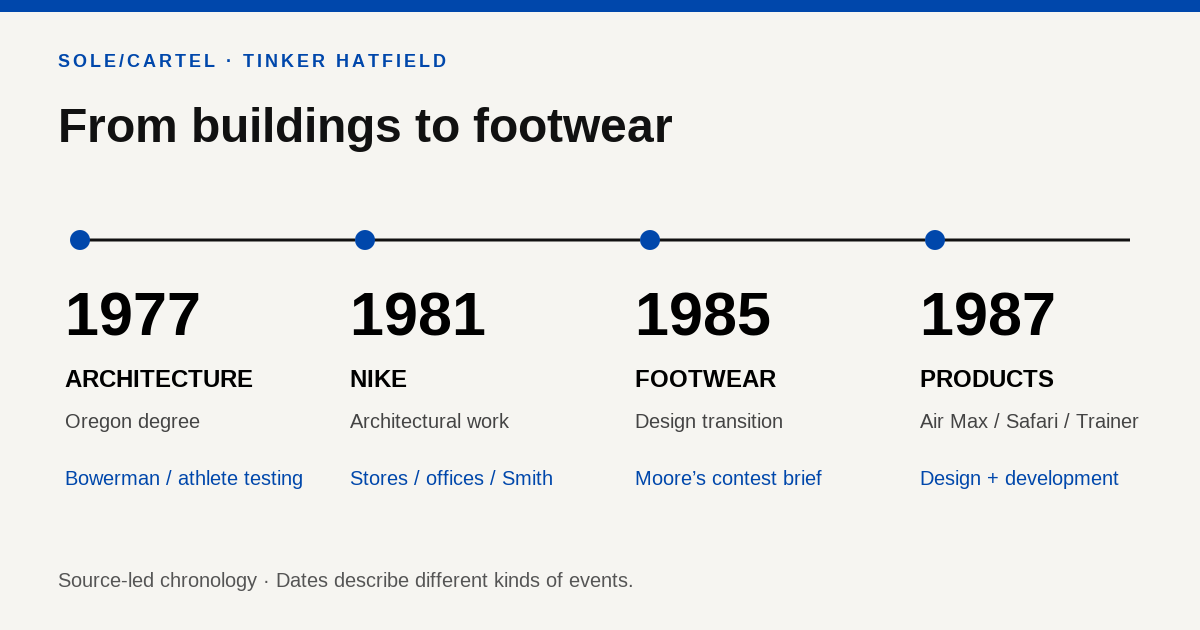
Compact chronology
| Date | Milestone | Evidence distinction |
|---|---|---|
| College years | Architecture studies and Bowerman wear-testing | Hatfield's later testimony; no dated test log examined. |
| 1977 | Oregon architecture degree | Institutional alumni record. |
| 1981 | Nike architectural employment | Institutional career chronology. |
| 1983 | Wilson Smith joins corporate architecture | Oregon's Smith profile. |
| 1984 | Westwood Olympics store | Smith's later project account. |
| 1985 | Product transition; contest placed at year-end | Institutional year; Hatfield's recalled contest timing. |
| 1986 | Air Max drawing | Museum caption; separate from retail. |
| January 1987 | UPI reports preceding quarter's results | Contemporary business context. |
| 1987 | Air Max 1 reaches the public | Nike product history. |
Source notes
Later testimony is attributed and repeated Hatfield interviews remain the same witness. The college injury chronology is omitted because accounts differ. The WIRED opening and contest capsule share a 100-word source allowance; no direct quotations appear. This chapter does not claim that the competition shoe became a named retail product. Nike's histories disagree on some early waffle dates, so the Waffle Trainer's release year is not asserted here. Photographs added for this review carry their own linked creator credits and licenses; an image’s appearance in a linked article does not establish permission to reproduce it. Detailed access records, source budgets and remaining gaps accompany this draft in its separate source notes.
For documentation practice, see Sole Cartel’s condition-record guide.