In Nike’s retrospective, Tinker Hatfield recalls waiting in a lake for a waterski boat. The neoprene bootie held his foot and ankle comfortably. He wondered what that enclosure could offer a shoe. Nike’s Huarache account.
That is a useful place to begin because it puts contact before appearance. A conventional drawing starts with the outline of a finished shoe. This account starts inside one: a material pressing against skin, wrapping a complicated shape without needing every boundary to be described by a seam. The design question was how much of the shoe could be organized around that immediate enclosure, and how the remaining structure would hold it in place.
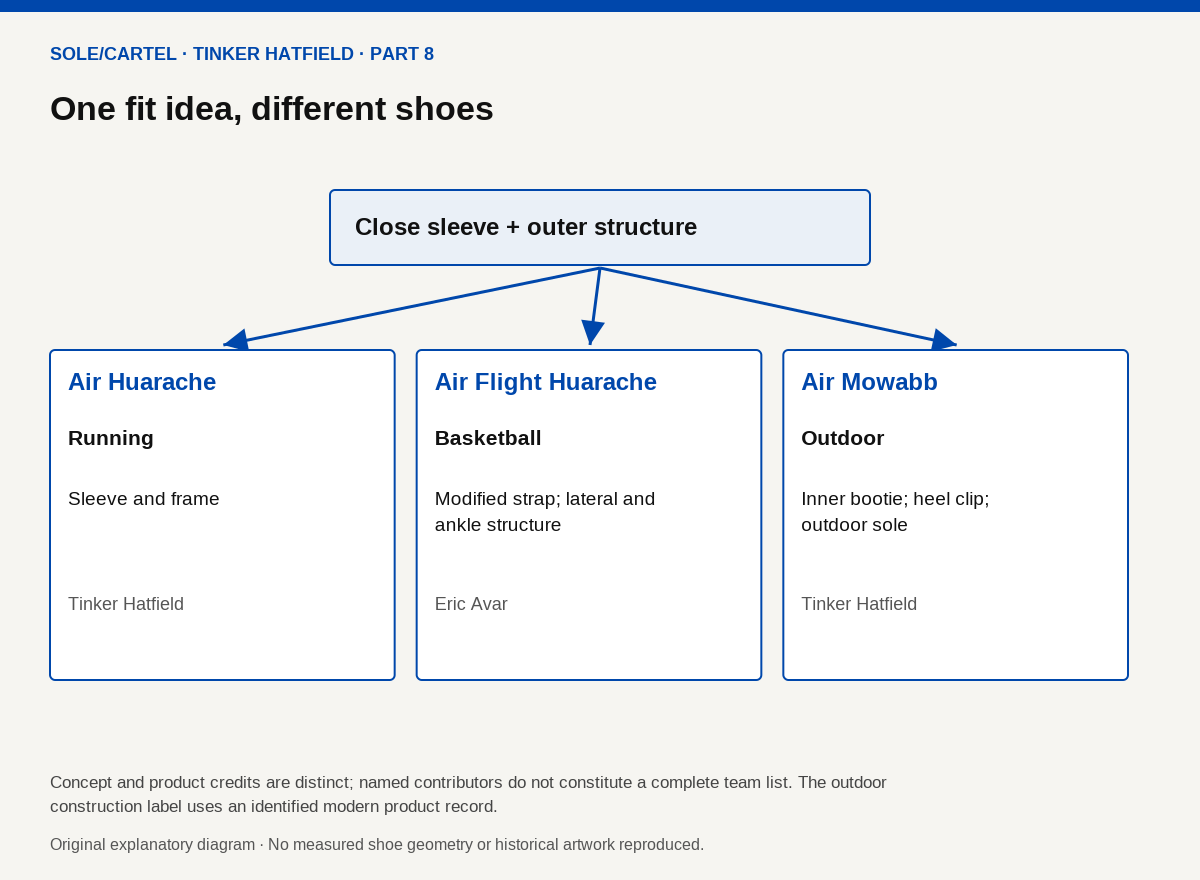
The resulting family matters because its members did different jobs. Running, basketball and outdoor movement put different demands on the same general idea of a close sleeve inside a supporting frame. Looking at the three together reveals both the strength and the limit of Hatfield’s proposition. An idea can travel further than one silhouette, but it travels through other designers, changed structures and new uses. The family resemblance is the beginning of the history, not the whole explanation.
A name with a history outside Nike
The name did not begin in a footwear laboratory. El Colegio de México’s dictionary defines a huarache as Mexican Indigenous footwear made with woven leather strips, with soles of leather or, in modern examples, tire rubber. Diccionario del español de México.
The Smithsonian’s National Museum of American History catalogues a leather huarache sandal dated to the 1940s. Its interwoven upper and Mexican manufacturing mark belong to a material history that predates Nike’s runner. The object’s catalogue number is CS.294440.062. Smithsonian object record.
That sandal helps clarify what a borrowed name can and cannot explain. Interlaced strips visibly produce an enclosure from separate elements. A close textile sleeve produces enclosure differently. There is a productive visual analogy between a foot held by a network of strips and a foot held by an external cage, but analogy does not establish identical construction or a direct chain of invention. Nor does the commercial success of a later branded shoe transfer authorship of the earlier footwear tradition.
A second Smithsonian record makes specificity even more necessary. The National Museum of the American Indian identifies cowhide sandals from Isla Tiburón, Sonora, as Comcaac, or Seri; they were collected in 1922. The documented techniques are perforating, lacing and tying. NMAI catalogue 11/2222.
These are different objects with different records. They should not be flattened into an imaginary universal Indigenous shoe. That distinction becomes relevant again when Hatfield discusses moccasins in the Mowabb’s development. A designer’s reference can be revealing while remaining selective. The interesting historical question is what he extracted from the reference, what the manufactured product changed, and whose work disappears when the reference is treated merely as a picturesque origin story.
The runner: enclosure becomes the structure
Nike places Hatfield’s sketches in 1990–early 1991. The design joined neoprene with an external skeleton. Hatfield recalls resisting a large side Swoosh because the shape was distinctive enough. Nike’s design history.
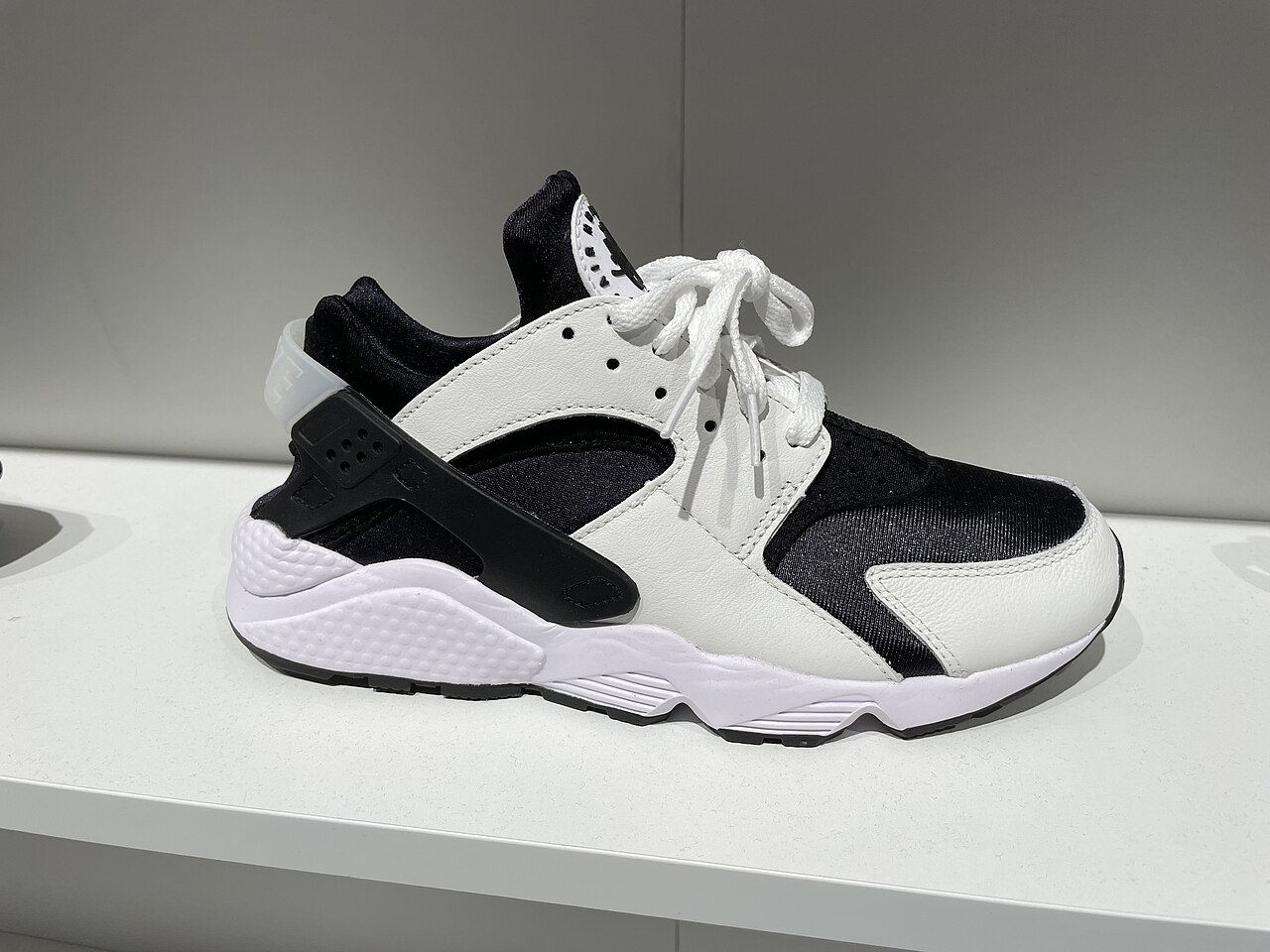
The change is legible in the relationship between the soft center and the firmer perimeter. The sleeve makes the shoe look occupied even without a foot inside it. The outer structure gives that soft volume a boundary. Rather than covering every part with an equally substantial upper, the design makes the division between enclosure and restraint visible. This is a different visual proposition from displaying a cushioning window: the main technological argument sits around the wearer, above the sole.
Removing a familiar large side mark raises the stakes of the silhouette. The frame, openings and contrasting surfaces must do more identifying work. That does not make the shoe unbranded. It makes construction itself part of the brand’s visual vocabulary. A viewer can recognize the relationship between the components before reading a label. The design’s apparent simplicity therefore carries a substantial commercial ambition: the object should announce its origin through form.
A period retail advertisement offers a less mythic description. In the July 14, 1993 issue of Athletics Weekly, The Sweat Shop advertised the Air Huarache as a lightweight training shoe introduced in 1991. It specified a neoprene sleeve, compression-moulded EVA midsole, forefoot and heel airbags, and a carbon-rubber waffle outsole. The listed version was Black/White. The Sweat Shop advertisement, PDF page 12.
Here the sleeve was one part of a larger selling argument. The seller needed to explain what sat under the foot, how the shoe met the ground and what sort of running it suited. The page placed these details beside competing shoes described through other named materials and structures. Huarache’s unusual upper had to compete inside that practical shopping environment. Its visual novelty did not exempt it from the ordinary questions a runner would bring to a purchase.
The basketball shoe required a different answer
For basketball, Nike says the back strap was modified, the outsole and lateral side firmed, and the outer structure extended around the ankle. The same retrospective says Michigan wore the Flight Huarache in the 1992 NCAA tournament. Nike’s basketball adaptation account.
Those changes are the heart of the adaptation. A runner’s recognizable sleeve was insufficient by itself. Basketball makes the side of the shoe central to the design problem: the foot does not simply move forward through a repeating stride. A useful family history must therefore follow the altered restraints and boundaries, rather than treating a taller collar as the complete explanation. The Flight version was a reconsideration of where the frame needed to act.
The contrast can be read through two different drawings of the same foot. In a side elevation, the sleeve and raised frame dominate: the shoe appears to hold the wearer by surrounding the ankle. In a plan view, width becomes more consequential. The relationship between the foot’s outline and the sole’s outer edge is where an otherwise similar upper can become a different sporting object. These views ask different questions, and neither can substitute for the other.
That is also why the open spaces matter visually. They make the frame legible as a structure with selected points of contact, rather than a continuous wall. The sleeve supplies a contrasting impression of enclosure. Read together, those two forms communicate both softness and restraint. This is a formal interpretation, not a measurement of stability: its value is explaining how a shoe can suggest security through a visible division of tasks, even before someone tries it on.
The individual credit is clearer in another Nike archive entry. Nike identifies Eric Avar as the footwear designer behind both the 1992 Air Flight Huarache and the later Air Zoom Huarache 2K4. Hatfield’s initiating concept and Avar’s named basketball work belong in the same account. Nike DNA: Huarache 2K4.
This distinction changes the usual reading of a designer retrospective. The relevant unit is sometimes a concept, sometimes a finished model and sometimes a particular component. A famous initiating designer can remain influential without absorbing the later designer’s work. Giving the basketball shoe its own credit also makes the engineering question more interesting: how was the idea made appropriate to a new sport, rather than merely made recognizable as a relative of a successful runner?
Michigan’s tournament visibility should also be separated from its result. Duke’s athletics record dates the championship game to April 6, 1992, at the Metrodome in Minneapolis, and records Duke’s 71–51 win over Michigan. That record verifies the event; Nike supplies the footwear identification. Duke’s championship history.
A shoe does not require a championship to acquire a persuasive sporting association. In this case the historical attraction includes a team appearing on the largest stage and a conspicuous basketball design meeting that occasion. The result prevents a convenient but false narrative in which equipment, cultural influence and victory all move together. A recognizable on-court image can outlast the scoreboard without proving that the footwear caused either the performance or the image’s appeal.
What a customer heard in 1992
A contemporary newspaper supplies a different reception record. Lydia Guajardo’s August 31, 1992 University Daily article discussed the Huarache basketball shoe while questioning advertising’s emphasis on appearance and celebrity. Foot Locker assistant manager Greg Hutchins emphasized lateral movement and heel support; the report named Huarache among local sellers. Its awkward technical wording is testimony to the retail conversation, not a laboratory finding. The University Daily, August 31, 1992.
The interesting conflict here is between the clarity of the product’s image and the difficulty of explaining its operation. A cutout collar could look like an absence of support to a shopper accustomed to judging security by the amount of material surrounding the ankle. The design asked that shopper to consider how a structure worked rather than simply how much of it was visible. Retail staff became interpreters of that argument, with their own commercial interests and practical vocabulary.
The article also exposes why a successful appearance is not the same thing as an agreed technical meaning. Advertising can make a name familiar before customers understand the differences among the shoes carrying it. A retailer’s advice can return the conversation to an intended activity, but it cannot make every person’s foot or experience identical. The Flight Huarache’s historical importance lies partly in this contested act of reading: an unconventional upper entered a market already full of expectations about what basketball protection should look like.
Mowabb: taking the idea onto uneven ground
In January 1991, Metropolitan Home was already previewing Hatfield’s Mowabb. Steven Holt’s feature placed it in a discussion of design that joined emotion to engineering. The caption connected the name to Moab, Utah, and presented the shoe for outdoor exercise rather than a health club. Hatfield described seeking references at races, Run-DMC concerts, Paris museums and Colorado rafting trips. Metropolitan Home, printed pages 43–46.
That period record catches the shoe before its later position as a collectible could determine the story. The article was interested in a new product and a broader design sensibility. It did not need the Mowabb to be an established classic. The outdoor setting was part of a proposition about activity: a person could move among surfaces and situations instead of organizing every exercise around one tightly bounded sporting category.
The same feature distinguished Nike’s laboratory work on foot mechanics from Hatfield’s search for cultural and visual references. Its enthusiastic presentation credited his team with combining those registers. That is a more useful division of labor than a portrait of a solitary inventor supplying both imagination and every technical answer. Holt’s period profile.
The later Rattan/Birch Mowabb record shows how the outdoor brief is expressed in a particular product. Nike describes a multi-level rubber sole and lateral outriggers, with an inner sleeve rising to the ankle and a heel clip above the foam midsole. Nike’s modern Mowabb specification.
These components divide the job among several boundaries. The sleeve encloses the foot, the clip acts around the heel and the sole establishes the contact below. Calling the shoe a hybrid can hide that organization. Its interest is the way a familiar fit concept can be placed over a base whose edges and surfaces have another purpose. The upper relationship travels while the ground-facing argument changes.
A multipurpose outdoor shoe contains an inherent compromise. A pedal is a small and comparatively regular contact surface; a rock can present an oblique edge; a walking step changes as the ground tilts. The design task is not solved by attaching a wilderness name to a familiar upper. It requires deciding which contacts the sole should accommodate and how the foot above it should be restrained when those contacts become uneven.
In Sneaker Freaker’s republication of its own 2008 interview, Hatfield recalls cycling around Moab and considering pedals, rocks and a conforming moccasin. He says he drew a fish and thought about fish colors and the Colorado and Green rivers. The account supports fish imagery; it does not identify a trout species. Hatfield’s Mowabb recollection.
The fish is not a technical diagram. It links color, place and the movement of an outdoor trip, while the pedal and rock suggest concrete contact problems. Together they show how visual association and use can develop alongside one another. A reference can make the object feel at home in a landscape without determining every material or outsole dimension. That is why the source is more interesting when its separate ideas remain separate.
The moccasin reference deserves the same care. Hatfield was describing an observation about conformation, then applying it to a different industrial object. The museum records discussed earlier show why the word cannot stand in for every Indigenous footwear tradition. The useful design proposition concerns adapting to a surface. It is possible to examine that proposition while retaining the distinctions between a designer’s analogy, the cultures invoked and the manufactured sneaker that emerged.
A surface that had to be manufactured
Sneaker Freaker also reports extended factory work in Asia to translate the Mowabb’s speckled sole into production, with early samples individually paint-flicked. Hatfield’s quoted recollection stresses the difficulty of communicating an unusual idea to a factory. The reported speckle development.
A speckle looks casual. Making repeated products with a deliberately irregular surface is a different problem from decorating one sample. Its appeal depends on variation being controlled well enough that the result still reads as the intended shoe. The factory episode therefore belongs inside design history, rather than after it as an administrative footnote. A sample establishes a possibility; production has to turn that possibility into an identifiable family of objects.
Hatfield also names Steve McDonald as the designer who brought him the related Air Revaderchi, with further outsole ideas. Hatfield on McDonald’s contribution.
That recollection offers a smaller, more credible account of influence than a claim that one outdoor model changed everything. A colleague saw room for a different response and developed it. The contribution is specific enough to discuss: another outsole approach, another named shoe. The legacy resides partly in making a problem available for further work. Treating all related products as Hatfield designs would erase precisely the exchange that makes the family historically interesting.
The family kept being revised
The basketball branch provides a later example. Nike’s 2K4 archive says Avar and his team used a Phylon midsole, separate heel and forefoot Zoom Air units, and a carbon-fiber shank. The original Los Angeles All-Star edition carried an inner-collar date of February 15, 2004. The original Huarache 2K4 record.
The later shoe could retain a family connection while organizing its cushioning and support around another generation of components. A design genealogy therefore differs from a sequence of faithful reproductions. It follows an idea that remains available for reinterpretation. The repeated name gives the designer a history to work with, but the new object has to establish its own relation between the foot, the upper and the floor.
Outdoor designers offered a similarly revealing retrospective in 2007. Interviewed by Sneaker Freaker, Bob Mervar and Peter Fogg explicitly said they had not been present for the original Mowabb. Mervar nevertheless related its bootie-and-shell construction to reducing unnecessary parts. They discussed Considered as work begun by Richard Clarke, Hatfield, McDonald and Mike Aveni before its move into ACG. Mervar and Fogg interview.
Fogg described the Water Cat as growing from Mike Aveni’s experiments with woven webbing uppers and removing material. He developed it through sketches, computer rendering and changes to the tooling. Mervar separately identified Matt Rask as the Soaker’s designer. Their interview makes the distribution of design work unusually visible. The designers on Water Cat and Soaker.
A stripped-back upper could thus lead to more than one kind of shoe. Open strips, a close sleeve and a shell are different ways of deciding where material must remain. Each makes absence into a design choice, but the resulting boundaries differ. This later exchange is a useful counterpoint to the earlier family: reduction is a recurring question, not a single patented-looking shape that every successor has to copy.
This was an interpretation by working successors, with the limits stated by the participants themselves. A construction could become useful again because it offered a way to think about component reduction. That does not retroactively turn every early design choice into an environmental program. It shows another route by which a shoe survives: later colleagues find a practical question inside it, then take that question into a different production brief.
In a 2013 interview with Josh Rubin, Hatfield described working individually with designers and respecting their independence. He also distinguished the freedom of protected innovation groups from the shorter timelines of category designers working with an available menu of technologies. Hatfield’s later working-method account.
The Huarache family makes that organizational distinction tangible. A promising construction still needs people to translate it into a category’s requirements, a factory’s processes and a product that can be explained to its buyer. The initiating gesture and the finished shoe are connected, but they are not interchangeable. An enduring idea creates more work for other people; it does not render their work unnecessary.
From sporting equipment to a material language
Nike’s Desert Oak Stüssy record, DD1381-200, describes a reinterpretation of the brands’ collaboration first introduced in 2000. It emphasizes the familiar heel clip and bootie construction in an earth-toned palette. Nike’s Stüssy retrospective.
Stüssy’s own February 9, 2021 announcement specified nubuck and textile, an external cage, elastic heel strap and encapsulated Air. It announced February 12 availability through Stüssy and selected stores. The campaign separately credited photographers Liam MacRae and Conrad Brown and stylist Genesis Duran. Stüssy’s release announcement.
The collaboration demonstrates how a performance construction can become a shared visual language. The sleeve and frame remain recognizable while the surrounding material palette changes the association of the object. The promotional setting adds another authored layer. A photograph, styling decision and distribution context can alter how a shoe is encountered without changing who originated its earlier design concept. Cultural meaning accumulates through these acts of presentation as well as through use.
There is also a tension here. A construction originally explained through fit can later be recognized mainly through its outline. That recognition sustains a retro market, but it can obscure how particular editions differ. A familiar cage may connect two objects visually while saying little about their precise textiles, foam or intended contemporary use. The historical pleasure of recognition becomes more substantial when it leads back into those differences.
What survives in the shoe
The clearest retro comparison is an admitted revision. Nike’s thirty-year Mowabb Gravity Purple record credits Hatfield’s 1991 design but explicitly describes a stretchier collar and softer midsole foam in the modern version. Those are manufacturer descriptions of changes, not independently measured properties. Mowabb Gravity Purple record.
For the separate Rattan/Birch Mowabb DC9554-200, Nike specifies nubuck, an inner sleeve, heel clip, variable-width lacing and lateral outriggers. DC9554-200 product record.
The Scream Green Huarache launch record describes synthetic accents and neoprene-like fabric; that wording should not be silently upgraded into a chemical identification. Nike’s Flight Huarache FD0183-101 record specifies heel and forefoot Air for that retro. Scream Green record; FD0183-101 record.
DTLR’s different Flight edition, FD0188-002, lists nubuck, a neoprene bootie and a TPU heel cage. That supports this retailer’s description of this edition, not every Flight ever made. FD0188-002 listing.
A useful collection record keeps those edition names and codes beside photographs of the collar, frame, sole and label. It records what is present, including repairs or changes, without asking a photograph to prove a hidden material formulation. Across this family, what survives most clearly is a relationship: soft enclosure within a visible supporting structure. Its history becomes richer when the collector preserves the differences through which that relationship kept being redesigned.
Compact chronology
-
1990–early 1991 — sketches: Nike’s retrospective dates Hatfield’s Huarache explorations. S01.
-
January 1991 — preview: Metropolitan Home presents Mowabb. S06.
-
1991 — model debut: Air Huarache; Mowabb’s design year. S13; S03.
-
1992 — basketball model/use: Avar’s Flight Huarache; Michigan tournament use attributed to Nike. S02; S01.
-
July 1993 — retail advertisement: The Sweat Shop documents the running specification. S07.
-
2004 — later model: Huarache 2K4’s Los Angeles All-Star edition. S02.
-
February 2021 — collaboration release: Stüssy announces its store availability. S14.