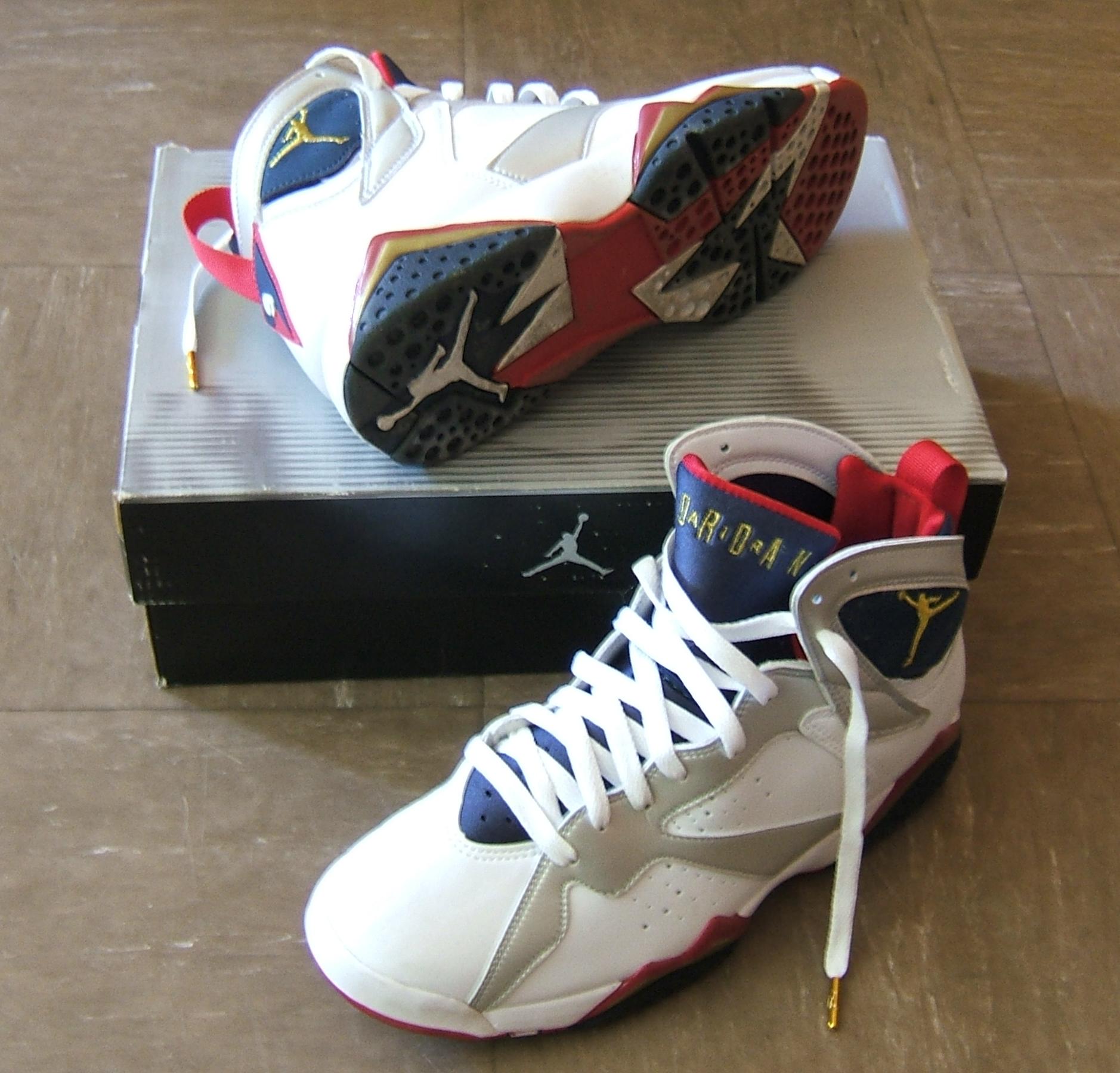
The shoes were ready for an Olympic future before that future had happened. Sotheby’s cataloged an Air Jordan VII “Olympic” salesman sample with a 1991 manufacturing date, sample tags and the number 9 at the heel. Its catalog distinguished that sample from the model’s 1992 public release. This is a commercial object caught between stages: an example intended to help sell a forthcoming product, carrying an identity associated with Jordan’s next international assignment. The object’s dating is the auction house’s attribution, rather than evidence of a 1991 retail launch. Sotheby’s sample record
Start there, rather than with a championship photograph, and the relationship between shoe and athlete becomes more interesting. A signature product has to anticipate events it cannot control. Designers can propose an image for the future; factories and salespeople can prepare it; a player still has to live through that future. The resulting shoe may become a souvenir of a victory, an interrupted career or an unexpected return. Its cultural meaning develops through those encounters. It cannot all have been programmed into the first drawing.
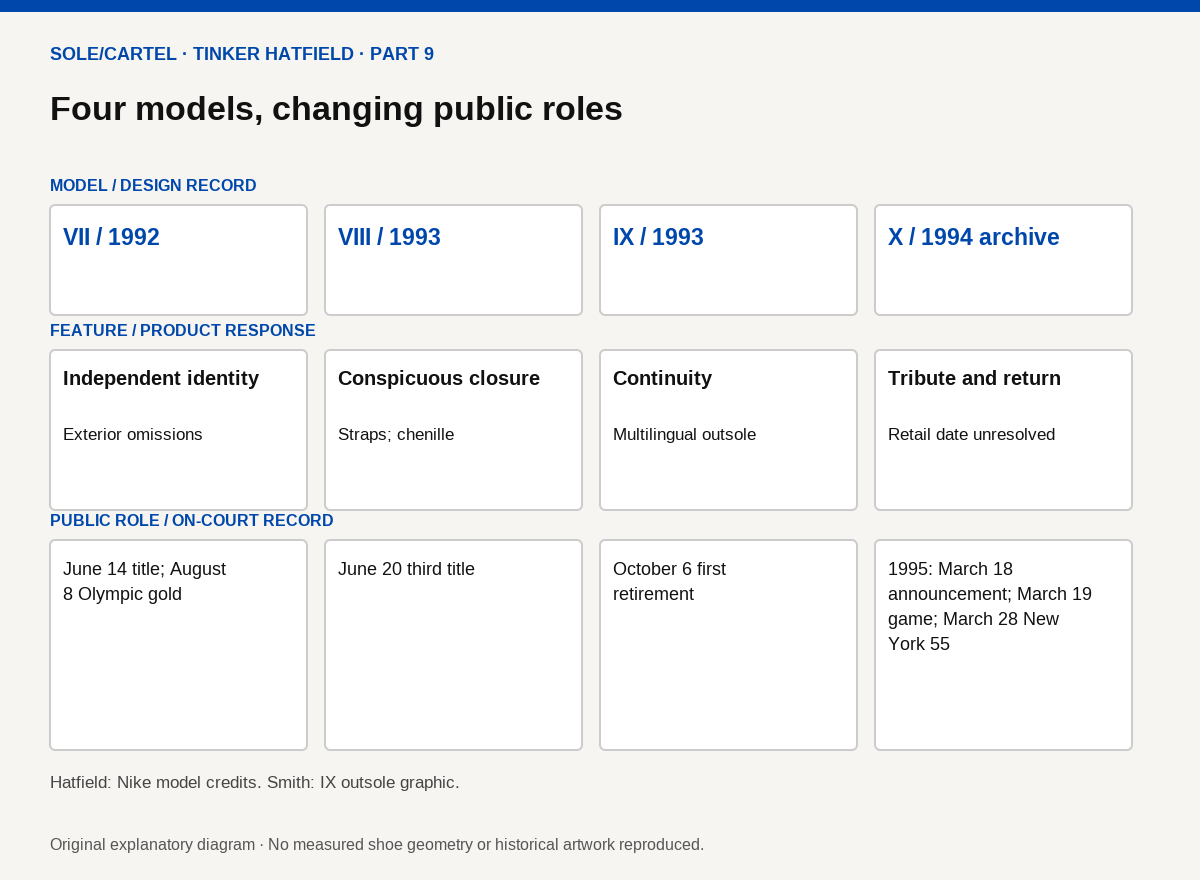
Across the VII, VIII, IX and X, Hatfield’s work meets four versions of a signature identity: an increasingly self-sufficient visual language, a champion’s equipment, a name that continues during absence, and a career assembled into a portable record. Read together, they suggest a consequential shift. The signature shoe remains attached to Michael Jordan, but it gains ways of speaking when he is doing something other than playing NBA basketball. The series begins to behave like an institution capable of keeping its own calendar.
VII: Recognition without the usual signals
Nike’s archive lists the Air Jordan VII as a 1992 release designed by Tinker Hatfield. Its explanation emphasizes two omissions: exterior Nike branding and a visible Air window. These were deliberate changes in the shoe’s presentation, according to the manufacturer’s retrospective account. The archive’s named artifact is the White/Neutral Grey–True Red edition, style 130014-100. That specificity matters: an archive entry is attached to a particular object and color arrangement, even when its accompanying narrative describes the whole model. Nike VII archive
Humphrey described the VII as a Huarache derivative: material removed where unnecessary and retained where support was wanted. Humphrey’s account
The important design question is what happens after an identifying device disappears. A window offers an immediately legible promise: something special sits inside. A familiar corporate mark supplies another shortcut. Removing those shortcuts puts more pressure on the shape, color and signature identity to carry recognition. In this reading, restraint becomes a form of ambition. A shoe can ask to be recognized through its own composition rather than through the repetition of every available sign of its manufacturer.
The championship attached to the VII also complicates the solitary-hero image. UPI’s June 14, 1992 report described Chicago’s bench helping erase a fifteen-point fourth-quarter deficit against Portland while Jordan sat. Scottie Pippen and the reserves reopened the game before Jordan returned; Chicago won 97–93 and the series in six. That period account makes the second title a collective achievement, with Jordan essential to a team that also needed other players to rescue its position. UPI’s championship report
A signature shoe compresses that collective work into an intimate object. Its owner can buy one player’s name, although the event commemorated by the purchase depended on many people. That compression is part of the product’s appeal and part of its historical limitation. The shoe offers a manageable way to remember a complicated season. Looking closely should expand the memory again, making room for the teammates whose actions are less easily embodied in a single pair.
Barcelona supplied a different setting for that identity. FIBA’s institutional history traces the Dream Team’s eligibility to its April 7, 1989 vote permitting all professional league players, including NBA players, in international events. The American Olympic roster combined eleven NBA players with the collegiate Christian Laettner. Jordan’s presence belonged to a larger change in the rules and organization of international basketball, rather than a tournament arranged around one signature athlete. FIBA’s team history
The gold-medal game took place on August 8, 1992. UPI reported the United States’ 117–85 victory over Croatia from Badalona, Spain. Its report describes an American team completing a dominant tournament, but also a final against an identifiable opponent with its own players and ambitions. The score supplies a firm historical anchor for the Olympic association; it cannot measure how many spectators subsequently wanted Jordan’s shoes. UPI’s Olympic final report
A surviving pair gives the association a more material form. Sotheby’s offered Olympic Air Jordan VIIs in 2023 with provenance from Brian McIntyre, a former NBA public-relations executive, and a letter supporting the account that Jordan wore them in Barcelona. That is the catalog’s provenance claim, not an independently established match to a particular game. It nevertheless distinguishes an athlete-associated specimen from an ordinary retail example or a later commemorative edition. Sotheby’s Olympic pair
The Olympic version makes a useful argument about how a signature can travel. National competition changes the framework around the athlete. A personal identity has to operate inside a team identity, while a commercial design has to remain legible within that new setting. The interesting result is adaptation rather than simple duplication. To a collector, a changed numeral can be a small detail; historically, it can mark the difference between an individual’s club role and his national assignment.
Advertising had its own authors and timetable. Paley’s catalog for “Hare Jordan” identifies Joe Pytka as director, Jim Riswold as copywriter, Darryl McDonald as art director and Darrell Van Citters in animation. Its record carries a November 30, 1991 date and a subject heading for Super Bowl XXVI in 1992; those fields should not be flattened into one presumed first-airing date. Paley’s original advertising record
Paley’s later exhibition research describes the Super Bowl XXVI commercial as pairing Jordan with Bugs Bunny on a basketball court and connecting it to the eventual 1996 film Space Jam. The institutional account establishes a particular cultural route: basketball personality, animated character and entertainment franchise. It does not make the shoe designer the author of that entire route. Paley’s exhibition account
That distinction improves the design history. Hatfield helps give the athlete a product vocabulary; advertising collaborators give him a fictional world in which to act. Their work can reinforce each other without sharing the same authorship. The cartoon partnership also changes the scale of competition. Sport supplies real stakes and unpredictable outcomes, while animation permits an athlete to become an exaggerated character. The signature can inhabit both registers. A shoe associated with that character can acquire meaning beyond the practical reason someone might initially wear it.
VIII: A champion’s equipment, made conspicuous
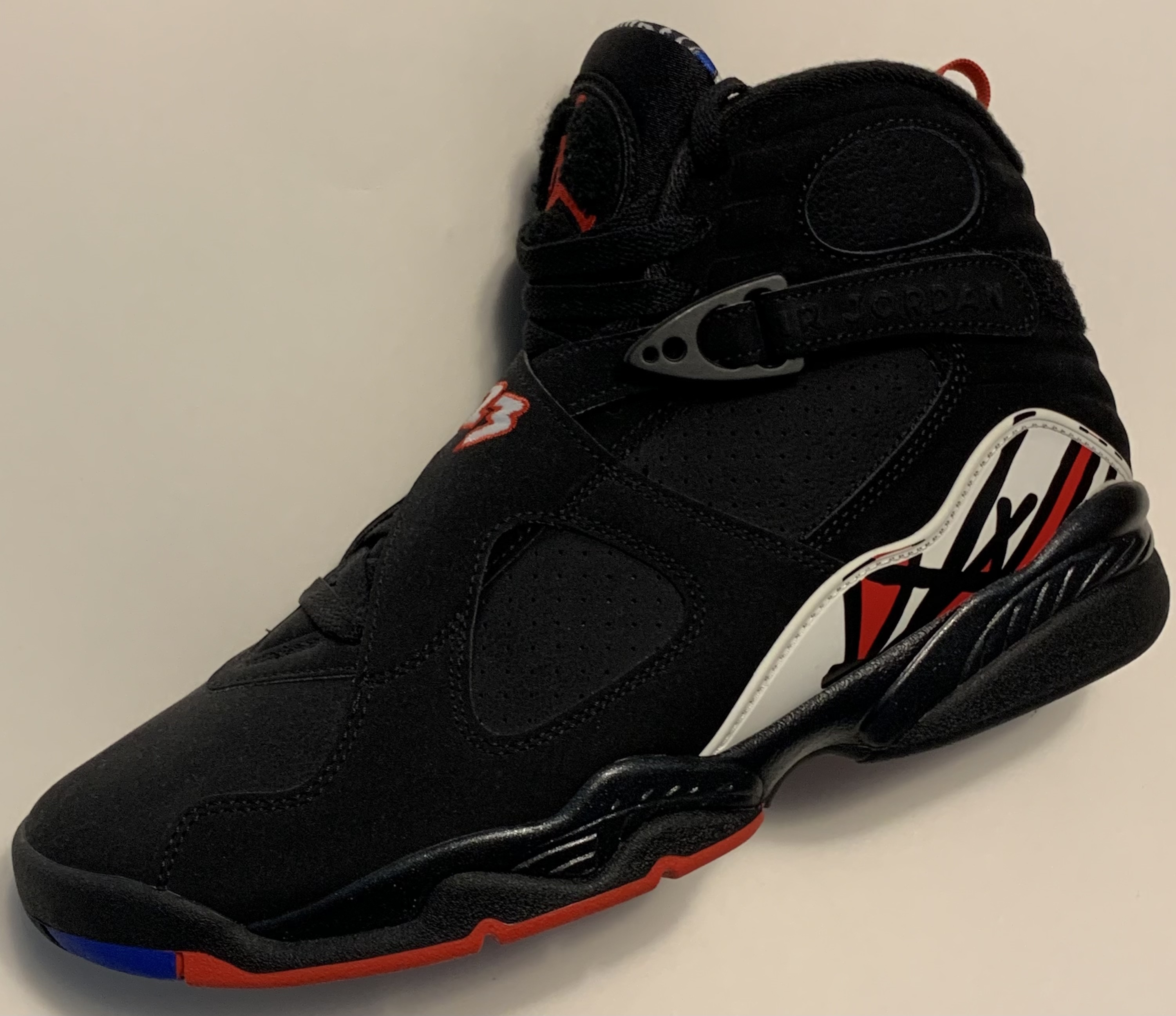

Nike dates the VIII to 1993 and credits Hatfield. Its archive describes a strapped design, a chenille tongue graphic and three original colorways, with the Black/Bright Concord–Aqua Tone artifact identified as style 130169-040. Compared with the VII’s story of omission, the VIII’s archive foregrounds things added to the surface: a closure crossing the upper and a distinctly tactile branding element. Nike VIII archive
In a direct 2020 interview, Jordan footwear executive Gentry Humphrey described the VIII’s straps as an attempt to limit Jordan’s foot moving within the shoe during hard cuts. That is a stated development aim, rather than comparative test evidence. Humphrey’s account
As a visual reading, the closure makes an equipment problem conspicuous. A lace can disappear into the general idea of a sneaker; a broad crossing fastener becomes part of its silhouette. The wearer has something to operate and the observer has something to notice. This gives a functional intention a theatrical dimension without requiring the mechanism to be decorative or the decoration to prove a performance benefit. A design can communicate seriousness by letting its method of attachment occupy the foreground.
The tongue supplies a different kind of emphasis. Where a hard-edged symbol would read mainly as outline, a raised textile treatment invites attention to texture. The result brings two kinds of detail into conversation: a fastening system that suggests equipment and a branding surface that suggests touch. One points toward the athlete in motion; the other becomes especially available when the shoe is held, displayed or photographed closely. Those different scales of attention help explain why construction details can survive as collector interests long after their original competitive setting has passed.
The third championship arrived on June 20, 1993, in a 99–98 Game 6 victory over Phoenix. Jeff Shain’s contemporary UPI report records Jordan’s 33 points, but its decisive sequence runs through Pippen, Horace Grant and John Paxson: Grant passed out to Paxson for the late three-pointer, then stopped Kevin Johnson on Phoenix’s last opportunity. The first three-peat was finished by decisions and actions distributed across the team. UPI’s Game 6 report
For a shoe history, this is more revealing than treating the trophy as a verdict on the product. A championship can transform what an object represents without establishing what the object caused. The shoe accumulates the memory of the game; the game does not supply a laboratory comparison between shoes. Keeping those meanings distinct lets the VIII be both sporting equipment and a compelling artifact of achievement. It also prevents the achievement from becoming a substitute for explaining the equipment.
The VIII therefore occupies a particular position in this sequence. It brings the practical apparatus of attachment into view at the same moment that a signature line can draw on repeated success. There is confidence in making the object this emphatic. Yet success creates a narrative trap: later readers know a championship came next, and every unusual feature can start to look inevitable. The more useful question is how the shoe organizes the athlete’s requirements into a recognizable form before anyone knows the final score.
IX: The name remains at work
On October 6, 1993, Jordan announced his retirement in Deerfield, Illinois. UPI’s contemporaneous report records his explanation that he had lost the motivation to prove more as a basketball player, while leaving open a possible return. That statement sets the immediate context without converting private grief, public speculation or later theories into a single explanation for his decision. He was stepping away from an occupation, with the future still unsettled. UPI’s retirement report
Nike’s response was public that same day. Another UPI report records Phil Knight saying that Jordan had not retired from Nike and that their partnership would continue; Knight said future plans had already been discussed. The report also described a then-current advertisement in which Jordan imagined life without constant public visibility. Product continuity was therefore an expressed contemporary intention, rather than a conclusion invented after the line survived. UPI’s corporate-response report
This is the hinge of the story. A signature product can begin as a way of following a working athlete, each new model accompanying the next season. Retirement interrupts that apparently natural rhythm. Continuing the line requires a different proposition: the name can stand for a durable set of associations even when the athlete is elsewhere. The commercial commitment precedes any proof that the proposition will work indefinitely. The history here is a decision to continue, not an automatic law that a famous athlete’s products must always prosper.
Nike lists the IX as a 1993 Hatfield design and describes a restrained upper, one-pull lacing and a multilingual outsole. Its own account acknowledges both basketball player editions and a baseball-cleat adaptation. The archive’s “never worn” language is too expansive to repeat as a claim about Jordan’s entire life or career. The relevant absence here is his first NBA retirement and the IX’s original basketball chapter, not a claim that he never put on any IX-derived footwear. Nike IX archive
The credited designer also needs company. In a direct interview published by Sneaker Freaker in 2007, Mark Smith said he had collaborated with Hatfield on Jordans IX through XV. That testimony establishes a working relationship broader than one isolated graphic contribution, without specifying an identical division of responsibilities on every model. Smith’s direct interview
A 2019 professional biography hosted by the Footwear Distributors and Retailers of America identifies Smith’s multilingual outsole graphic as a notable IX contribution. This supplies a more specific credit than the archive’s single designer field. Hatfield’s overall design credit and Smith’s graphic work can both remain visible in the account. Smith’s professional biography
The outsole is an unusually suggestive place to put language. It is integral to the object yet largely concealed during ordinary standing. Reading it asks the owner to turn the shoe over and give it attention outside the simple act of wearing it. That creates a second encounter with the product: first as an object with an exterior profile, then as an object containing a message. In my reading, the gesture anticipates the collector’s habit of treating every surface as potentially meaningful.
Multilingual expression can announce an ambition to reach beyond one locality without proving that every locality responds in the same way. The distinction matters especially for a celebrity product. A company can imagine a worldwide audience; people within that audience bring different experiences, affiliations and reasons for buying. The IX’s language should be read as a designed statement of outward address. Its historical interest lies in that ambition and in the collaborative work needed to materialize it, rather than in an unsupported claim that one shoe united the world.
A further Paley record places Jordan in a commercial cataloged for Super Bowl XXVIII in 1994, alongside Steve Martin and several athletes. The credits distinguish Pytka’s direction, Stacy Wall’s copywriting and Jelly Helm’s art direction. The catalog date is November 30, 1993. Without the underlying playback, this record supports the advertisement’s existence and credited participants, not a shot-by-shot reconstruction of its action. Paley’s 1994 campaign record
Absence from a league is consequently different from disappearance from culture. A signature identity has several places to work: footwear, graphics, advertisements and the remembered image of the player. Those places can keep producing new material when the weekly game schedule stops supplying it. The IX makes that separation unusually clear. Its story is about the infrastructure around a signature athlete as much as it is about a silhouette. Designers and campaign makers keep the identity active while its namesake explores another role.
X: A career becomes a surface
Nike’s X archive identifies Hatfield as designer and gives 1994 as the original-release year. It describes a tribute conceived while Jordan was away, with full-length Air cushioning and a grooved outsole. The White/Black–Light Steel Grey archive artifact is style 130209-101. These are the manufacturer’s retrospective identification and construction account; the archive alone does not document a first retail day across every market. Nike X archive
Nike’s later Light Steel Grey listing describes the grooved outsole as a chronicle of Jordan’s early career achievements. The surface does two jobs in the product story: a component of a shoe and a place for biography. That is a documentary feature account, rather than a transcription of every inscription on an original specimen. Nike’s later edition account
The competing date deserves to remain visible: Sporting News’s 2023 model timeline labels the X “1995.” That is a later editorial chronology, not a period retail notice. Sporting News’s timeline
This article retains Nike’s 1994 archive identification and separates it from the documented 1995 return. A period catalog or advertisement establishing the first regional retail availability has not been secured, so an exact first sale remains unresolved. Calling the X a 1995 comeback shoe can describe its public association without settling its earliest commercial arrival. A single year beside a model name is useful for orientation; it is less useful when it silently merges design, manufacture, release and sporting memory.
The atmosphere of tribute was quite concrete before the return. UPI reported the November 1, 1994 ceremony at which the Bulls retired Jordan’s number 23 and unveiled his bronze sculpture at the United Center. The event publicly marked a completed chapter. It helps explain the context in which a career could be treated as something to commemorate, although it does not establish that the ceremony caused the X’s design. UPI’s ceremony report
On March 18, 1995, the premise changed again. UPI reported Jordan’s statement announcing his return to the Bulls: “I’m back.” The dispatch said he was scheduled to play Indiana the following day. The announcement and the game are separate events; the two-word statement alone does not document what he wore when he actually took the court. UPI’s announcement report
The March 21 Cayman Compass carries Reuters’ contemporary account of that Sunday return: Jordan wore number 45, scored 19 points and played 43 minutes in Chicago’s 103–96 overtime defeat at Indiana. He described his timing as needing work. The archive warns of digitization errors, so its account is used for this game rather than its mistaken baseball-team wording. The comeback began with a loss and an athlete rebuilding rhythm, not a perfectly finished restoration. Reuters’ period game account
On March 28, Jordan scored 55 against New York. UPI’s report, published March 29 with a March 28 dateline, also records his pass to Bill Wennington for the winning basket in a 113–111 game. The distinction between event date and publication date is small but consequential. The remembered scoring total belongs to a game that still required a final collaborative decision. UPI’s New York report
The X could accommodate other basketball identities too. Nike’s City Series history describes five city treatments, including New York’s orange and royal, Orlando’s blue and Seattle’s green and gold. It distinguishes Jordan’s personalized Chicago pair, with 45 stitched on the collar, from other versions and player editions. This was an explicit system of local variation within a shoe carrying one person’s name. Nike’s City Series account
As a design reading, that system is an important step beyond the personal souvenir. A common form can accommodate affiliations that do not all point toward the same team. The player’s signature becomes a framework within which other basketball loyalties can operate. There is a productive tension here: the line asks for identification with Jordan while making room for places and colors beyond his own uniform. This is one way a signature can become larger than a literal representation of its owner.
The tribute also changes when its subject resumes his career. What had looked like a concluding record becomes an incomplete one. That incompleteness gives the object historical force. It holds an earlier understanding of the athlete, while the athlete’s next actions revise that understanding. The shoe does not need to predict the return to become associated with it. It needs a form that can survive a change in interpretation, carrying a past-tense biography into a present-tense contest.
What survives in the shoe
For the VII, the modern Cardinal listing provides an exact documentary reference: CU9307-106, with white leather, Cardinal Red and Chutney accents, an embroidered collar Jumpman and 23 at the heel. Set beside the earlier Olympic sample, the heel identifier preserves a meaningful distinction in Jordan’s public roles. This is a comparison of named records, not a claim that the modern shoe duplicates the original sample’s materials or shape. Nike’s Cardinal listing
For the VIII, Nike’s Playoffs listing identifies 305381-062 and describes black nubuck, molded details and a midfoot strap. It gives a specific later object through which to examine the model’s visible closure language. A collector can record strap configuration, tongue treatment and surface condition without turning an advertisement’s enthusiasm into a test of support or a promise of wearability. Nike’s Playoffs listing
Nike’s Powder Blue IX listing, FQ8992-101, calls the edition a return to original design specifications and separately dates that color arrangement’s first appearance to 1994. The distinction between the model’s archive year and a particular colorway’s year is useful. “Original specifications” remains the seller’s claim, rather than an independently verified equivalence in chemistry, durability or court behavior. Nike’s Powder Blue listing
The later Light Steel Grey X, HJ6779-104, offers a particularly concrete restoration claim. Nike identifies the returning toe-cap overlay and Dark Powder Blue outsole Jumpman, alongside an outsole recording early career achievements. Those specified details provide better comparison points than an undifferentiated “OG” label. The listing supports this edition’s advertised features, not a physical inspection of an original pair. Nike’s Light Steel Grey listing
Taken together, these records suggest a practical collector’s habit: identify the edition before deciding what its details mean. A numeral can mark a role; a closure can preserve a design intention; a graphic can carry a collaborator’s work; an altered surface can reveal a later choice about what to restore. The best historical comparison keeps those questions attached to particular objects. That is how a signature shoe becomes more than a row of model numbers: each surviving version preserves a different relationship between the athlete, the people making his image and the future they imagined.
Compact chronology
| Date / evidence type | Record |
|---|---|
| 1991 | Salesman sample: manufacturer date attributed by catalog. Sources: S01. |
| 1992 | VII archive year; June 14 second title; August 8 Olympic gold. Sources: S02, S03, S05. |
| 1993 | VIII archive year; June 20 third title. Sources: S09, S11. |
| 1993 | IX archive year; October 6 first retirement and continuing Nike partnership. Sources: S14, S12, S13. |
| 1994 / 1995 | X: Nike archive 1994; conflicting editorial 1995; first regional retail unresolved. Sources: S18, S19. |
| 1995 | March 18 announcement; March 19 return game; March 28 New York 55. Sources: S21, S22, S23. |
Source notes
Manufacturer histories are attributed; period reports anchor sporting events. Auction descriptions establish cataloged provenance claims, not independently verified wear. Advertising records were read without accessing the original playback. The unresolved retail-date conflict is retained explicitly. See the accompanying claim ledger and gate record for review.