Three names on a document
On the cover of European patent EP2278896B1, published on 10 January 2018, three inventors appear: Tiffany A. Beers, Michael R. Friton and Tinker L. Hatfield. The application was filed on 29 April 2009. Its illustrated embodiments describe automatic lacing, including straps moved by a mechanism and guided through a hollow plate. The drawings are proposals within a patent specification, rather than a parts inventory for a retail shoe. The cover supplies a useful opening image for this history: Hatfield’s name occupies one line among several. S01
This is where a history of a celebrated designer should finish: with the work becoming harder to attribute to one person. The ambition remains recognizable. A familiar object is asked to behave differently, and its behavior is made visible enough to become a story. But realizing that ambition requires decisions that a silhouette cannot disclose. Someone must decide where the mechanism belongs, how the wearer controls it and how the finished object can be made repeatedly. Those choices are part of design even when they cannot be signed with a striking sketch.
MAG and HyperAdapt also reverse the usual sequence of a performance narrative. Instead of a practical improvement acquiring a theatrical reputation, a theatrical promise becomes an engineering assignment. That reversal makes these shoes a demanding final case study. We must judge the promise, the mechanism, the public event and the surviving artifact on their own evidence. Calling everything a self-lacing shoe collapses the very changes that make the story worth telling.
A future produced for the camera
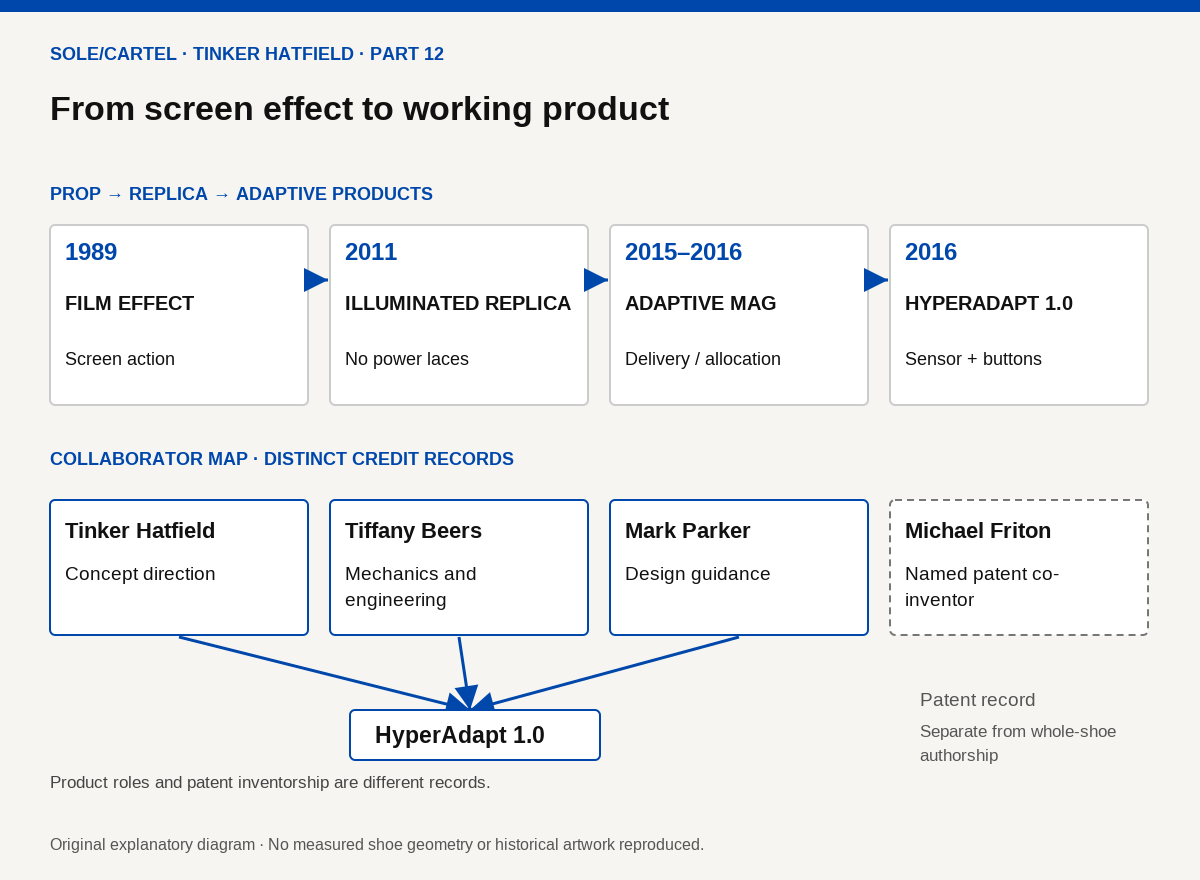
The official film record dates Back to the Future Part II to 22 November 1989 and credits Robert Zemeckis as director, with Zemeckis and Bob Gale as writers. Its story sends Marty and Doc to 2015. The year inside the fiction therefore differs from the year audiences first encountered it. A future date in a screenplay is a dramatic setting, not a manufacturer’s release commitment. S02
Scott Eden’s 2016 WIRED reporting traces Hatfield and Mark Parker’s film-design discussions to 1988. It also records Beers’s early working prototype in 2007 as bulky, rigid and dependent on a permanent power connection. The distance between those two objects is central: a memorable screen concept and a workable product did not arrive together. S03
Penn State’s 2017 interview with Beers describes the film effect as guide wires pulled by crew members hidden beneath a platform, with lighting powered from a battery pack under Michael J. Fox’s jacket. The same account identifies Beers as a 2002 plastics engineering technology graduate who led much of the subsequent development. She describes making hundreds of prototypes and resolving specific problems such as friction in the lace path. S04
The effect was successful because the audience saw an action, not an explanation. The shoe appeared to recognize its wearer and close itself. There was no reason for the film to disclose the surrounding apparatus: hiding that apparatus was the work. Product design inherited the opposite obligation. The apparatus would have to travel with the wearer, survive handling and fit into the object whose apparent effortlessness had generated the demand.
A film prop should consequently be respected as a film prop. It solved a real production problem without solving every problem that a consumer product would later face. Treating it as an almost-complete prototype obscures the ingenuity of both teams. The film crew created a convincing gesture. The footwear engineers had to make that gesture repeatable without a platform, concealed operators or a camera selecting the favorable view.
2011: resemblance was already enough to organize an event
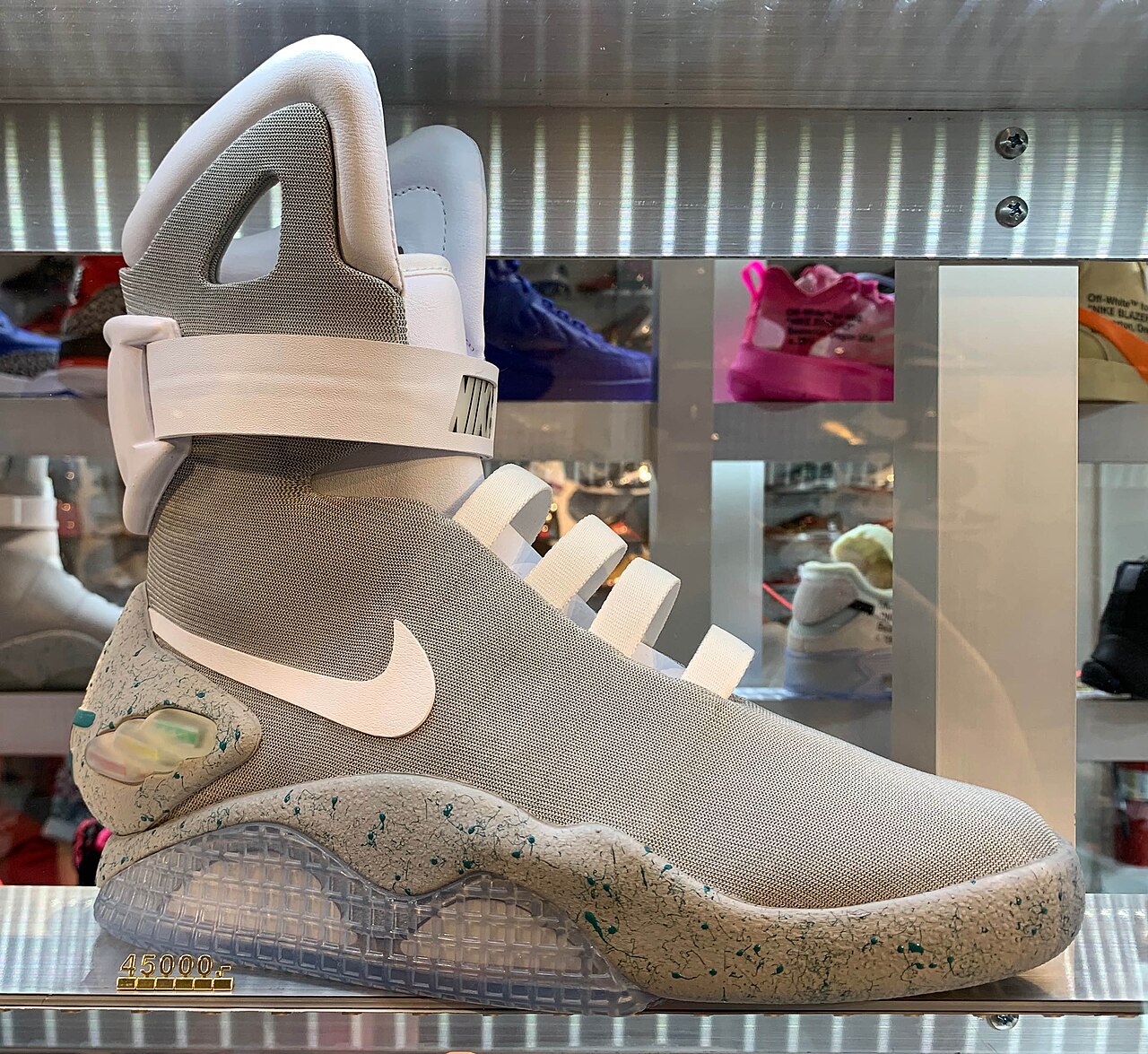
Nike Japan’s September 2011 announcement explicitly says the 2011 Nike Mag did not have automatically tightening power laces. It describes rechargeable illumination, additional foam support at the ankle and toe, and a planned auction of one pair at Nike Harajuku on 22 September. This is a period description of a particular replica and a regional event. It is stronger evidence than assuming that a familiar exterior contains the mechanism shown in the movie. S05
The replica could have cultural force before it could fulfill the cinematic action. Recognition came from a package of associations: the high collar, luminous details, the film and the actor. The absence of automatic lacing did not erase those associations. It did, however, define which part of the promise was being offered. For a collector, that is a fundamental distinction between owning an image made tangible and owning the later operating system that the image had suggested.
In its 11 November 2011 statement, the Michael J. Fox Foundation reports more than $4.7 million raised through the Mag auction activity. It describes 1,500 limited-edition pairs in the ten-day eBay auction, with Fox’s 8 September Letterman appearance opening an event that closed on 18 September. A matching challenge was to double the proceeds to $9.4 million. These are the beneficiary’s reported event figures, not evidence of a normal retail launch. S06
The foundation’s 2011 annual report presents the campaign on a page headed by the Nike auction, followed by columns of donor names. Its printed page 25 again records the 1,500 pairs and matching funds. The document makes participation visible as part of the object’s history: the shoe sits within an account of giving, rather than only a sequence of products. S07
That change of setting matters. A release organized around fundraising asks the object to carry a purpose beyond purchase. The desire to possess something recognizable can be redirected into support for an institution. The institution, in turn, acquires an audience that might not have arrived through its usual communications. This is a specific cultural mechanism supported by the form of the event; it does not require a claim that every participant held the same motive.
Nor should fundraising be confused with a medical result. The reported money demonstrates a consequence of the campaign. It does not measure an individual research outcome, establish that a treatment worked or convert the shoe into an assistive device. The association with Fox and his foundation became part of what the Mag meant, while remaining separate from the question of how its lacing worked.
2015 and 2016: a demonstration, a draw, a result
The foundation’s 4 October 2016 announcement distinguishes the new adaptive Mag from the version auctioned in 2011. It recalls the delivery of an adaptive pair to Fox the previous year, then describes a new draw running through 11 October, with winners to be notified on 17 October. The announcement also lists separate live auctions. Delivery to one wearer, a public entry period and subsequent allocations are different events, even when they are folded into one release story. S08
The calendar resists an easy triumphal ending in 2015. A demonstration can honor a cinematic anniversary while the wider distribution remains in the following year. That is not a minor clerical distinction. It tells us what had become possible at each point: a working presentation, a controlled allocation and an event with an eventual result. None of those states establishes mass availability or the experience of ordinary long-term ownership.
On 20 October 2016, the foundation reported $6.75 million from the draw, and described 88 pairs across the draw and auctions with a final 89th pair still to be auctioned at its November gala. It separately identified proceeds from the Hong Kong and London auctions. The page is an interim statement with a remaining event, rather than the last accounting of the campaign. S09
Its 2016 annual report, printed page 41, supplies the later figure: $6.95 million from the online draw and international live auctions. The page describes 89 pairs and the final gala pair’s $200,000 auction result, with Beers and Hatfield pictured at the event. The two totals belong to different reporting moments and scopes. They should not be interchanged or treated as a contradiction merely because they appear in summaries of the same campaign. S10
A shoe becomes a cultural artifact through such records as well as through its appearance. Donation pages, annual reports, event photographs and allocation terms show the institutions and people through which the object traveled. They also prevent the cultural story from floating free of material particulars. The limited adaptive release was not simply the old replica with a new date attached. Its mechanism and its distribution were both part of its identity.
This changes what a convincing provenance record should contain. A model name and year provide a starting point, but they cannot stand in for the campaign, edition or route of allocation. The historical significance lies partly in the distinctions that a short sales description tends to remove. Keeping those distinctions restores the relationship between a collectible object and the public actions that produced its reputation.
HyperAdapt: make the mechanism ordinary enough to wear
Nike’s HyperAdapt 1.0 development account explicitly credits a three-way collaboration. Hatfield proposed making adaptive lacing real; Beers explored the mechanics; Parker helped guide the design. The page describes a heel sensor that initiates tightening and two side buttons for adjustment. Its claim of a personalized, body-like fit is Nike’s product argument. The documented controls support a narrower statement: initial tightening could be triggered by entry, while the wearer retained a way to change it. S11
That distinction is the useful design breakthrough. Automatic action need not mean surrendering control. A shoe can remove one routine task and still let its wearer correct the result. The buttons make the system legible: the wearer can ask for more or less rather than accept a single hidden judgment. This arrangement makes the product easier to discuss as an interface, without pretending that the interface knew every changing need of an athlete.
In a separate December 2016 WIRED interview, Beers describes the difficulty of shrinking the technology, the use of fishing line in the fit system and the need for wearer-initiated release. Her account treats the finished shoe as an imperfect concept-car stage. Those details keep development visible beneath the launch language: a successful demonstration of adaptive tightening still involved choices, compromises and tasks left to the user. S12
This is a different visual brief from reproducing a movie object. The mechanism must have somewhere to live, but its enclosure also becomes something a person sees and carries. Every decision about showing or concealing it affects the meaning of the shoe. An exposed or illuminated component can invite curiosity; an unobtrusive form can make unfamiliar behavior feel less demanding. Neither choice eliminates the engineering constraints. It gives those constraints a public expression.
Darren Rovell’s contemporary ABC News/ESPN account describes the move from development work in Taiwan to production in Vietnam. It also explains the MT2 marking as a reference to Mark, Tinker and Tiffany, and reports the late 2016 product introduction. These are manufacturing and participant-credit details from the launch period. The report contains an incorrect 1988 date for the film sequel, so that date is excluded here in favor of the official film record. S13
The marking is a compact answer to the temptation to make this another solitary-genius story. A visible name may provide the recognizable center of a project, but a product has to pass through many kinds of competence. The engineer who resolves friction or packaging is not merely executing an already finished idea. Those decisions change what the idea can become. Manufacturing adds another test: whether the solution can leave a development room as something repeatable.
Automation redistributes effort rather than making effort disappear. With these controls, the wearer no longer has to reproduce a knot to obtain the initial closure, but must learn which input changes the result. The trade is visible in the relationship between the entry sensor and the adjustment buttons: one proposes a starting point, while the others allow correction. A useful design question follows. Does the new sequence make the experience easier for the particular wearer, in the particular situation? The presence of a motor cannot answer that question by itself. The experience must be observed rather than awarded by novelty.
For the collector, this gives interaction an unusual historical value. Recording how a control was intended to be used helps preserve the design even when a surviving example cannot demonstrate it. A readable manual, an identified charging accessory and a clear account of the user sequence can explain what the object once asked of its owner. That explanation belongs beside the photographs. It allows a future reader to understand the ambition without needing either a working sample or an exaggerated account of its capabilities.
A manual changes the meaning of the object
Nike’s English GB HyperAdapt 1.0 instruction manual describes a preset fit, lateral buttons, a reset procedure and a magnetic charging puck at the outsole’s MT2 marking. It identifies a rechargeable lithium-ion-polymer battery that is not user-accessible or replaceable. It also tells users not to disassemble the shoe or charger and not to use or charge a damaged shoe. These are edition-specific manufacturer instructions, not conclusions drawn from photographs. The manual is retained here as a historical product document, not a promise of present support. S14
The manual makes a sharp change in the collector’s relationship to the shoe. A knot is replaced by a sequence of states: charged, activated, adjusted, released, reset. The wearer must understand an object that can answer an input, and the owner must preserve information alongside it. The instruction book and charging equipment become historical evidence of the experience that the product was designed to offer.
This is also where futuristic appearance meets ordinary maintenance. The artifact cannot be understood through its silhouette alone. A visually complete pair and a functioning pair answer different questions. If condition documentation records only external wear, it misses part of the design. If a seller demonstrates illumination but provides no basis for the state of the adjustment mechanism, the photograph and demonstration still leave different gaps. This is a reason to ask better descriptive questions, rather than to invent a health assessment from appearance.
In Nike’s FY2017 shareholder letter, Parker places HyperAdapt 1.0 within a wider push toward adaptive performance and faster product innovation. The letter supplies management’s strategic framing. It does not publish a model-specific adoption rate, long-term reliability result or independent measure of benefit. The company positioned the shoe as a platform beginning; the document alone cannot tell us how widely that beginning changed everyday footwear. S15
The platform language is revealing because it asks the public to value the product twice: once for what it does now and again for what it might lead to. A historian can recognize that ambition without granting the second promise in advance. The present object deserves examination on its own terms. Its future significance must be reconstructed from later products and records, not read backward from an optimistic launch statement.
The future also has an end-of-support date
Nike’s later Adaptive Fit archive places HyperAdapt in 2016, followed by Adapt BB in 2019, an updated basketball version in 2020 and AutoMax in 2020. The archive uses familiar footwear families to describe the expanding idea. Its performance assertions remain Nike’s claims. The sequence establishes that adaptive fit was explored across later named products; it does not establish that every shoe had identical hardware, software or collaborators. S16
Nike’s current support notice says the Adapt App was removed globally from app stores on 6 August 2024. It states that on-shoe controls continue to provide core functions without the app, while future operating-system changes may limit an already-installed app. This notice concerns the later Adapt ecosystem. It is not evidence that HyperAdapt 1.0 depended on that app, nor that all adaptive shoes stopped operating on the retirement date. S17
The distinction is more interesting than a simple claim that the future failed. A product can retain one kind of function while losing another route to it. The later record invites a broader standard for innovation: not just whether an unfamiliar action can be made possible, but how its controls, documentation and support survive. That standard should be applied to the actual edition and system concerned, rather than used as a retrospective verdict on every object in the family.
It also complicates the familiar sneaker timeline. A conventional history often treats the retail release as the moment a design becomes settled. Here, later interface decisions can alter the experience of an existing object. A full condition history therefore has to leave room for events beyond manufacture, purchase and wear. The shoe’s cultural life may be long; the surrounding technical arrangements can have a different calendar.
A legacy that leaves room for other names
Mentorship belongs in this history as a question about what a design practice passes on. Celebrating a finished object is easier than preserving the habits that produced it: listening, revising, testing an assumption and explaining an unfamiliar idea. The collaborator records invite us to judge a legacy by how much room it creates for other people’s work.
Across this series, the lasting design thread is the movement between a problem and its public expression. Fit becomes an embrace; cushioning becomes a window; an athlete’s identity becomes a set of material and graphic decisions. Those are interpretations of the cases examined here, not a claim that Hatfield invented every component or controlled every consequence. The thread is valuable precisely because the surrounding work has remained visible: athletes, engineers, fellow designers, advertisers, manufacturers and collectors keep changing what a shoe can mean.
MAG and HyperAdapt make the final lesson unusually clear. The object can become famous before its promised behavior exists. Its later mechanism can be historically important without becoming universal. Its fundraising can matter without proving performance. Its designer can deserve recognition without swallowing the engineer’s contribution. A comprehensive history should be large enough to hold all of those statements at once.
What survives is consequently more than the outline of a shoe. It is a method of asking an ordinary object to do something unfamiliar, followed by the difficult collaborative work of finding out what that request entails. The most useful tribute is to retain the questions, the compromises and the names. The future took a team. Its history should keep the team in view.
What survives in the shoe
Begin with the edition: film-production object, 2011 illuminated replica, 2016 adaptive Mag or HyperAdapt 1.0. Record identifiers, packaging and provenance before attaching a general story. Note which functions have actually been documented and which are merely assumed from the name. Keep photographs of markings and the supplied equipment with the record. A retrospective product page is useful context, but the exact manual and the individual object answer more particular questions.
For HyperAdapt, document the presence and identity of its charger and instructions, the condition of the upper and sole, and any observed controls or indicators without turning them into a diagnosis. This article has not examined a physical pair or tested a battery. It supplies no present repair, charging or wearability clearance. The historically important distinction is between the functions an edition was designed to provide and the condition of a surviving example. A collector can preserve both stories without claiming that one proves the other.
Compact chronology
| Record date | What the date identifies | Evidence |
|---|---|---|
| 1989-11-22 | Film release; story visits 2015 | S02 |
| 2009-04-29 /2018-01-10 | Patent filing / grant publication, not shoe releases | S01 |
| September 2011 | Illuminated replica and fundraising auctions | S05, S06 |
| 2015 /October 2016 | Adaptive delivery to Fox / allocation campaign | S08 |
| 2016 | HyperAdapt controls and product development | S11 |
| 2019 /2020 | Later Adapt BB /AutoMax entries | S16 |
| 2024-08-06 | Later Adapt App retirement, not HyperAdapt shutdown | S17 |
Source notes
Source identifiers link to original records throughout. The ledger records source dates, scope and access limits. Corporate and participant accounts remain attributed; beneficiary statements report their own fundraising. Research PDFs are retained for verification, with no permission inferred to reproduce their artwork. The explanatory graphic is original and does not reproduce a patent drawing or film still.