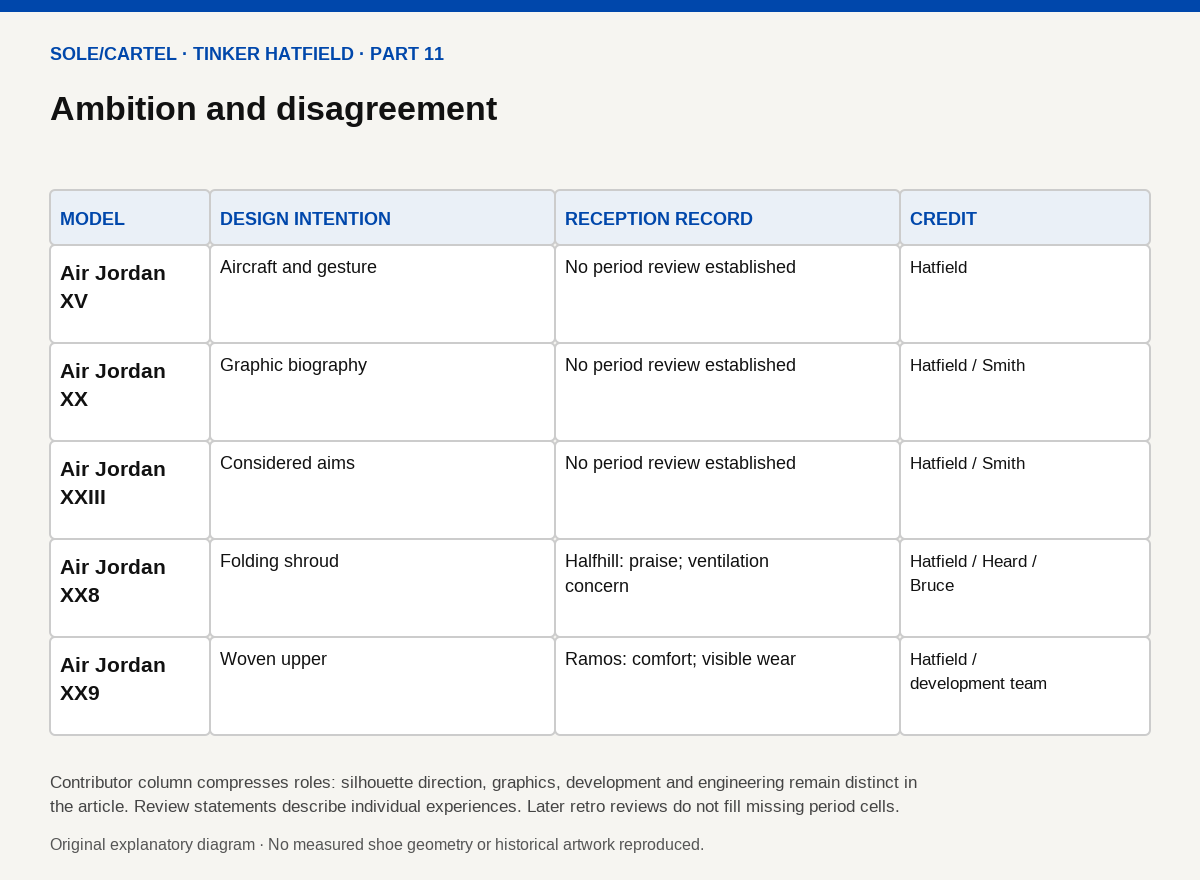
On January 8, 2008, Jordan Brand announced the Air Jordan XX3. Its proposition joined Michael Jordan’s biography to manufacturing ambition: Hatfield and Jordan were named collaborators, and the shoe was presented as Nike basketball’s first embrace of its Considered design ethos. The 2008 announcement.
That is a demanding brief for an anniversary object. A commemorative shoe can be asked to summarize a career through symbols, while a performance shoe must accommodate somebody else’s next game. The XXIII had to make those purposes coexist. Its importance in this history is the attempt to place another question alongside them: how should a prestigious basketball shoe be made?
The later work cannot be understood as a procession of universally admired classics. These shoes make different bets about what a Jordan should communicate. A projecting tongue, an illustrated strap, an intricately stitched upper and a folding shroud each move the relationship between image and use. Looking at those bets in sequence reveals an active design practice, with room for resistance, rather than a signature frozen at the end of the championship years.
1999: the signature continues
Jordan retired again in January 1999; his final NBA game came in April 2003. NBA record.
Nike’s archive dates the XV to 1999 and credits Hatfield. Its retrospective connects the design to the X-15 aircraft and interprets the protruding tongue as an echo of Jordan’s own on-court expression. The same account places Jordan in the shoes with business suits, framing an identity beyond the basketball uniform. Nike’s XV archive.
The tongue makes an unusually literal portrait. A face or photograph would identify the athlete directly; this small bodily gesture instead asks recognition to do the work. It pushes outward from an otherwise enclosed form. That tension gives the shoe an argumentative silhouette: the upper seems controlled until the projecting element interrupts it. The interruption is also where the athlete’s familiar image enters a shoe intended to continue without his regular presence on court.
The aircraft reference needs the right name. NASA describes the X-15 as a rocket-powered research aircraft, flown between 1959 and 1968 in a program involving NASA, the Air Force, the Navy and North American Aviation. Its work included investigating flight at hypersonic speeds. It was not the fighter jet of Nike’s abbreviated description. NASA’s X-15 history.
That correction improves the design reading. Research aircraft stand for experimentation at a boundary, not simply military aggression. Their image can supply a language of speed and unfamiliar surfaces without proving anything about a sneaker’s performance. The XV borrowed an association; the basketball shoe still had to answer to a foot, a floor and a direction change. The gap between those scales is part of its strangeness.
A later judgment complicates an easy dismissal. In his June 2013 XV Retro review, Nightwing2303 praised traction and cushioning but reported inconsistent heel lockdown and poor ventilation. He described a mixed experience rather than a simple success or failure. This was a retro review, with no exact SKU established here, not evidence of the original public response in 1999. The dated XV Retro review.
A shoe can be visually difficult and still offer a feature a player values. Conversely, a persuasive silhouette can leave a specific foot dissatisfied. The XV’s history becomes more useful when those questions remain available separately. The projecting tongue is an effective subject for visual criticism; heel hold belongs to the interaction between the particular shoe and wearer. Neither judgment has to cancel the other.
2005: autobiography becomes a surface
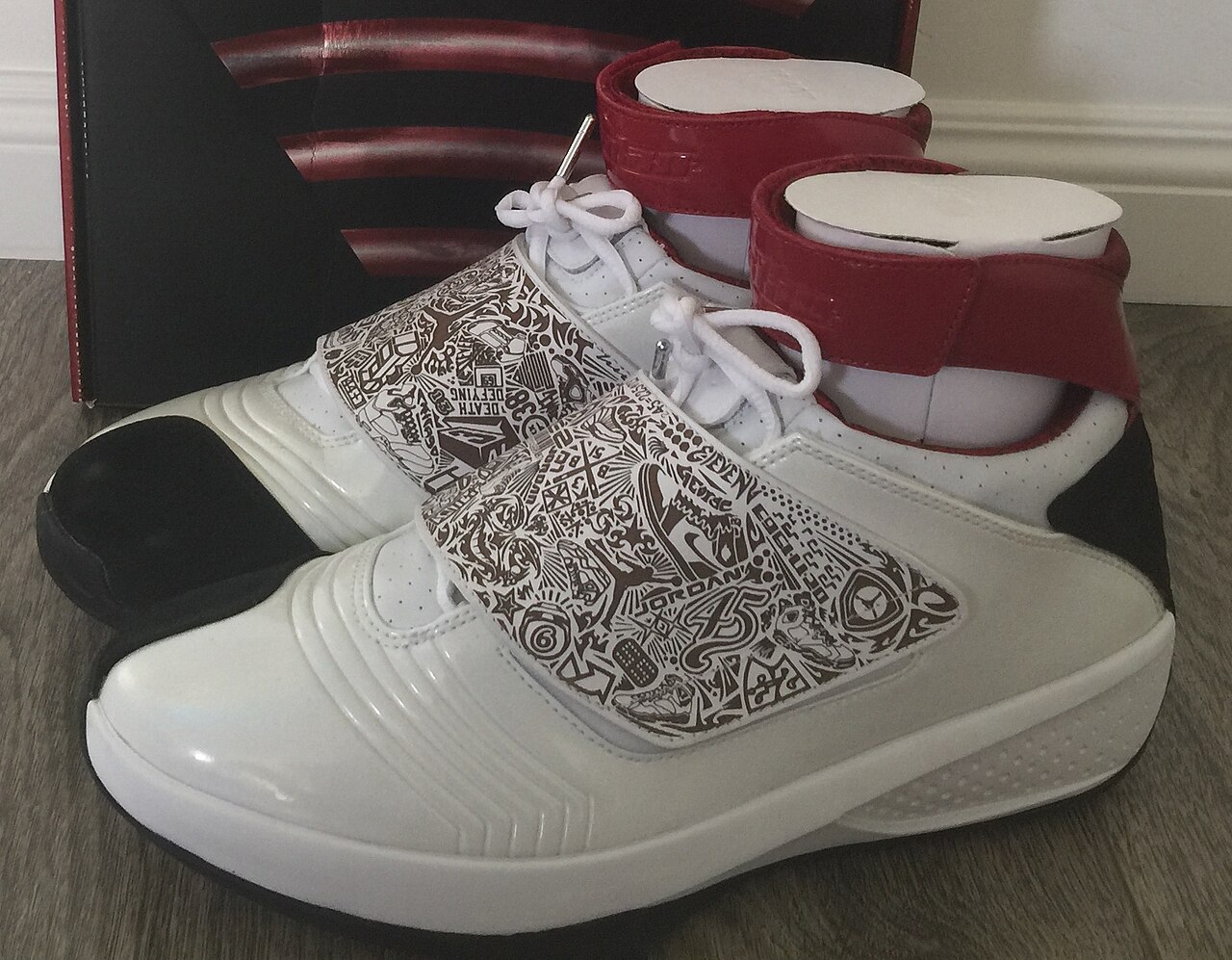
Nike dates the XX to 2005 and explicitly credits both Tinker Hatfield and Mark Smith. The archive describes more than 200 upper icons relating to Jordan’s life, and 69 side dimples referring to his highest-scoring game. These are the brand’s explanations of the imagery, not an independent count of every mark. Nike’s XX archive.
The change from the XV is substantial. Where a projecting tongue isolates one gesture, a field of icons asks the eye to travel. The viewer can recognize a few elements immediately and return to decode others. A commemorative surface therefore offers two experiences: graphic texture from a distance and a more intimate reading close up. That difference suits an object which can be worn, handled or displayed.
Smith’s professional biography, hosted by the footwear industry association FDRA, calls him the XX’s co-designer and identifies his laser-based narrative graphics. It also names him as co-designer with Hatfield on the XXIII. His biography describes work across product, graphics, presentations and Jordan’s motorsports identity; his role cannot be reduced to decorating a finished Hatfield shoe. Smith’s participant biography.
The distinction matters because a graphic can alter the organizing idea of a product. On an autobiographical shoe, choosing what can be represented, how densely and at what scale is part of design. Calling that contribution an embellishment would make the story itself incidental. The XX places narrative inside the visual center of the object. Its collaborators had to make that narrative coexist with the forms that close around a moving foot.
Nike’s later Stealth anniversary account connects the XX to motorsport and cycling. It identifies a midfoot strap, heel and ankle support, and Independent Podular Suspension cushioning. The record concerns a return ten years after the original, so it is useful as a dated interpretation of the design rather than a complete specification of every 2005 pair. The Stealth retro account.
A broad midfoot strap offers a particularly visible meeting of use and image. It is both a closure surface and a place the eye stops. That gives the graphic a role larger than a small badge, but it also means the visual identity is encountered every time the wearer opens or fastens the shoe. The autobiography becomes part of an ordinary action. A collector reading the surface and a player handling the closure meet the same design through different habits.
2008: craft, identity and manufacturing ambition
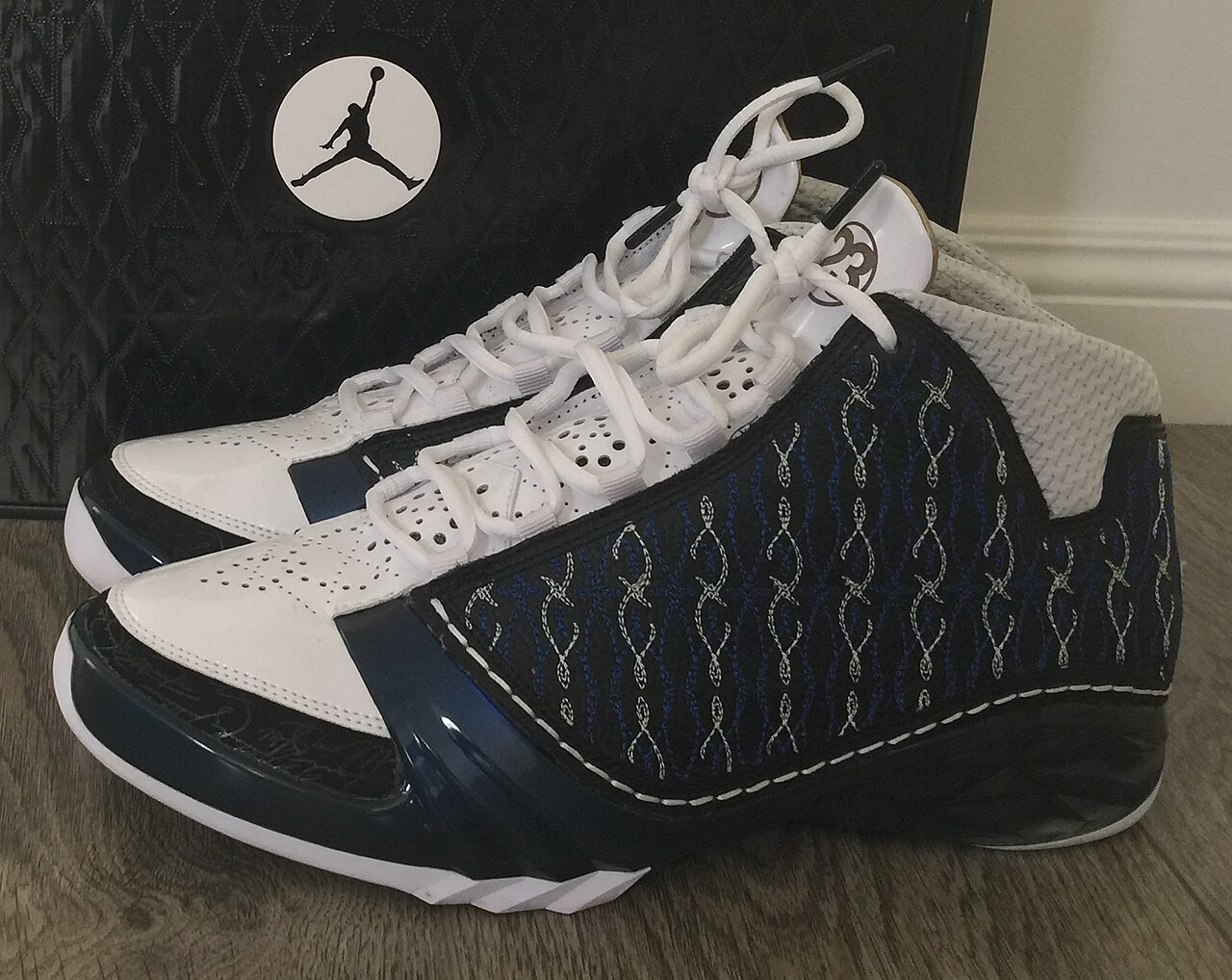

The XX3 launch described a newly engineered, patent-pending stitching machine for the upper’s intricate detailing. Jordan’s fingerprint supplied the outsole pattern, and his thumbprint appeared behind the tongue. Considered was explained as seeking less waste and environmentally preferred materials wherever possible, while retaining athletic performance. These were announced design aims. The XX3 construction and goals.
The fingerprint is a different kind of autobiography from the XX’s crowded imagery. It points to an individual without requiring a reader to identify a career episode. Moving it under the shoe gives the personal reference a second reading as a repeated pattern. Above, the stitching makes the act of joining conspicuous. The anniversary is communicated through a relationship between a body, a surface and the manufacturing process, not only through an anniversary number.
There is a useful tension between intricate craft and industrial repeatability. A stitched pattern can look patient and individual, yet the announcement made the machine itself a selling point. The claim was not that every detail escaped industrial production. It was that industrial capability could deliver a more elaborate surface. That is a revealing version of luxury in a performance product: precision and visible complexity become evidence of care.
Nike’s January 2010 corporate responsibility announcement defined Considered Design through reducing or eliminating waste and toxics, and increasing environmentally preferred materials. It presented a company-wide strategy and acknowledged continuing difficulties, including overtime in contract factories. It does not supply a product-level lifecycle comparison for the XXIII. Nike’s responsibility statement.
The environmental ambition adds a criterion that a display cabinet cannot settle. A complicated stitched upper may be attractive, and a reduced-material design may be appealing, but appearance alone cannot reveal a factory’s waste stream. This is not a reason to disregard the brief. It is a reason to understand what changed in the ambition: the prestigious shoe was being asked to demonstrate responsibility as well as invention. Whether that ambition was fully realized requires a different kind of record from a finished pair.
The XXIII also resists the idea that a career retrospective must end with a final monument. A fingerprint can mark a conclusion, but the construction argument points forward. The material and manufacturing questions remain usable by subsequent teams even after the anniversary has passed. That is a more durable form of influence than an insistence that every later shoe preserve the same silhouette or symbolism.
Jordan Brand’s January 8, 2009 announcement made continuation explicit. Michael Jordan unveiled the Air Jordan 2009 in New York; the release credited his collaboration with Jason Mayden and introduced a year-based name in place of the I–XX3 sequence. The announcement described the new model as the start of another chapter. The 2009 announcement.
Mayden’s named role matters in a series about Hatfield. A signature franchise is larger than one designer’s run of models. Different contributors can inherit the responsibility to move it forward, and the naming system itself can change. The XXIII’s commemorative weight did not require the brand to become a museum. It established another historical reference against which new work would be judged.
2013: a silhouette and a platform meet
In a January 2013 interview, product developer Josh Heard separated the XX8’s roles. Hatfield supplied silhouette direction; Heard and Rob Bruce brought Flight Plate technology from Nike’s Innovation Kitchen. His team handled production. He also recalled Hatfield drawing a single instep line for a zipper, with a quiet exterior and a colorful interior revealed by folding the shroud. Heard’s direct account.
That is a concrete account of collaboration. A single line could be decisive for the visible object without supplying every answer underfoot. Equally, a developed cushioning platform needed a body in which to become a shoe. The two ideas met rather than descending intact from one sketch. The XX8 therefore offers a particularly clear challenge to the familiar habit of treating a credited designer as the author of every component.
Heard also explained the XX8’s inner fit system. Nylon straps supplied strength, with Lycra between them allowing movement. The straps connected to the strobel area below the foot, so lacing drew from underneath rather than simply pressing downward from above. He presented this as a route to an enclosing fit that could still articulate. Heard on the inner structure.
That description shifts attention away from the zipper. The most conspicuous line on the shoe was not the whole fastening argument. Beneath it, straps could be arranged around the foot to establish a different relationship between pulling and enclosure. The apparent simplicity of the closed exterior depended on a more complicated organization within. This is where the theatrical outline and the practical brief become inseparable.
The shroud also made the wearer an editor of the silhouette. Folded down, the same product exposed a contrasting interior and changed its apparent height. Closed, it presented a comparatively uninterrupted outer surface. Those are not merely two color arrangements. They are different ways of making the foot visible inside the shoe, and different degrees of visual interruption around the ankle. The design made disagreement possible without even changing pairs.
Matt Halfhill’s February 12, 2013 Nice Kicks review recorded precisely that reaction. Informal comments at his gym were positive with the shroud down and negative with it up; one observer did not recognize the same shoe. Halfhill praised traction, cushioning and lockdown but reported dampness around the tongue and heel. His account is an individual review, not a survey of opinion. Halfhill’s contemporary review.
The episode gives the visual experiment a social setting without requiring a myth about everyone hating it. The wearer chose a configuration; other people read that configuration as a different object. A jacket collar can change an outfit in a similar way, but here the transformation occurs in a product carrying expectations about athletic containment. The XX8 made the appearance of enclosure conspicuous enough to become a topic before play began.
Nightwing2303’s February 4, 2013 WearTesters review also separated the elements. He praised the XX8’s traction, cushioning, fit and support while criticizing ventilation. He emphasized that the flexible zipped collar did not function as a brace. The review supports a distinction between the shroud’s appearance and the structures he felt working during play. The contemporary WearTesters review.
This distinction runs through Hatfield’s history of visible technology. What a shoe appears to do is part of its cultural life, but it is not identical to how its components act. A tall surface can imply protection; a less conspicuous structure may do more to restrain movement. The XX8’s theatrical exterior made that distinction unusually sharp. The resulting debate belongs to the design’s history rather than being an obstacle to a celebratory account.
2014: weaving becomes an organizing idea
Jordan Brand unveiled the XX9 in New York on April 17, 2014, according to its press release republished by WearTesters. The announcement presented a performance-woven upper combining support, structure, interior comfort and abrasion resistance in one layer. It described variable flex zones and Flight Web tunnels and straps integrated with lacing. Retail was planned for September; the announcement was not the retail event. The preserved XX9 announcement.
The contrast with the XX8 is useful. The new upper made variation within a surface the main proposition. Instead of asking a continuous outer shroud to conceal a complex interior, the woven design proposed that different areas of one material could answer different needs. The visual and structural problem moved toward the pattern itself. A woven graphic could belong to the construction rather than sit on top of it.
John Brownlee’s April 17, 2014 Fast Company reporting supplies another named contributor. Rob Bruce recalled admiring the detailed labels on Nike NFL jerseys, made by an Italian Avery Dennison operation, and considering the process for a shoe. Brownlee interviewed Bruce alongside dissected prototypes. This is direct reporting of a development account, separate from repeating the launch release’s claims. Brownlee’s Bruce interview.
Bruce described his role to Brownlee as exploring three to five years ahead, watching other industries and trade shows for useful processes. Brownlee identified his earlier consumer-electronics background at IDEO. The interview connected that longer horizon to prototypes leading toward the XX9, rather than presenting the woven shoe as an idea completed at its public unveiling. Bruce’s development horizon.
The contrast in timescales helps explain the collaboration. A signature model must eventually become a bounded product, with a name and a release plan. Exploration begins with possibilities that do not yet have that shape. Borrowing a process from another industry requires people who can keep asking what it might do before a seasonal product brief has decided precisely what it must be.
The label is an unexpectedly small reference for a signature basketball shoe. Its usefulness lies in a combination of properties: readable detail, a surface that meets skin, and a process that can produce repeated patterns. The conceptual leap is not simply making a shoe resemble a piece of clothing. It is recognizing that the production of a modest garment component might answer a larger footwear question. That observation gives Bruce’s role a specificity which the phrase “designed by Hatfield” cannot provide.
Jarron Ramos’s November 2, 2014 XX9 review praised its conforming fit and more natural ride. He also reported peeling rubber at the arch bridge and tearing of the upper’s outer layer at the medial forefoot. He said those issues had not yet impaired his pair’s performance. His review combined admiration with an objection to wear at a premium price. Ramos’s contemporary wear record.
Ramos also found the XX9’s ventilation limited, despite the textile construction. He liked the shoe’s relatively conventional outline and its lack of distraction during play. Those assessments belong together: his preference was for a product that largely disappeared from attention while moving, even though he remained conscious of moisture and of visible wear afterward. Ramos on use and appearance.
This makes the XX9 a useful closing comparison with the shrouded XX8. A design can be visually quieter without being less experimental in its construction. The ambition has moved into the material and the arrangement of its zones. For a wearer who wants the shoe to recede during play, that kind of novelty may be more persuasive than an unfamiliar outline. For a collector looking across a room, the hierarchy may be reversed.
The criticism goes directly to the design proposition. An upper promoted for comfort and abrasion resistance could feel excellent and still acquire damage a buyer disliked. A bridge intended to make movement smoother could also be a place where wear became visible. Those observations do not refute every engineering claim, but they prevent the launch language from becoming the only historical record. The finished object continued to gather evidence after its unveiling.
Seen together, the XX8 and XX9 show reinvention at different scales. One reorganized the outer silhouette and the act of revealing an interior. The other emphasized how a surface could be manufactured with different jobs embedded within it. Their shared performance ambition did not produce the same appearance, nor did it remove criticism. Hatfield’s continuing influence lies in keeping the brief open enough for those different answers and in working with people able to turn a direction into a product.
Later lives are new arguments
Nike’s Billie Eilish XV product record identifies SKU DN2863-200 and describes the silhouette as one of her favorites. It presents her edition as containing at least 20 percent recycled material by weight. That statement concerns this collaboration, not the original XV’s composition, and it establishes a specific later admirer rather than a reversal of universal opinion. The Billie Eilish edition record.
A later collaborator can find something useful in a form which another wearer found awkward. The XV’s oddness becomes available for a different personal identity, rather than waiting to be officially rehabilitated. That is one route from performance equipment to cultural artifact: the object’s unusual choices survive long enough to be interpreted outside the original sporting brief. The reinterpretation adds a chapter; it does not erase the earlier one.
TITAN’s December 23, 2020 announcement paired its XX3 collaboration with the XXXV for the Manila basketball retailer’s tenth anniversary. It described crimson accents, gold details and a shard pattern tied to its Lightning Fist identity. The XX3 was being used to carry another organization’s basketball story, alongside a then-current performance model. TITAN’s collaboration announcement.
That pairing is a compact statement about a living archive. A former flagship and a current game shoe could stand together without serving the same purpose. The older form supplied a recognizable structure for new associations; the newer one represented the next performance proposition. The signature had outgrown dependence on Jordan’s own playing calendar, while remaining available as a language for basketball communities to adapt.
What survives in the shoe
Nightwing2303’s March 2015 XX review is a useful warning against collapsing editions. He began with two original pairs whose cushioning felt hardened and whose traction felt slick, then based his review on a new 2015 pair. He also found the 2015 Laser edition’s leather inner sleeve harder to enter than the originals’ stretchier lining. These are his comparisons, not a chemical diagnosis. The edition-specific XX review.
For a collection record, those distinctions are more useful than a model-wide promise. The documentary comparisons here are the 1999 XV archive entry and later DN2863-200 collaboration, the 2005 XX archive and the reviewer’s identified 2015 Laser edition, and the 2008 XX3 announcement against TITAN’s 2020 reinterpretation. No specimen was physically examined for this article. A pair’s labels, provenance, observable construction and condition must be recorded at the edition level.
What survives is therefore more than the headline inspiration. The XV retains an interruption in its silhouette; the XX turns a closure into a narrative surface; the XXIII makes joining and personal marks visible; the XX8 allows the wearer to change the outline; the XX9 makes a woven surface central to its argument. Together they preserve a practice of asking what the next shoe should do, and allowing the answer to remain open to disagreement.
Compact chronology
1999 — XV original-release year in Nike’s archive. Archive.
2005 — XX original-release year, with Hatfield and Smith credited. Archive.
January 8, 2008 — XX3 announcement; planned limited release January 25, All-Star release February 16 and nationwide release February 23. Announcement.
January 30, 2013 — Heard interview, before the reported February 15 Houston and February 16 nationwide XX8 releases. Interview.
April 17, 2014 — XX9 unveiling; September retail planned. Announcement.
December 23, 2020 — TITAN collaboration announcement. Participant record.
Source notes
The linked records distinguish corporate intentions, participant testimony and individual wear reviews. Detailed claim mapping, access observations, exact source allocations and unresolved scope omissions accompany the review package. The matrix marks gaps in period reception rather than filling them with later retro judgments. The added shoe photographs carry their own linked credits and licenses. No archival sketches are reproduced.