The object before the legend
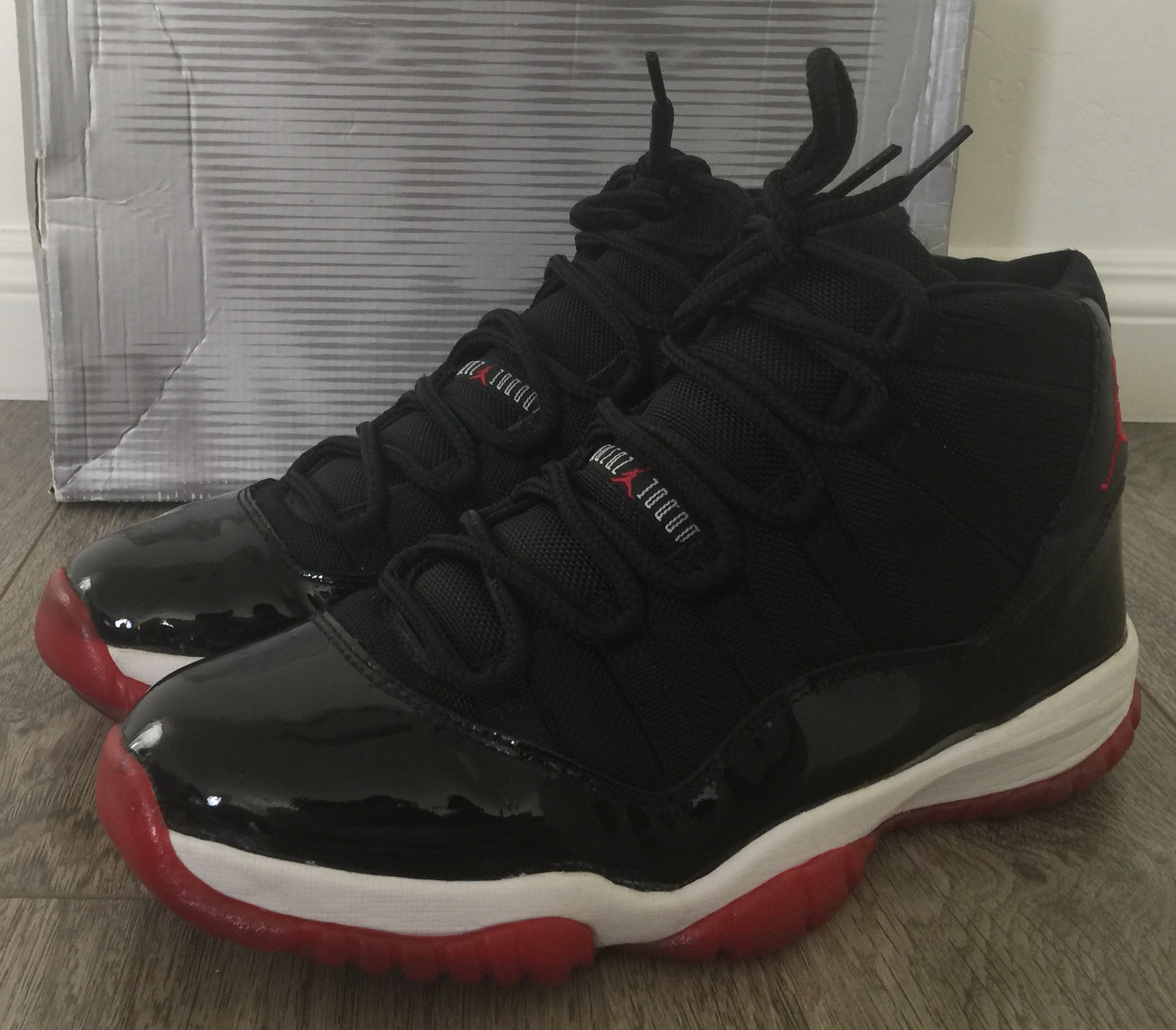
Nike’s archive identifies a white, black and dark-concord Air Jordan XI, style 130245-101, as a 1995 release designed by Tinker Hatfield. Its polished black band turns a basketball upper into something unusually formal. The same archive connects the model to Jordan’s fourth championship and Space Jam. Those associations now seem inseparable; the release date makes a useful correction. The shoe was already a product before the film became part of its public identity. Nike XI archive
Start with that band. It establishes a boundary around the foot, changes the way light describes the upper and makes the softer fabric above it seem lighter. The XI does not need a large printed narrative to announce that it is special. Its materials do the work. In an ordinary side view, the boundary is almost architectural: a dark base, a pale upper volume, a translucent edge beneath. This is a reading of the design, rather than evidence of how every purchaser understood it. It explains why the XI can sustain several identities without changing its basic outline. The same surface can suggest athletic equipment, evening dress or an object made for a cinematic close-up.
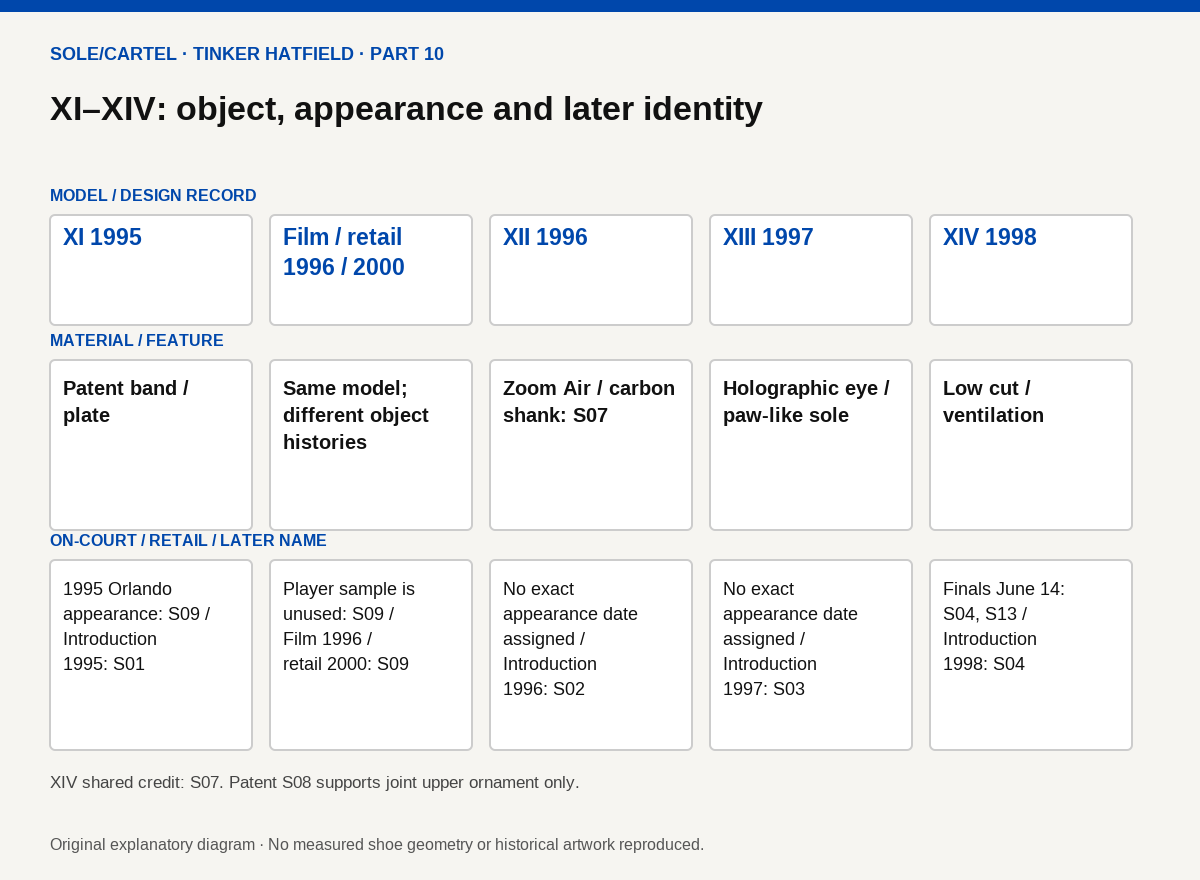
The XI–XIV sequence is best understood through that capacity to carry meaning. Each shoe offers a different organizing idea: a reflective band, radiating stitches, a predatory animal, an automotive emblem. They were also products developed by people working ahead of an athlete’s next public appearance. The second Chicago championship run did not make those decisions inevitable. Looking backward from the trophies conceals the uncertain work that preceded them, and makes an annual design process look like a series of illustrations commissioned after the results were known.
Designing through an uncertain return
In a 2015 interview, Hatfield described continuing the Jordan line after the first retirement despite opposition within Nike. He recalled supportive conversations with Howard White, but said White did not necessarily expect Jordan to return. Hatfield’s account describes conviction about a continuing signature business, rather than certain knowledge of a comeback. It also remembers a small operation in which he brought Mark Smith into graphics work. This is retrospective testimony about the line’s continuity, not a dated production log for the XI. Hatfield’s retirement interview
That distinction changes the story. Continuing a signature line without its player is a commercial and imaginative wager. The designer must decide which qualities belong to an individual’s active career and which could remain meaningful beyond it. If the answer is only the latest game, the product has little room to move. If the answer includes a recognizable attitude, material vocabulary and standard of presentation, a shoe can imagine another chapter before that chapter has happened. Hatfield’s remembered resistance is significant because it reveals disagreement about this possibility. It should not become a theatrical tale in which everyone else lacked judgment and one person alone understood the future.
A Nike design account reproduced by SneakerFiles in 2018 describes another problem: video analysis suggested that basketball shoes could bend excessively during movement. In the account, Hatfield pursued a stiff plate beneath the foot, alongside cushioning, while the upper combined a shining lower band with textile above. The reproduced account also says Jordan wanted a shiny basketball shoe, and that a Japanese custom Nike baseball shoe helped Hatfield identify patent leather as an answer. The explanation ties the XI’s appearance to both mechanical ambition and a comparison with automobile bodywork and a fabric roof. It is a manufacturer’s retrospective account reproduced by a specialist publication; it is not an independent laboratory assessment of the finished shoe. Reproduced Nike XI development account
The interesting design move is the division of labor. Stiffness belongs below; visual sheen gathers around the perimeter; the textile carries the upper volume. A shoe can therefore look fluid without requiring every part to behave flexibly. That is a more useful way to understand technical expression than treating every visible line as a direct diagram of performance. A polished band does not prove a player moved better. It can nevertheless make a product’s structure legible. The XI’s image suggests a contained, purposeful machine, even when the observer cannot see the component intended to control bending.
What the shine concealed
Foot Locker’s historical description identifies the XI’s upper as ballistic nylon mesh with a polymer coating, bounded by patent leather, and records a carbon-fiber plate and full-length Air cushioning. It describes the XII as moving to Zoom Air with a carbon-fiber shank, a leather upper, a contrasting reptile-like forefoot panel and metal lace loops. These are historical product descriptions, not the results of Sole Cartel examining an original pair. Their value here is to distinguish the construction vocabulary beneath two visibly different designs. Foot Locker’s model history
The material contrast helps explain the XI’s enduring clarity. The band reads as a continuous piece, while the lacing system breaks the textile into repeated vertical intervals. The translucent outsole introduces another kind of visibility: partial, cloudy, suggestive rather than a cutaway demonstration. For a collector, these relationships matter as much as an isolated list of ingredients. A replacement part can reproduce a color and still alter the balance of the whole. A differently shaped band changes how much textile appears above it. A different translucency changes how heavy the base looks. Those are observable design questions; none requires pretending that a photograph establishes a resin formula.
There was never only one answer to what an XI upper should be. In 2015, Sports Illustrated reported Hatfield’s explanation of the XI Low IE: he changed the pattern for ventilation, removed patent leather and used mesh with decorative elements for a summer-oriented shoe. The report quotes a Nike release and also reproduces confusing references to the VI in its surrounding text. The narrow, usable evidence is Hatfield’s explanation of the featured XI Low IE, rather than that muddled model chronology. Hatfield on the XI Low IE
The Low IE is valuable because it resists the idea that an icon is a fixed recipe. The XI’s most recognizable material could be removed when a different use suggested another answer. That is a design history hiding inside the family name: continuation through revision, rather than repetition alone. It also gives criticism somewhere concrete to begin. Someone can prefer the high-top’s visual coherence while recognizing the low version’s different intention. Treating every deviation as a failure to reproduce the canonical object makes it harder to see the original designer working on another problem.
A player shoe, a film shoe, a retail name
Sotheby’s 2021 catalogue describes a signed, unused player sample associated with Space Jam. It places Jordan’s use of the black XI color scheme against Orlando on May 14, 1995, before the 1996 film, and distinguishes that history from a 2000 public retail release. The offered sample is not documented there as a pair worn during filming. Its connection to the movie does not erase its unused condition or convert it into an authenticated screen-worn prop. Sotheby’s player-sample catalogue
Those differences are the substance of collecting, rather than inconvenient footnotes. A model worn by an athlete, a sample made for him, an object visible on screen and a later shop release can share a design while having different histories. The name links them; provenance separates them. This is also how a shoe becomes a cultural artifact. Its outline starts to carry memories of several settings at once. Basketball supplies one form of recognition, cinema another, and a later release offers consumers an object through which to revisit both. The cultural connection can be real without every physical pair having participated in the originating event.
The surviving Warner Bros. film website retains its 1996 copyright notice. It is a small piece of the film’s original promotional environment, rather than evidence about footwear manufacturing. As an artifact beside the shoe, it shows that the movie also had its own designed public surface. Warner Bros.’ 1996 site
The movie’s reception was not universally reverent. Scott Goss’s review in the University of Delaware’s The Review, dated November 22, 1996, criticized its creativity, animation, editing and commercial premise. This is one contemporary campus critic’s judgment, not a survey of the audience. It nevertheless interrupts the assumption that later affection describes the original critical climate. The Review, page B2
The criticism and the shoe’s later appeal can coexist. A successful cultural association does not require a film to satisfy every reviewer. Nor does a loved shoe prove that the surrounding entertainment was artistically beyond dispute. The useful question is what the association adds. Here it places Jordan’s product in a deliberately fantastical setting, extending a sports identity into entertainment. The shoe becomes portable evidence of that crossing. For some collectors, the remembered image matters more than the story’s quality; for others, the commercial machinery is part of the fascination. Neither response needs to be presented as universal.
Nike Japan’s November 2016 announcement made the anniversary machinery explicit. Its twentieth-anniversary collection brought back the film-associated XI and IX alongside a XXXI interpretation. It scheduled the XI for December 10 in Japan. That is a regional 2016 release announcement, not the date of the XI’s introduction or its first screen appearance. Nike Japan’s anniversary collection
XII: a different kind of authority
Nike’s XII archive identifies a 1996 introduction and a white, black and taxi-colored original, style 130690-101. It attributes the design to Hatfield and describes a Japanese-flag influence. The account also places the familiar red version in 1997. These dates separate the model’s arrival from the championship-season associations through which later audiences often encounter it. Nike XII archive
Beside the XI, the XII replaces the continuous reflective band with a more insistent division of the upper. Its radiating lines direct attention outward from a low point, while the contrasting forefoot panel changes the apparent weight of the shoe. The result feels more armored in a visual sense. That is an interpretation of its surface, not a claim about measured protection. The design does not abandon the XI’s concern with material contrast; it changes the terms. Shine and fabric give way to a graphic arrangement that can remain legible even when the color treatment is restrained.
Nike’s Singapore listing for the later Taxi edition, SKU CT8013-117, identifies sunrise-style stitching, Zoom Air and a taxi-related naming story. Its description concerns the listed modern product. It helps document how a contemporary retail account joins a design reference to a colorway name, but does not establish the exact leather specification of a 1996 shoe. Nike Taxi edition
The two reference systems do different work. The radiating pattern describes an arrangement on the object. Taxi names a color association that can circulate without requiring the viewer to know how the shoe was developed. Neither replaces the model’s construction history. The XII therefore offers a useful check on the more spectacular XI narrative. A signature shoe can establish authority through repeated surface lines and controlled contrast, rather than through one material that announces novelty. It can also gather a memorable retail identity after the underlying design has become familiar. Model, edition and nickname remain related categories, rather than interchangeable names for the same historical event.
XIII: the animal and the unfinished drawing
An Air Jordan XIII sketch reproduced in Aaron Dodson’s direct Hatfield interview is dated September 11, 1995. Hatfield recalled presenting the concept to Jordan during the filming of the Frozen Moment advertisement in 1996. The account credits Mark Smith’s graphics work and describes a proposed strap that was abandoned after Jordan tried the shoe. It offers unusually useful evidence of a design taking shape before the public product. Hatfield’s XIII interview
The rejected strap matters because it restores an option that the finished shoe cannot show. A retail object usually presents its decisions as settled facts: this opening, this fastening system, this outline. A dated drawing and a remembered trial reveal alternatives. Athlete collaboration becomes more concrete when it changes or removes something. It need not mean the athlete supplied every idea, and the designer’s initial drawing need not predict every final detail. The history is more interesting when a proposal can fail locally while the larger concept survives. That is the difference between collaboration as a marketing label and collaboration as a sequence of decisions.
Nike’s XIII archive dates the model to 1997. It links the panther concept to the holographic eye and a paw-like outsole, and identifies Zoom Air and carbon fiber among the design’s technical elements. Its featured black and red original carries style 136002-062. Nike XIII archive
The animal reference is distributed rather than printed as a complete illustration. An eye becomes a small changing surface. The sole supplies the suggestion of a paw when the shoe turns over. The upper can communicate an organic body without drawing an animal’s face across the toe. This gives the XIII a distinctive kind of storytelling: its parts reward inspection at different angles. The idea is strongest as a relation between details, rather than a claim that an animal’s movement was literally transferred into a human performance benefit. The concept can organize appearance while the engineering answers a different set of questions.
The four designs can also be compared by how they ask to be seen. The XI rewards a side view that lets the band run uninterrupted. The XII turns a surface into a field of lines. The XIII offers details that disclose themselves when the object is tilted. The XIV concentrates attention into small signs and openings. This comparison describes their visual organization, rather than a measured hierarchy of quality. It suggests why a single ranking can be less informative than a careful account of differences. A reader who values a coherent silhouette may prefer one answer; a reader who enjoys hidden detail may prefer another. Neither preference needs a championship to justify it.
A signature line has to manage that tension between recognition and surprise. Repeating the same visual device would make the family easy to identify, but would narrow what the next shoe could say. Changing the organizing idea keeps the athlete’s identity open to reinterpretation. Across this sequence, the continuity lies partly in the ambition to make each design readable on its own terms.
The dated sketch also disrupts a tidy annual procession. Work on a future model can already exist while an earlier one is entering public life. A sequence in a collector’s cabinet is therefore different from a sequence in a design studio. One is arranged by finished products; the other includes overlapping experiments, discarded proposals and delayed decisions. That overlap is essential to the second-dynasty story. The later result should not be read backward into every earlier drawing as though the designer already knew which shoe would accompany which public moment.
XIV: the last Chicago image and the shared credit

The contemporary record gives the basketball event a firm date. UPI’s June 14, 1998 report describes Chicago’s 87–86 win over Utah, Jordan’s 45 points and the decisive basket with 5.2 seconds remaining. It identifies the championship as the Bulls’ sixth and third in succession. The dispatch establishes the event; it does not identify or technically evaluate his footwear. UPI’s Game Six report
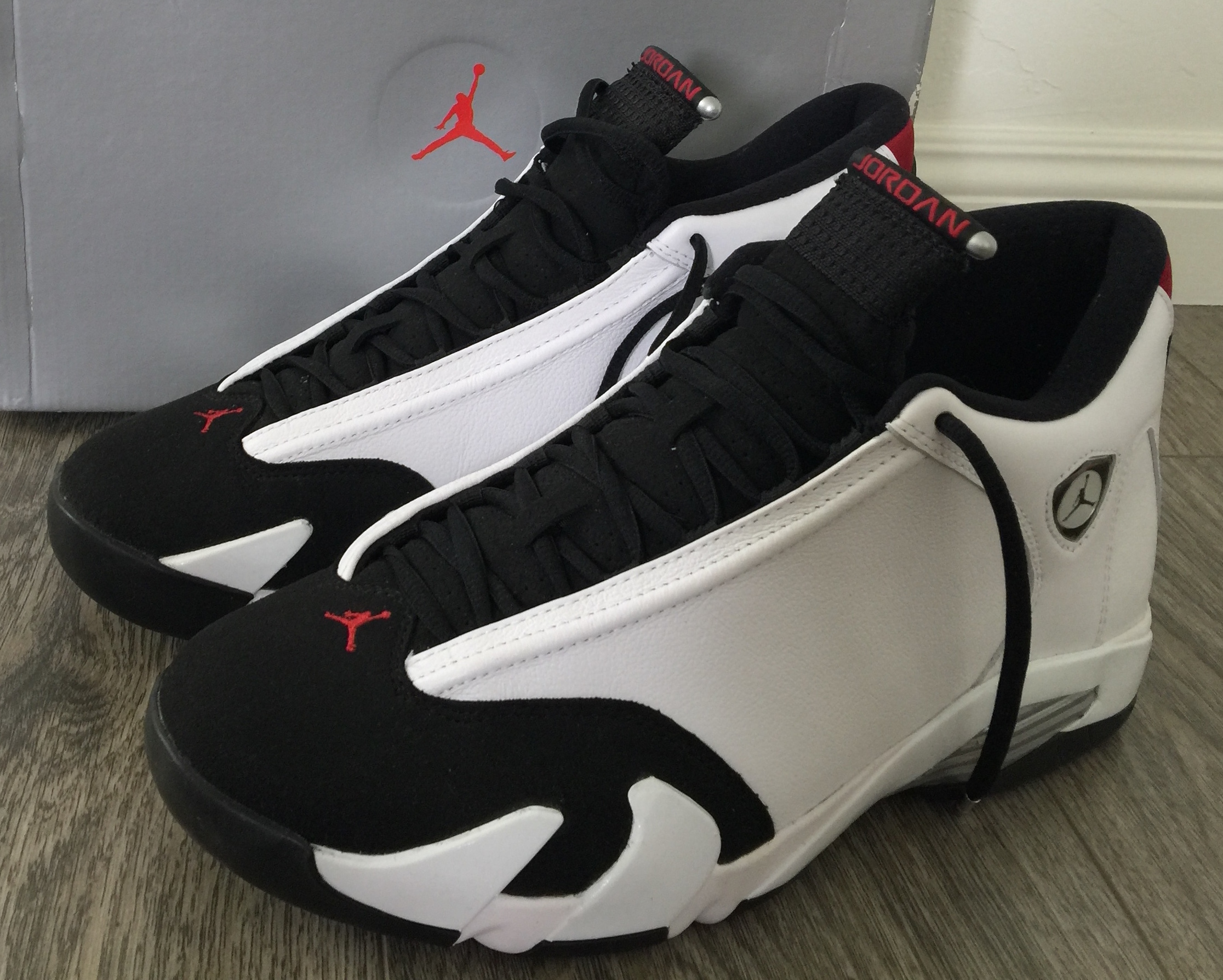
Nike’s XIV archive connects the model to that Finals appearance and says Hatfield gave Jordan an early pair he was asked not to wear yet. The page’s main XIV entry gives 1998, but another block on the same page incorrectly presents 1991 and Black/Infrared information. That internal conflict is retained in our notes rather than silently treated as a second XIV release history. The usable account describes a low-cut shoe with automotive references and ventilation details. Nike XIV archive
The shared authorship needs another record. Foot Locker credits the XIV to Hatfield and Mark Smith. Foot Locker’s shared credit
A separate contemporary legal document names both men as inventors of an ornamental portion of a shoe upper: the application was filed April 23, 1998, and patent USD400000 was granted October 27. The patent does not name the Air Jordan XIV or apportion their work on the complete shoe. It provides a narrow, dated record of joint upper-design activity, not permission to assign every technical component to either individual. Joint upper-design patent
That is enough to resist the easy lone-author summary, while leaving the unresolved division of work visible. The signature athlete gives the series its name. A lead designer gives it a recognizable direction. Neither role makes graphics, development or another designer’s contribution disappear. The XIV’s small emblem and body-like surfaces invite comparison with an automobile, but the car reference does not explain the entire shoe. It is a way of organizing a product’s appearance, and it becomes more meaningful when attached to a collaborative design process rather than a legend about inspiration arriving fully formed.
Nike’s retrospective Last Shot account identifies the black and varsity-red XIV with the 1998 basket. It also distinguishes the 2005 retro’s toe treatment from the 1998 original and the 2011 return. The account demonstrates that a familiar name can survive changes between editions; it does not make those editions physically identical. Nike’s Last Shot history
The nickname is an effective act of compression. It turns a complete season, a late-game possession and a shoe into a phrase short enough for a box label or conversation. Its effectiveness is precisely why it needs historical unpacking. The game did not happen because of the model, and the original product was not simply an accessory designed after a famous basket. The XIV arrived in public inside an event whose eventual importance could not be manufactured in advance. Later storytelling closes that uncertainty; a careful history opens it again.
What survives in the shoe
The XI’s formal possibilities continued through other people’s work. Nike’s Cap and Gown account identifies Donald Kelsey, Harrison Liu, Eric Sandy and Leah Nagengast as contributors to the later edition. It describes nubuck and graduation-cord references in the materials and laces. This is a documented reinterpretation, with its own team, rather than evidence that those features existed in the 1995 original. Nike’s Cap and Gown design account
For an exact retro comparison, GOAT’s listing identifies the 2018 Concord XI as SKU 378037-100, released December 8, with 45 at the heel. Compare that identified edition with Nike’s 1995 archive artifact, not with a generic image labelled original. GOAT’s 2018 Concord record
The useful collector record begins with which object is present. Record the style code, dated edition and documented provenance, then describe visible features: band proportions, heel marking, stitching, eye device, emblem, outsole and toe treatment. No original specimen was physically examined for this article, and no claim of chemical equivalence or present-day wearability follows from the cited images. Across XI–XIV, what survives most clearly is a method of giving technical products distinctive visual identities. Retros preserve and revise those identities. The worthwhile comparison asks what each edition actually carries forward, rather than asking its nickname to stand in for its history.
Compact chronology
| Date | Kind of evidence | Event |
|---|---|---|
| 1995 | Model introduction | XI: Nike archive, S01. |
| May 14, 1995 | Athlete appearance | Black XI against Orlando, S09 retrospective catalogue. |
| September 11, 1995 | Dated drawing | XIII sketch, S06. |
| 1996 | Model introduction / film | XII: S02; Space Jam: S09, S15. |
| 1997 | Model introduction | XIII: S03. |
| April 23 / October 27, 1998 | Patent filing / grant | Joint ornamental-upper record: S08; no model name. |
| June 14, 1998 | Game / model appearance | Finals: S13; XIV identification: S04. |
| 1998 | Model introduction | XIV corrected main archive entry: S04, corroborating S07. |
| 2000 | Public retail | Film-associated XI color scheme: S09. |
| December 10, 2016 | Regional retro schedule | Japan anniversary XI: S10. |
| December 8, 2018 | Identified retro | Concord 378037-100: S19. |